
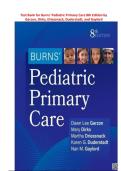
Test Bank For Burns' Pediatric Primary Care, 8Th Edition By Dawn Lee Garzon, Mary Dirks, Martha Driessnack, Karen G. Duderstadt, And Nan M. Gaylord
TEST BANK FOR BURNS' PEDIATRIC PRIMARY CARE, 8TH EDITION BY DAWN LEE GARZON, MARY DIRKS, MARTHA DRIESSNACK, KAREN G. DUDERSTADT, AND NAN M. GAYLORD Strengthen your understanding of pediatric primary care with this comprehensive study and practice resource based on Burns' Pediatric Primary Care, 8th Edition. The 8th edition provides broad coverage of pediatric health promotion, prevention, assessment, development, diagnosis, and management from infancy through adolescence. It is an evidence-based resource written from a nurse practitioner perspective. This study resource is designed for nursing, pediatric nurse practitioner, family nurse practitioner, and other healthcare students who need additional practice reviewing pediatric primary care concepts. It can be used alongside the textbook, lecture notes, clinical materials, and other approved resources for coursework and examination preparation. PEDIATRIC PRIMARY CARE Review the foundations of pediatric primary care, including the role of the healthcare provider, preventive care, health promotion, family-centered care, assessment, clinical decision-making, and management of common pediatric health concerns. CHILD HEALTH AND ENVIRONMENTAL INFLUENCES Develop a stronger understanding of factors that influence children's health. Topics include global and national influences, environmental factors, social determinants of health, cultural considerations, equity, inclusion, and diversity. The 8th edition also expands discussion of environmental and climate-related influences on pediatric health. PEDIATRIC AND FAMILY ASSESSMENT Practice important concepts related to pediatric history taking, physical examination, developmental assessment, family assessment, communication, health screening, and recognition of abnormal findings. DEVELOPMENTAL MANAGEMENT Review growth and development throughout childhood, including newborns, infants, early childhood, middle childhood, and adolescents. Practice questions can help reinforce developmental milestones, developmental theories, age-appropriate assessment, health promotion, and anticipatory guidance. BEHAVIORAL AND MENTAL HEALTH Strengthen your knowledge of behavioral and mental health promotion in children and adolescents. Review concepts involving developmental behavior, mental health concerns, neurodivergence, family support, assessment, communication, and appropriate referral. NUTRITION AND BREASTFEEDING Review pediatric nutritional requirements and common nutrition-related concerns. Topics include breastfeeding, infant nutrition, childhood nutrition, nutritional assessment, healthy eating, and age-appropriate dietary guidance. SLEEP AND ELIMINATION Practice concepts involving normal sleep patterns, sleep-related concerns, elimination, toilet training, constipation, and other common issues encountered in pediatric primary care. PHYSICAL ACTIVITY AND SPORTS Review recommendations and clinical considerations associated with physical activity, exercise, sports participation, injury prevention, and healthy lifestyles in children and adolescents. IMMUNIZATIONS Strengthen your understanding of pediatric immunization concepts, preventive care, vaccine education, safety considerations, and communication with families. DENTAL AND ORAL HEALTH Practice assessment and health-promotion concepts related to pediatric oral health, dental care, prevention, and common oral conditions. INJURY PREVENTION AND CHILD MALTREATMENT Review pediatric injury prevention, safety education, recognition of potential maltreatment, appropriate assessment, documentation, and professional responsibilities when safety concerns arise. PAIN AND FEVER MANAGEMENT Develop a stronger understanding of pediatric pain and fever assessment and management. Practice concepts involving age-appropriate assessment, pharmacologic and nonpharmacologic interventions, patient and family education, and safety. PEDIATRIC INJURIES AND TOXIC EXPOSURES Review common pediatric injuries and toxic exposures encountered in primary care. Practice recognizing important clinical findings, determining priorities, and understanding appropriate management principles. PALLIATIVE CARE The 8th edition includes pediatric palliative care as part of its expanded content. Review patient- and family-centered approaches to serious illness, symptom management, communication, and supportive care. CONGENITAL AND INHERITED DISORDERS Strengthen your understanding of congenital and genetic conditions affecting pediatric patients. Practice concepts involving assessment, family history, recognition of clinical findings, management, education, and referral. NEONATAL DISORDERS Review important neonatal conditions and primary care considerations. Practice questions can reinforce assessment findings, risk factors, newborn health concerns, and appropriate follow-up. EYE AND VISION DISORDERS Review common pediatric eye and vision conditions, screening, assessment, recognition of abnormal findings, and appropriate management or referral. EAR AND HEARING DISORDERS Practice concepts involving pediatric hearing assessment, ear disorders, screening, treatment considerations, and prevention of complications. RESPIRATORY DISORDERS Strengthen your knowledge of common pediatric respiratory conditions. Review assessment, clinical manifestations, diagnosis, management, medication considerations, patient education, and recognition of urgent findings. CARDIOVASCULAR DISORDERS Study pediatric cardiovascular conditions and the principles of assessment, monitoring, management, and referral. Practice recognizing clinical findings that may require additional evaluation. GASTROINTESTINAL DISORDERS Review common pediatric gastrointestinal concerns and disorders, including assessment, nutrition, hydration, diagnostic considerations, management, and family education. INFECTIOUS DISEASES Practice concepts involving common pediatric infections, clinical presentation, prevention, treatment considerations, infection control, immunization, and patient education. INFLAMMATORY AND DERMATOLOGIC DISORDERS Review common inflammatory and skin conditions encountered in pediatric primary care. Practice identifying characteristic findings, appropriate management principles, and education for children and families. HEMATOLOGIC, ENDOCRINE, AND METABOLIC DISORDERS Strengthen your understanding of pediatric hematologic and endocrine conditions. Review clinical manifestations, diagnostic considerations, treatment principles, monitoring, and follow-up. MUSCULOSKELETAL AND NEUROLOGIC DISORDERS Practice assessment and management concepts involving pediatric musculoskeletal and neurological conditions. Focus on recognizing important findings, identifying potential complications, and determining appropriate next steps. GENITOURINARY AND REPRODUCTIVE HEALTH Review pediatric genitourinary conditions and adolescent reproductive health. Practice age-appropriate assessment, patient education, preventive care, confidentiality considerations, and management principles. CLINICAL REASONING AND EXAM PREPARATION This resource is intended to help students move beyond memorization by applying pediatric primary care knowledge to clinical scenarios. Use the practice questions to identify important findings, determine priorities, evaluate possible interventions, and reinforce evidence-based pediatric care. For effective preparation, attempt questions independently before checking the answers. Review unfamiliar concepts in the textbook and use incorrect responses as opportunities to identify knowledge gaps. WHY THIS RESOURCE IS USEFUL Use this study resource for chapter-by-chapter review, pediatric primary care coursework, clinical preparation, examination revision, group study, or independent practice. It is particularly useful for students who need a structured way to review the broad range of pediatric topics covered in the 8th edition. Burns' Pediatric Primary Care, 8th Edition contains 43 chapters covering pediatric primary care from foundational concepts through gynecology and reproductive health, making it a broad reference for pediatric assessment and management. IMPORTANT NOTE This is an independent educational study and practice resource. It is not an official Elsevier instructor resource and does not claim to reproduce confidential examination content. Use it as a supplementary learning aid together with the official textbook, course materials, instructor guidance, and approved study resources.
Documentinformatie
- Geüpload op
- 9 september 2026
- Aantal pagina's
- 135
- Geschreven in
- 2026/2027
- Type
- Tentamen (uitwerkingen)
- Bevat
- Vragen en antwoorden


