
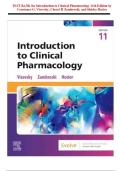
Test Bank For Introduction To Clinical Pharmacology, 11Th Edition By Constance G. Visovsky, Cheryl H. Zambroski, And Shirley M. Hosler
TEST BANK FOR INTRODUCTION TO CLINICAL PHARMACOLOGY, 11TH EDITION BY CONSTANCE G. VISOVSKY, CHERYL H. ZAMBROSKI, AND SHIRLEY M. HOSLER Strengthen your pharmacology knowledge with this comprehensive study and practice resource based on Introduction to Clinical Pharmacology, 11th Edition by Constance G. Visovsky, Cheryl H. Zambroski, and Shirley M. Hosler. The 11th edition is published by Mosby/Elsevier and focuses on safe medication administration, pharmacologic principles, drug classifications, therapeutic effects, adverse effects, and nursing responsibilities. This resource is designed to help nursing students review important pharmacology concepts, practice applying medication knowledge to clinical situations, and prepare for course examinations and NCLEX-style assessments. It can be used alongside the textbook, lecture notes, classroom materials, and other approved study resources. GENERAL PHARMACOLOGY PRINCIPLES Review the foundations of pharmacology, including pharmacology terminology, medication actions, drug classifications, therapeutic effects, side effects, adverse effects, contraindications, precautions, and factors that influence medication responses. The material also supports understanding of the nursing process as it applies to medication administration. Students can review assessment, planning, implementation, and evaluation while connecting pharmacologic knowledge to safe patient care. LEGAL, REGULATORY, AND ETHICAL ASPECTS Medication administration requires careful attention to professional responsibilities and patient safety. Practice topics include legal responsibilities, regulatory considerations, ethical principles, medication errors, documentation, patient education, and safe administration practices. DRUG CALCULATIONS AND MEDICATION ADMINISTRATION Strengthen calculation and medication-administration skills through practice involving dosage calculations, medication preparation, routes of administration, and safe medication practices. These concepts are particularly important for students preparing for nursing examinations and clinical practice. ANTI-INFECTIVE MEDICATIONS Review medications used to manage bacterial, viral, fungal, parasitic, and other infectious conditions. Practice concepts include drug actions, therapeutic uses, important adverse effects, patient teaching, precautions, and nursing considerations. ALLERGY AND RESPIRATORY MEDICATIONS Study pharmacologic management of respiratory and allergic conditions. Topics include medication classes used for respiratory disorders, expected therapeutic responses, adverse effects, precautions, and patient education. RENAL, URINARY, AND CARDIOVASCULAR MEDICATIONS Review medications affecting the renal and urinary systems as well as cardiovascular medications. Practice can help reinforce concepts involving blood pressure, fluid balance, cardiovascular function, therapeutic monitoring, adverse reactions, and nursing responsibilities. CENTRAL NERVOUS SYSTEM MEDICATIONS Strengthen knowledge of medications used for central nervous system conditions. Review therapeutic effects, safety considerations, adverse effects, interactions, and appropriate nursing monitoring. MENTAL HEALTH MEDICATIONS Prepare for questions involving pharmacologic treatment of mental health conditions. Review medication classes, therapeutic effects, adverse reactions, patient education, safety considerations, and nursing assessment. ANALGESIA AND ANESTHESIA Review medications used for pain management and anesthesia. Practice concepts involving therapeutic effects, safety precautions, adverse effects, monitoring, and patient education. INFLAMMATION, ARTHRITIS, AND GOUT Study pharmacologic management of inflammatory disorders, arthritis, and gout. Review medication actions, therapeutic purposes, important adverse effects, contraindications, and nursing considerations. GASTROINTESTINAL MEDICATIONS Practice questions related to medications used for gastrointestinal disorders. Topics may include medication actions, indications, adverse effects, administration considerations, and patient teaching. IMMUNIZATION AND IMMUNOMODULATION Review immunizations and medications that affect immune function. Practice concepts include indications, precautions, patient education, safety, and nursing responsibilities. HEMATOLOGIC MEDICATIONS Strengthen knowledge of medications affecting the blood and hematologic system. Review therapeutic purposes, monitoring requirements, adverse effects, and important nursing considerations. CANCER TREATMENT The 11th edition adds a dedicated chapter on drugs for cancer treatment. Practice material can help students review major pharmacologic concepts associated with cancer treatment, medication safety, adverse effects, and patient monitoring. REPRODUCTIVE HEALTH Review medications related to reproductive health and strengthen understanding of therapeutic uses, precautions, adverse effects, and patient education. THYROID AND ADRENAL MEDICATIONS Practice pharmacology concepts involving thyroid and adrenal disorders, including medication actions, therapeutic effects, adverse effects, and nursing monitoring. DIABETES MEDICATIONS Review drug therapy for diabetes, including medication actions, monitoring, patient education, safety considerations, and recognition of potential complications. OSTEOPOROSIS MEDICATIONS Strengthen understanding of medications used in osteoporosis management, including therapeutic purposes, administration considerations, adverse effects, and patient teaching. EYE AND EAR MEDICATIONS Review medications used for eye and ear conditions, including administration principles, safety precautions, therapeutic effects, and patient education. OVER-THE-COUNTER DRUG THERAPY Practice important concepts involving nonprescription medications, safe use, potential interactions, precautions, and the importance of obtaining an accurate medication history. NGN AND CLINICAL JUDGMENT PREPARATION The 11th edition includes Next Generation NCLEX preparation sections, case studies, review questions, and critical-thinking activities. It also includes updated medication information and High Alert Drugs features. This makes the resource useful for students who want to develop clinical reasoning rather than rely solely on memorization. Working through scenario-based questions can help students identify relevant patient information, recognize medication-related risks, determine appropriate nursing actions, and evaluate therapeutic responses. WHY USE THIS STUDY RESOURCE This resource can be used for chapter-by-chapter review, exam preparation, pharmacology revision, nursing-school assignments, group study, and independent practice. Students can use the questions to identify weak areas and then return to the relevant textbook chapter for deeper review. For the best results, attempt each question independently before reviewing the explanation. Pay close attention to medication classifications, expected effects, adverse effects, contraindications, patient teaching, and nursing responsibilities. The resource is especially useful for LPN/LVN and nursing students studying clinical pharmacology and preparing for pharmacology examinations or NCLEX-style assessments. IMPORTANT NOTE This is an independent educational study and practice resource. It is not an official Elsevier/Mosby instructor resource and does not claim to reproduce secure examination content. Use it as a supplementary learning aid together with the official textbook, course materials, and approved study resources.
Documentinformatie
- Geüpload op
- 9 september 2026
- Aantal pagina's
- 160
- Geschreven in
- 2026/2027
- Type
- Tentamen (uitwerkingen)
- Bevat
- Vragen en antwoorden


