
Victoria Collection
System Operator: Exam
S-Tier Universal Mastery Test Bank | QA + Detailed
Rationales
PART 0: THE TABLE OF CONTENTS
● PART I: THE PREVIEW
○ The Mission & Critical Axioms
● PART II: THE ELITE TEST BANK
○ Tier 1 (Questions 1–18): Foundational Syntax & Application
○ Tier 2 (Questions 19–37): Complex Application & Simulation
○ Tier 3 (Questions 38–55): Grandmaster Synthesis
PART I: THE PREVIEW
Mastering this test bank translates directly to elite operational control, transforming theoretical
regulatory knowledge into split-second, defensible field decisions. Complete absorption of these
parameters ensures absolute compliance with Victoria’s rigorous environmental, structural, and
safety frameworks.
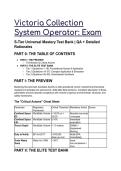
The "Critical Axioms" Cheat Sheet
Parameter Regulatory Critical Threshold Mandatory Action Source
Framework
Confined Space WorkSafe Victoria < 19.5% or > Absolute non-entry
O2 23.5% / evacuate
Confined Space WorkSafe Victoria ≥ 10% Immediate
LEL evacuation
Trench Depth WorkSafe Victoria > 1.5 metres SWMS +
Engineered
Shoring
Duty to Notify EP Act 2017 > $10,000 Notify EPA
clean-up cost immediately
Trade Waste Water Act 1989 > 38°C Issue
Temp non-compliance /
Cool
PART II: THE ELITE TEST BANK
,Tier 1 - Foundational Syntax & Application
Q1: An operator observes a raw sewage overflow from a blocked main that is completely
contained within the utility’s fenced depot. The cleanup will cost an estimated $12,000. Based
on the principles of the Environment Protection Act 2017, which action is the FIRST legal
requirement? A) Wait until the blockage is cleared to assess the total environmental impact
before reporting. B) Log the spill internally, as the duty to notify only applies if the spill leaves the
property boundary. C) Notify the EPA as soon as practicable, as the cleanup cost meets the
threshold for material harm. D) Implement the General Environmental Duty by simply hosing the
sewage into a stormwater drain.
● Answer: C (Notify the EPA as soon as practicable, as the cleanup cost meets the
threshold for material harm)
● Distractor Analysis:
○ A is incorrect: The statutory duty to notify applies when you become aware of the
incident, not after cleanup operations are complete .
○ B is incorrect: The duty applies even if the incident is completely contained to your
property or site .
○ D is incorrect: Discharging into a stormwater drain actively violates the General
Environmental Duty and creates further pollution.
The Mentor's Analysis: The statutory duty to notify the EPA is triggered instantly by specific
financial or environmental thresholds. When facing a spill costing over $10,000 to remediate,
the immediate priority is formal notification . By utilizing direct EPA communication, you bypass
the common trap of assuming on-site containment negates reporting duties. Professional
Intuition: Material harm triggers EPA notification regardless of property boundaries.
Q2: A crew is preparing to enter a subterranean valve vault. The calibrated gas monitor reads
an Oxygen concentration of 19.0%. Based on the principles of WorkSafe Victoria confined
space codes, which conclusion is the MOST APPROPRIATE? A) The environment is slightly
oxygen-enriched; entry is permitted with standard PPE. B) The environment is safe, as the
reading is well above the 10.0% critical failure threshold. C) The environment is
oxygen-deficient; entry is strictly prohibited until ventilation restores the atmosphere. D) The
environment is safe for a maximum of 15 minutes without respiratory protection.
● Answer: C (The environment is oxygen-deficient; entry is strictly prohibited until ventilation
restores the atmosphere)
● Distractor Analysis:
○ A is incorrect: Oxygen levels below 19.5% are deficient, not enriched .
○ B is incorrect: Human survival is severely compromised long before oxygen drops
to 10.0%; the legal hard deck is 19.5% .
○ D is incorrect: Time limits do not override the strict atmospheric requirements for
unventilated confined space entry without specialized breathing apparatus.
The Mentor's Analysis: Confined space atmospheres are governed by inflexible numerical limits.
When facing an atmosphere below 19.5% O2, the immediate priority is mechanical ventilation.
By utilizing strict adherence to the 19.5% threshold, you bypass the common trap of subjective
tolerance assessments. Professional Intuition: Never bargain with atmospheric limits; <19.5%
O2 is an automatic non-entry condition.
Q3: An operator is utilizing the WSA 05 Conduit Inspection Reporting Code to classify a cracked
concrete pipe. Based on the principles of WSA 05, which conclusion is CORRECT regarding
defect coding? A) Structural codes (STR) determine physical damage, while Service codes
, (SRV) identify flow restrictions. B) A structural grade of 5 indicates a brand-new pipe with zero
physical anomalies. C) Root intrusion is exclusively coded as a critical structural collapse. D)
Maintenance structure scores are always combined with conduit scores to generate a single
average.
● Answer: A (Structural codes (STR) determine physical damage, while Service codes
(SRV) identify flow restrictions)
● Distractor Analysis:
○ B is incorrect: In WSA 05, a grade of 5 indicates severe failure or collapse, not
pristine condition.
○ C is incorrect: Roots restrict flow and are primarily categorized under
service/operational codes, unless they cause catastrophic structural fracturing.
○ D is incorrect: Maintenance structures are assessed separately from the pipe itself.
The Mentor's Analysis: WSA 05 separates physical integrity from hydraulic capacity. When
facing pipeline degradation, the immediate priority is distinguishing between Structural (pipe wall
damage) and Service (flow blockage) defects. By utilizing this dual-grading system, you bypass
the common trap of condemning a structurally sound pipe merely because it needs mechanical
root cutting. Professional Intuition: Structural grades dictate capital renewals; Service grades
dictate preventative maintenance.
Q4: A trench is excavated to repair a collapsed gravity sewer. The final depth is measured at 1.8
metres. Based on the principles of WorkSafe Victoria excavation standards, which action is
MANDATORY? A) Rely solely on the natural cohesion of the soil if it appears solid. B) Notify the
EPA of a notifiable incident regarding soil displacement. C) Ensure the excavation is
appropriately benched, battered, or shored. D) Proceed without a Safe Work Method Statement
(SWMS) if the work takes less than one hour.
● Answer: C (Ensure the excavation is appropriately benched, battered, or shored)
● Distractor Analysis:
○ A is incorrect: Visual assessment of soil cohesion does not bypass the statutory
requirement for mechanical protection at depths >1.5m .
○ B is incorrect: Excavation alone is not a pollution incident .
○ D is incorrect: Any trench deeper than 1.5 metres is defined as high-risk
construction work and absolutely requires a SWMS .
The Mentor's Analysis: Ground disturbance over 1.5 metres introduces fatal engulfment risks.
When facing deep excavations, the immediate priority is implementing engineered ground
support. By utilizing shoring, benching, or battering, you bypass the common trap of trusting
unverified soil stability. Professional Intuition: If a trench exceeds 1.5 metres, physical ground
support and a SWMS are non-negotiable.
Q5: An industrial customer discharges a high-volume effluent into the municipal sewer. The
effluent has a stable pH of 3.2. Based on the principles of the Water Act 1989 and standard
Trade Waste limits, which conclusion is the MOST ACCURATE? A) The discharge is compliant
as long as it contains no solid waste. B) The discharge is a strict violation, as trade waste pH
must generally be maintained between 6.0 and 10.0. C) The discharge is acceptable if diluted
with potable water prior to the meter. D) The discharge is only non-compliant if the temperature
exceeds 38°C.
● Answer: B (The discharge is a strict violation, as trade waste pH must generally be
maintained between 6.0 and 10.0)
● Distractor Analysis:
○ A is incorrect: Chemical composition, specifically extreme acidity, degrades sewer
infrastructure regardless of solid content .
System Operator: Exam
S-Tier Universal Mastery Test Bank | QA + Detailed
Rationales
PART 0: THE TABLE OF CONTENTS
● PART I: THE PREVIEW
○ The Mission & Critical Axioms
● PART II: THE ELITE TEST BANK
○ Tier 1 (Questions 1–18): Foundational Syntax & Application
○ Tier 2 (Questions 19–37): Complex Application & Simulation
○ Tier 3 (Questions 38–55): Grandmaster Synthesis
PART I: THE PREVIEW
Mastering this test bank translates directly to elite operational control, transforming theoretical
regulatory knowledge into split-second, defensible field decisions. Complete absorption of these
parameters ensures absolute compliance with Victoria’s rigorous environmental, structural, and
safety frameworks.
The "Critical Axioms" Cheat Sheet
Parameter Regulatory Critical Threshold Mandatory Action Source
Framework
Confined Space WorkSafe Victoria < 19.5% or > Absolute non-entry
O2 23.5% / evacuate
Confined Space WorkSafe Victoria ≥ 10% Immediate
LEL evacuation
Trench Depth WorkSafe Victoria > 1.5 metres SWMS +
Engineered
Shoring
Duty to Notify EP Act 2017 > $10,000 Notify EPA
clean-up cost immediately
Trade Waste Water Act 1989 > 38°C Issue
Temp non-compliance /
Cool
PART II: THE ELITE TEST BANK
,Tier 1 - Foundational Syntax & Application
Q1: An operator observes a raw sewage overflow from a blocked main that is completely
contained within the utility’s fenced depot. The cleanup will cost an estimated $12,000. Based
on the principles of the Environment Protection Act 2017, which action is the FIRST legal
requirement? A) Wait until the blockage is cleared to assess the total environmental impact
before reporting. B) Log the spill internally, as the duty to notify only applies if the spill leaves the
property boundary. C) Notify the EPA as soon as practicable, as the cleanup cost meets the
threshold for material harm. D) Implement the General Environmental Duty by simply hosing the
sewage into a stormwater drain.
● Answer: C (Notify the EPA as soon as practicable, as the cleanup cost meets the
threshold for material harm)
● Distractor Analysis:
○ A is incorrect: The statutory duty to notify applies when you become aware of the
incident, not after cleanup operations are complete .
○ B is incorrect: The duty applies even if the incident is completely contained to your
property or site .
○ D is incorrect: Discharging into a stormwater drain actively violates the General
Environmental Duty and creates further pollution.
The Mentor's Analysis: The statutory duty to notify the EPA is triggered instantly by specific
financial or environmental thresholds. When facing a spill costing over $10,000 to remediate,
the immediate priority is formal notification . By utilizing direct EPA communication, you bypass
the common trap of assuming on-site containment negates reporting duties. Professional
Intuition: Material harm triggers EPA notification regardless of property boundaries.
Q2: A crew is preparing to enter a subterranean valve vault. The calibrated gas monitor reads
an Oxygen concentration of 19.0%. Based on the principles of WorkSafe Victoria confined
space codes, which conclusion is the MOST APPROPRIATE? A) The environment is slightly
oxygen-enriched; entry is permitted with standard PPE. B) The environment is safe, as the
reading is well above the 10.0% critical failure threshold. C) The environment is
oxygen-deficient; entry is strictly prohibited until ventilation restores the atmosphere. D) The
environment is safe for a maximum of 15 minutes without respiratory protection.
● Answer: C (The environment is oxygen-deficient; entry is strictly prohibited until ventilation
restores the atmosphere)
● Distractor Analysis:
○ A is incorrect: Oxygen levels below 19.5% are deficient, not enriched .
○ B is incorrect: Human survival is severely compromised long before oxygen drops
to 10.0%; the legal hard deck is 19.5% .
○ D is incorrect: Time limits do not override the strict atmospheric requirements for
unventilated confined space entry without specialized breathing apparatus.
The Mentor's Analysis: Confined space atmospheres are governed by inflexible numerical limits.
When facing an atmosphere below 19.5% O2, the immediate priority is mechanical ventilation.
By utilizing strict adherence to the 19.5% threshold, you bypass the common trap of subjective
tolerance assessments. Professional Intuition: Never bargain with atmospheric limits; <19.5%
O2 is an automatic non-entry condition.
Q3: An operator is utilizing the WSA 05 Conduit Inspection Reporting Code to classify a cracked
concrete pipe. Based on the principles of WSA 05, which conclusion is CORRECT regarding
defect coding? A) Structural codes (STR) determine physical damage, while Service codes
, (SRV) identify flow restrictions. B) A structural grade of 5 indicates a brand-new pipe with zero
physical anomalies. C) Root intrusion is exclusively coded as a critical structural collapse. D)
Maintenance structure scores are always combined with conduit scores to generate a single
average.
● Answer: A (Structural codes (STR) determine physical damage, while Service codes
(SRV) identify flow restrictions)
● Distractor Analysis:
○ B is incorrect: In WSA 05, a grade of 5 indicates severe failure or collapse, not
pristine condition.
○ C is incorrect: Roots restrict flow and are primarily categorized under
service/operational codes, unless they cause catastrophic structural fracturing.
○ D is incorrect: Maintenance structures are assessed separately from the pipe itself.
The Mentor's Analysis: WSA 05 separates physical integrity from hydraulic capacity. When
facing pipeline degradation, the immediate priority is distinguishing between Structural (pipe wall
damage) and Service (flow blockage) defects. By utilizing this dual-grading system, you bypass
the common trap of condemning a structurally sound pipe merely because it needs mechanical
root cutting. Professional Intuition: Structural grades dictate capital renewals; Service grades
dictate preventative maintenance.
Q4: A trench is excavated to repair a collapsed gravity sewer. The final depth is measured at 1.8
metres. Based on the principles of WorkSafe Victoria excavation standards, which action is
MANDATORY? A) Rely solely on the natural cohesion of the soil if it appears solid. B) Notify the
EPA of a notifiable incident regarding soil displacement. C) Ensure the excavation is
appropriately benched, battered, or shored. D) Proceed without a Safe Work Method Statement
(SWMS) if the work takes less than one hour.
● Answer: C (Ensure the excavation is appropriately benched, battered, or shored)
● Distractor Analysis:
○ A is incorrect: Visual assessment of soil cohesion does not bypass the statutory
requirement for mechanical protection at depths >1.5m .
○ B is incorrect: Excavation alone is not a pollution incident .
○ D is incorrect: Any trench deeper than 1.5 metres is defined as high-risk
construction work and absolutely requires a SWMS .
The Mentor's Analysis: Ground disturbance over 1.5 metres introduces fatal engulfment risks.
When facing deep excavations, the immediate priority is implementing engineered ground
support. By utilizing shoring, benching, or battering, you bypass the common trap of trusting
unverified soil stability. Professional Intuition: If a trench exceeds 1.5 metres, physical ground
support and a SWMS are non-negotiable.
Q5: An industrial customer discharges a high-volume effluent into the municipal sewer. The
effluent has a stable pH of 3.2. Based on the principles of the Water Act 1989 and standard
Trade Waste limits, which conclusion is the MOST ACCURATE? A) The discharge is compliant
as long as it contains no solid waste. B) The discharge is a strict violation, as trade waste pH
must generally be maintained between 6.0 and 10.0. C) The discharge is acceptable if diluted
with potable water prior to the meter. D) The discharge is only non-compliant if the temperature
exceeds 38°C.
● Answer: B (The discharge is a strict violation, as trade waste pH must generally be
maintained between 6.0 and 10.0)
● Distractor Analysis:
○ A is incorrect: Chemical composition, specifically extreme acidity, degrades sewer
infrastructure regardless of solid content .


