
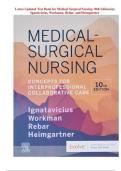
Latest Updated Test Bank for Medical-Surgical Nursing (10th Edition) by Donna D. Ignatavicius, Cherie R. Workman, Nicole M. Rebar, and Linda Heimgartner
The Latest Updated Test Bank for Medical-Surgical Nursing (10th Edition) by Donna D. Ignatavicius, Cherie R. Workman, Nicole M. Rebar, and Linda Heimgartner is designed to help nursing students strengthen their understanding of adult health nursing, pathophysiology, clinical assessment, nursing interventions, patient safety, and evidence-based medical-surgical care. The 10th edition emphasizes clinical reasoning, patient-centered care, prioritization, and the connection between disease processes and nursing practice. This independent study resource supports students preparing for medical-surgical nursing courses, classroom examinations, clinical experiences, and NCLEX-style assessments. The practice question bank provides an organized way to review major medical-surgical concepts, apply nursing knowledge to patient-care situations, develop clinical judgment, and identify areas requiring additional study. What's Included Comprehensive Practice Questions Chapter-based medical-surgical nursing questions Multiple-choice practice questions Clinical application questions Patient-care scenarios Nursing assessment questions Prioritization and delegation exercises Safety and quality-care questions Pathophysiology application questions Pharmacology-related nursing questions Clinical judgment practice NCLEX-style review questions Detailed Educational Explanations Answer explanations Clinical reasoning support Nursing intervention rationales Assessment and prioritization guidance Patient-safety considerations Pathophysiology reinforcement Medication and treatment concepts Patient education principles Evidence-based nursing applications Acute and chronic care considerations Core Content Areas Foundations of Medical-Surgical Nursing Scope and principles of medical-surgical nursing Nursing roles and competencies Clinical judgment Nursing process Evidence-based practice Patient-centered care Quality improvement Patient safety Interprofessional collaboration Care coordination Ethical and legal considerations Cultural responsiveness Health literacy Patient advocacy Discharge planning Transitional care Clinical Assessment and Nursing Practice Health history and physical assessment Focused and comprehensive assessments Recognition of patient deterioration Vital-sign interpretation Laboratory and diagnostic data Medication administration Pain assessment and management Infection prevention and control Mobility and fall prevention Nutrition and elimination Skin integrity Oxygenation and ventilation Fluid and electrolyte balance Acid-base regulation Patient education Documentation and communication Cardiovascular Disorders Cardiovascular assessment Hypertension Coronary artery disease Angina Myocardial infarction Heart failure Dysrhythmias Valvular heart disease Cardiomyopathies Peripheral arterial disease Venous thromboembolism Deep-vein thrombosis Peripheral venous disease Shock Cardiovascular medications Cardiac monitoring Postoperative cardiovascular care Respiratory Disorders Respiratory assessment Oxygen therapy Airway management Asthma Chronic obstructive pulmonary disease Pneumonia Tuberculosis Pulmonary embolism Pleural disorders Pneumothorax Acute respiratory failure Mechanical ventilation Tracheostomy care Chest tubes Respiratory infection prevention Respiratory medications Neurological Disorders Neurological assessment Stroke Transient ischemic attacks Seizure disorders Epilepsy Traumatic brain injury Increased intracranial pressure Meningitis Encephalitis Multiple sclerosis Parkinson disease Amyotrophic lateral sclerosis Spinal cord injury Neuromuscular disorders Cognitive impairment Neurological emergencies Rehabilitation and safety Gastrointestinal and Hepatic Disorders Gastrointestinal assessment Gastroesophageal reflux disease Peptic ulcer disease Gastritis Inflammatory bowel disease Irritable bowel syndrome Appendicitis Diverticular disease Intestinal obstruction Gastrointestinal bleeding Ostomy care Pancreatitis Hepatitis Cirrhosis Portal hypertension Liver failure Nutritional support Enteral and parenteral nutrition Renal and Urinary Disorders Renal assessment Urinary tract infections Kidney stones Acute kidney injury Chronic kidney disease End-stage kidney disease Hemodialysis Peritoneal dialysis Urinary retention Incontinence Benign prostatic hyperplasia Nephrotic syndrome Glomerulonephritis Fluid and electrolyte complications Renal replacement therapy Urinary catheter care Endocrine Disorders Endocrine assessment Diabetes mellitus Hypoglycemia Hyperglycemia Diabetic ketoacidosis Hyperosmolar hyperglycemic state Thyroid disorders Adrenal disorders Cushing syndrome Addison disease Pituitary disorders Metabolic complications Insulin therapy Oral antidiabetic medications Diabetes education Long-term complication prevention Hematologic and Immune Disorders Hematologic assessment Anemia Iron-deficiency anemia Sickle cell disease Thalassemia Leukemia Lymphoma Multiple myeloma Thrombocytopenia Coagulation disorders Disseminated intravascular coagulation Blood transfusion therapy Neutropenia Immunodeficiency Autoimmune disorders Infection risk Protective precautions Musculoskeletal Disorders Musculoskeletal assessment Fractures Dislocations Sprains and strains Osteoarthritis Rheumatoid arthritis Osteoporosis Amputations Joint replacement Traction Cast and splint care Compartment syndrome Mobility assistance Rehabilitation Fall prevention Pain and inflammation management Integumentary Disorders and Wound Care Skin assessment Pressure injuries Surgical wounds Burns Cellulitis Dermatitis Psoriasis Skin infections Wound staging and classification Wound drainage Dressing changes Negative-pressure wound therapy Nutrition for wound healing Infection prevention Pressure-injury prevention Patient and caregiver education Oncology and Cancer Care Cancer prevention and screening Cancer diagnosis and staging Chemotherapy Radiation therapy Immunotherapy Targeted therapy Surgical oncology Treatment-related complications Neutropenia Thrombocytopenia Nausea and vomiting Mucositis Fatigue Pain management Palliative care Hospice care End-of-life communication Infectious Diseases Infection assessment Standard precautions Transmission-based precautions Sepsis Septic shock Healthcare-associated infections Viral infections Bacterial infections Fungal infections Emerging infections Antimicrobial therapy Antimicrobial resistance Isolation procedures Infection prevention Patient and family education Older Adult and Complex Care Geriatric assessment Age-related physiological changes Polypharmacy Falls and injury prevention Delirium Dementia Functional decline Frailty Chronic illness management Caregiver support Advance care planning Palliative and end-of-life care Transitions between care settings Long-term care Rehabilitation Clinical Judgment and NCLEX Preparation Medical-surgical nursing requires students to integrate assessment findings, pathophysiology, laboratory results, medications, patient history, safety concerns, and responses to treatment. Practice questions can help students develop skills such as: Recognizing relevant patient cues Identifying changes in patient condition Interpreting assessment findings Connecting symptoms with pathophysiology Analyzing laboratory and diagnostic results Establishing nursing priorities Selecting appropriate interventions Determining when to notify the health-care provider Applying delegation and assignment principles Evaluating patient responses Recognizing complications Providing patient education Applying infection-control measures Using clinical judgment in complex situations Coordinating care with the interprofessional team Scenario-based questions may also help students prepare for NCLEX-style clinical judgment tasks involving prioritization, safety, delegation, medication administration, acute deterioration, chronic illness, patient education, and evaluation of outcomes. Why Choose This Study Resource? Connects Theory to Clinical Practice Medical-surgical nursing requires more than memorizing diseases. Students must understand how pathophysiology, assessment findings, medications, interventions, complications, and patient responses relate to one another. Builds Clinical Reasoning Patient-care scenarios encourage students to analyze information, recognize meaningful cues, establish priorities, and select appropriate nursing actions. Supports Medical-Surgical Exam Preparation Chapter-focused questions provide an organized way to review course material before nursing school examinations, cumulative assessments, and clinical evaluations. Reinforces Patient Safety Practice activities help students identify risks, prevent complications, recognize deterioration, and select interventions that promote safe care. Strengthens Prioritization and Delegation Medical-surgical nursing frequently requires decisions about which patient to assess first, which intervention is most urgent, and which tasks may be delegated appropriately. Encourages Active Learning Answering questions and reviewing explanations allows students to identify knowledge gaps, reinforce difficult concepts, and focus study time on areas requiring additional review. Who This Resource Is For ADN nursing students BSN nursing students Medical-surgical nursing students Adult-health nursing students Entry-level graduate nursing students Students preparing for NCLEX-style assessments Students preparing for medical-surgical clinical rotations Nursing tutors and educators Students reviewing acute and chronic patient-care concepts Students studying pathophysiology and nursing interventions Students preparing for pharmacology-integrated nursing examinations How to Use This Resource Effectively Read the relevant textbook chapter or lecture material. Review the applicable disease process, assessment findings, and nursing interventions. Complete practice questions without immediately checking the answers. Analyze why each answer is appropriate. Review related concepts when an answer is incorrect. Connect symptoms and laboratory findings with pathophysiology. Create notes for recurring safety, prioritization, and medication principles. Practice identifying the most urgent patient problem. Review delegation and assignment concepts. Practice evaluating patient responses to interventions. Revisit difficult topics before examinations. Combine the question bank with instructor materials, lecture notes, clinical resources, and your official textbook. Key Study Topics Students can use this resource to reinforce important areas such as: Medical-surgical nursing Adult health nursing Nursing assessment Clinical judgment Nursing process Pathophysiology Patient prioritization Delegation and assignment Patient safety Quality improvement Evidence-based nursing practice Medication administration Pharmacology integration Patient education Discharge planning Care coordination Cardiovascular nursing Respiratory nursing Neurological nursing Gastrointestinal nursing Hepatic disorders Renal and urinary nursing Endocrine disorders Diabetes management Hematologic disorders Immune disorders Musculoskeletal nursing Integumentary disorders Wound care Oncology nursing Infectious diseases Sepsis Fluid and electrolyte balance Acid-base balance Oxygenation Pain management Mobility and rehabilitation Geriatric nursing Chronic illness management Acute-care nursing Palliative and end-of-life care Clinical deterioration Infection prevention Interprofessional collaboration NCLEX-style clinical judgment Academic Integrity & Educational Disclaimer This is an independent educational study resource intended to supplement medical-surgical nursing coursework and examination preparation. It is not affiliated with, endorsed by, or officially distributed by Donna D. Ignatavicius, Cherie R. Workman, Nicole M. Rebar, Linda Heimgartner, or the publisher of Medical-Surgical Nursing. It does not claim to contain confidential, secure, unreleased, or proprietary examination questions. Students should use this material alongside their official textbook, course resources, instructor guidance, current nursing recommendations, and applicable professional standards. The resource is intended for learning and practice rather than as a substitute for formal instruction. Key Benefits at a Glance Comprehensive medical-surgical nursing review Adult-health nursing practice Clinical judgment exercises Patient assessment questions Prioritization and delegation practice Pathophysiology application Medication and treatment concepts Patient-safety review Acute and chronic care scenarios Cardiovascular and respiratory review Neurological and gastrointestinal practice Renal and endocrine nursing concepts Hematologic and immune disorders Musculoskeletal and wound-care review Oncology and infectious-disease practice Geriatric and complex-care concepts NCLEX-style questions Chapter-focused study Clinical scenario practice Answer explanations and rationales Convenient examination preparation
Document information
- Uploaded on
- September 9, 2026
- Number of pages
- 623
- Written in
- 2026/2027
- Type
- Exam (elaborations)
- Contains
- Questions & answers


