
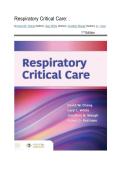
Respiratory Critical Care: .
by David W. Chang (Author), Gary White (Author), Jonathan Waugh (Author), & 1 more
1st Edition
,TABLE OF CONTENTS
Chapter 1 Principles of Mechanical Ventilation
Chapter 2 Classification of Mechanical Ventilation
Chapter 3 Modes of Mechanical Ventilation
Chapter 4 Non-invasive and Invasive Airway Management
Chapter 5 Initiation of Mechanical Ventilation
Chapter 6 Monitoring in Mechanical Ventilation
Chapter 7 Waveform Analysis and Application
Chapter 8 Management of Mechanical Ventilation
Chapter 9 Critical Care Procedures
Chapter 10 Pharmacotherapy in Critical Care
Chapter 11 Weaning from Mechanical Ventilation
Chapter 12 Neonatal and Pediatric Mechanical Ventilation
Chapter 13 Medical Critical Care Issues
Chapter 14 Traumatic Critical Care Issues
Chapter 15 Critical Care Guidelines and Bundles
,Test Bank: Respiratory Critical Care, 1st Edition (Chang, 2021)
Chapters 1–15
CHAPTER 1: FUNDAMENTALS OF RESPIRATORY CRITICAL CARE
Multiple Choice Questions
1. What is the primary function of the respiratory system?
A) Thermoregulation
B) Gas exchange of oxygen and carbon dioxide
C) Production of surfactant
D) Immune defense against airborne pathogens
Answer: B
Rationale: The primary function of the respiratory system is gas exchange—delivering oxygen to
the blood and removing carbon dioxide. While the other options are secondary functions, gas
exchange is the fundamental purpose.
2. The normal partial pressure of oxygen in arterial blood (PaO2) is approximately:
A) 40–45 mmHg
B) 60–70 mmHg
C) 80–100 mmHg
D) 110–120 mmHg
Answer: C
Rationale: Normal PaO2 ranges from 80–100 mmHg in a healthy adult breathing room air at sea
level. Values below 60 mmHg indicate significant hypoxemia.
3. Which of the following is the most important muscle of ventilation?
A) External intercostals
B) Sternocleidomastoid
C) Diaphragm
D) Internal intercostals
Answer: C
Rationale: The diaphragm is the primary muscle of inspiration and accounts for approximately
70–80% of the work of breathing during quiet respiration.
, 4. The oxygen-hemoglobin dissociation curve shifts to the right in response to:
A) Decreased temperature
B) Alkalosis
C) Decreased 2,3-DPG
D) Acidosis
Answer: D
Rationale: A rightward shift (Bohr effect) occurs with acidosis, increased temperature, increased
2,3-DPG, and hypercarbia—all of which facilitate oxygen unloading to tissues.
5. Dead space ventilation refers to:
A) Ventilation of areas with perfusion but no ventilation
B) Ventilation of areas that do not participate in gas exchange
C) The total volume of gas in the lungs at end-expiration
D) Alveolar ventilation minus tidal volume
Answer: B
Rationale: Dead space includes anatomical dead space (conducting airways) and alveolar dead
space (ventilated but not perfused alveoli). These areas receive ventilation but do not contribute
to gas exchange.
6. Normal anatomical dead space in an average adult is approximately:
A) 50 mL
B) 150 mL
C) 300 mL
D) 500 mL
Answer: B
Rationale: Anatomical dead space is approximately 150 mL (roughly 1 mL per pound of ideal
body weight) and consists of the conducting airways where no gas exchange occurs.
7. A patient's arterial blood gas (ABG) shows: pH 7.32, PaCO2 55 mmHg, HCO3- 28 mEq/L,
PaO2 58 mmHg. This is most consistent with:
A) Acute respiratory alkalosis
B) Acute metabolic acidosis with hypoxemia
C) Chronic respiratory acidosis with hypoxemia
D) Mixed metabolic and respiratory alkalosis
Answer: C
Rationale: The elevated PaCO2 with low pH indicates respiratory acidosis. The elevated HCO3-
(compensatory response) suggests chronicity. The low PaO2 indicates concurrent hypoxemia.
by David W. Chang (Author), Gary White (Author), Jonathan Waugh (Author), & 1 more
1st Edition
,TABLE OF CONTENTS
Chapter 1 Principles of Mechanical Ventilation
Chapter 2 Classification of Mechanical Ventilation
Chapter 3 Modes of Mechanical Ventilation
Chapter 4 Non-invasive and Invasive Airway Management
Chapter 5 Initiation of Mechanical Ventilation
Chapter 6 Monitoring in Mechanical Ventilation
Chapter 7 Waveform Analysis and Application
Chapter 8 Management of Mechanical Ventilation
Chapter 9 Critical Care Procedures
Chapter 10 Pharmacotherapy in Critical Care
Chapter 11 Weaning from Mechanical Ventilation
Chapter 12 Neonatal and Pediatric Mechanical Ventilation
Chapter 13 Medical Critical Care Issues
Chapter 14 Traumatic Critical Care Issues
Chapter 15 Critical Care Guidelines and Bundles
,Test Bank: Respiratory Critical Care, 1st Edition (Chang, 2021)
Chapters 1–15
CHAPTER 1: FUNDAMENTALS OF RESPIRATORY CRITICAL CARE
Multiple Choice Questions
1. What is the primary function of the respiratory system?
A) Thermoregulation
B) Gas exchange of oxygen and carbon dioxide
C) Production of surfactant
D) Immune defense against airborne pathogens
Answer: B
Rationale: The primary function of the respiratory system is gas exchange—delivering oxygen to
the blood and removing carbon dioxide. While the other options are secondary functions, gas
exchange is the fundamental purpose.
2. The normal partial pressure of oxygen in arterial blood (PaO2) is approximately:
A) 40–45 mmHg
B) 60–70 mmHg
C) 80–100 mmHg
D) 110–120 mmHg
Answer: C
Rationale: Normal PaO2 ranges from 80–100 mmHg in a healthy adult breathing room air at sea
level. Values below 60 mmHg indicate significant hypoxemia.
3. Which of the following is the most important muscle of ventilation?
A) External intercostals
B) Sternocleidomastoid
C) Diaphragm
D) Internal intercostals
Answer: C
Rationale: The diaphragm is the primary muscle of inspiration and accounts for approximately
70–80% of the work of breathing during quiet respiration.
, 4. The oxygen-hemoglobin dissociation curve shifts to the right in response to:
A) Decreased temperature
B) Alkalosis
C) Decreased 2,3-DPG
D) Acidosis
Answer: D
Rationale: A rightward shift (Bohr effect) occurs with acidosis, increased temperature, increased
2,3-DPG, and hypercarbia—all of which facilitate oxygen unloading to tissues.
5. Dead space ventilation refers to:
A) Ventilation of areas with perfusion but no ventilation
B) Ventilation of areas that do not participate in gas exchange
C) The total volume of gas in the lungs at end-expiration
D) Alveolar ventilation minus tidal volume
Answer: B
Rationale: Dead space includes anatomical dead space (conducting airways) and alveolar dead
space (ventilated but not perfused alveoli). These areas receive ventilation but do not contribute
to gas exchange.
6. Normal anatomical dead space in an average adult is approximately:
A) 50 mL
B) 150 mL
C) 300 mL
D) 500 mL
Answer: B
Rationale: Anatomical dead space is approximately 150 mL (roughly 1 mL per pound of ideal
body weight) and consists of the conducting airways where no gas exchange occurs.
7. A patient's arterial blood gas (ABG) shows: pH 7.32, PaCO2 55 mmHg, HCO3- 28 mEq/L,
PaO2 58 mmHg. This is most consistent with:
A) Acute respiratory alkalosis
B) Acute metabolic acidosis with hypoxemia
C) Chronic respiratory acidosis with hypoxemia
D) Mixed metabolic and respiratory alkalosis
Answer: C
Rationale: The elevated PaCO2 with low pH indicates respiratory acidosis. The elevated HCO3-
(compensatory response) suggests chronicity. The low PaO2 indicates concurrent hypoxemia.


