

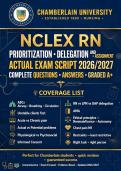
,COMPREHENSIVE NCLEX RN PRIORITIZATION DELEGATION
QUESTIONS AND ANSWERS GRADED A+
QUESTIONS AND ANSWERS GRADED A+
● Which tasks are appropriate for the nurse in a long-term care unit to
delegate to unlicensed assistive personnel? Select all that apply.
1. Assign lunch times to other UAP on the unit
2. Assist a client with bathing and changing an ostomy appliance
3. Collect vital signs on a client newly arrived on the unit
4. Pick up a prescribed oral antibiotic from the pharmacy
5. Record intake and output for a client with chronic neurogenic bladder.
Answer: 3. Collect vital signs on a client newly arrived on the unit
4. Pick up a prescribed oral antibiotic from the pharmacy
5. Record intake and output for a client with chronic neurogenic bladder
Rationale:
Client care that is specific to the nursing process (assessment,
monitoring, assisting in planning, evaluation) cannot be delegated to
unlicensed assistive personnel (UAP). UAP can assist with basic care
activities, check routine vital signs, document intake and output, and
assist with activities of daily living, hygiene, and positioning for stable
clients. The nurse is ultimately accountable for the care provided by
UAP.
● The 11:00 AM routine fingerstick (glucose monitoring) test for a
client was assigned to the unlicensed assistive personnel by the nurse. At
11:15 AM, the client tells the nurse that no one checked the blood level.
The nurse should take what action first?
,1. Ask the unlicensed assistive personnel about the situation
2. Inform the nurse manager
3. Perform the test
4. Review the fingerstick procedure with the UAP. Answer: 1. Ask the
unlicensed assistive personnel about the situation
Because this is not an emergency situation, the nurse should expend
sufficient effort to first determine if the test was performed rather than
assume it was not.
When the completion of an assigned task is questioned, the nurse should
first confirm the status of the task with the designated personnel.
● The nurse is caring for a confused client in soft wrist restraints. Which
tasks can the nurse safely assign to unlicensed assistive personnel?
Select all that apply.
1. Assess circulation and sensation of the extremities
2. Perform range of motion exercises
3. Reapply the restraints after toileting
4. Report changes in skin integrity
5. Turn and reposition the client in bed. Answer: 2. Perform range of
motion exercises
3. Reapply the restraints after toileting
4. Report changes in skin integrity
5. Turn and reposition the client in bed
, Members of the health care team providing direct care for clients in
physical restraints are required to complete an educational training
program and demonstrate competency in caring for a client in restraints.
Therefore, the nurse can safely assign the following tasks to unlicensed
assistive personnel: performing range of motion exercises, reapplying
restraints, repositioning a restrained client in bed, and immediately
reporting changes observed in the skin or any other problems.
● An elderly client visits the clinic for an annual examination, which
includes updating the client's advance care plan. When considering the
client's advance care planning needs, which topics should the nurse
discuss? Select all that apply.
1. Financial power of attorney
2. Health care proxy
3. Life insurance beneficiary
4. Living will
5. Safe deposit box. Answer: 2. Health care proxy
4. Living will
Advance care planning allows the client to determine desired treatments
(eg, cardiopulmonary resuscitation, intubation, mechanical ventilation)
and decision makers in the event the client is unable to do so. Advanced
directives are legal documents outlining these wishes and include living
wills and health care proxies (durable powers of attorney for health care
or medical power or attorney).
QUESTIONS AND ANSWERS GRADED A+
QUESTIONS AND ANSWERS GRADED A+
● Which tasks are appropriate for the nurse in a long-term care unit to
delegate to unlicensed assistive personnel? Select all that apply.
1. Assign lunch times to other UAP on the unit
2. Assist a client with bathing and changing an ostomy appliance
3. Collect vital signs on a client newly arrived on the unit
4. Pick up a prescribed oral antibiotic from the pharmacy
5. Record intake and output for a client with chronic neurogenic bladder.
Answer: 3. Collect vital signs on a client newly arrived on the unit
4. Pick up a prescribed oral antibiotic from the pharmacy
5. Record intake and output for a client with chronic neurogenic bladder
Rationale:
Client care that is specific to the nursing process (assessment,
monitoring, assisting in planning, evaluation) cannot be delegated to
unlicensed assistive personnel (UAP). UAP can assist with basic care
activities, check routine vital signs, document intake and output, and
assist with activities of daily living, hygiene, and positioning for stable
clients. The nurse is ultimately accountable for the care provided by
UAP.
● The 11:00 AM routine fingerstick (glucose monitoring) test for a
client was assigned to the unlicensed assistive personnel by the nurse. At
11:15 AM, the client tells the nurse that no one checked the blood level.
The nurse should take what action first?
,1. Ask the unlicensed assistive personnel about the situation
2. Inform the nurse manager
3. Perform the test
4. Review the fingerstick procedure with the UAP. Answer: 1. Ask the
unlicensed assistive personnel about the situation
Because this is not an emergency situation, the nurse should expend
sufficient effort to first determine if the test was performed rather than
assume it was not.
When the completion of an assigned task is questioned, the nurse should
first confirm the status of the task with the designated personnel.
● The nurse is caring for a confused client in soft wrist restraints. Which
tasks can the nurse safely assign to unlicensed assistive personnel?
Select all that apply.
1. Assess circulation and sensation of the extremities
2. Perform range of motion exercises
3. Reapply the restraints after toileting
4. Report changes in skin integrity
5. Turn and reposition the client in bed. Answer: 2. Perform range of
motion exercises
3. Reapply the restraints after toileting
4. Report changes in skin integrity
5. Turn and reposition the client in bed
, Members of the health care team providing direct care for clients in
physical restraints are required to complete an educational training
program and demonstrate competency in caring for a client in restraints.
Therefore, the nurse can safely assign the following tasks to unlicensed
assistive personnel: performing range of motion exercises, reapplying
restraints, repositioning a restrained client in bed, and immediately
reporting changes observed in the skin or any other problems.
● An elderly client visits the clinic for an annual examination, which
includes updating the client's advance care plan. When considering the
client's advance care planning needs, which topics should the nurse
discuss? Select all that apply.
1. Financial power of attorney
2. Health care proxy
3. Life insurance beneficiary
4. Living will
5. Safe deposit box. Answer: 2. Health care proxy
4. Living will
Advance care planning allows the client to determine desired treatments
(eg, cardiopulmonary resuscitation, intubation, mechanical ventilation)
and decision makers in the event the client is unable to do so. Advanced
directives are legal documents outlining these wishes and include living
wills and health care proxies (durable powers of attorney for health care
or medical power or attorney).


