

MGMT 200 Tod Bergstrom Final
Winter University of
Washington Actual exam
questions and answers 2025-
2026 latest update
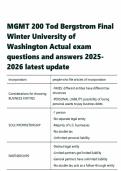
Incorporators . people who file articles of incorporation
-TAXES: different entities have different tax
Considerations for choosing structures
BUSINESS ENTITIES ' -PERSONAL LIABILITY: possibility of losing
. personal assets to pay business debts
-1 person
-No separate legal entity
SOLE PROPRIETORSHIP -Majority of U.S. businesses
-No double tax
-Unlimited personal liability
-Distinct legal entity
. -Limited partners get limited liability
PARTNERSHIPS i
i -General partners have unlimited liability
. -No double tax; acts as a follow-through entity
,LIMITED LIABILITY COMPANY -Basically a construct under state law that gives
(LLC) | partners in partnerships limited liability
-Franchiser allows franchisee to use their
i Trademark/Business Model
-Not liable for actions of franchisee unless they
exert too much control (respondeat superior)
3 types:
FRANCHISE ,
i product distributorships (GM, car dealerships)
. business format/chain-style businesses
i (McDonalds)
trademark or Trade Name/manufacturing
i (coca cola)
. -Public v. Closely Held
-"Corporations are people too"
CORPORATION —.Sepfa\rate legal entities-- no shareholder
: liability
-Subject to double tax
| _BUSINESS JUDGMENT RULE
. honest mistakes or poor guesses do not create
BUSINESS JUDGMENT RULE
: liability for management or Board of Directors
Piercing the "CORPORATE -One of the benefits of the corporate form is
VEIL" i that it provides limited liability for owners
-In order to get personal assets of shareholder
. creditors must prove:
. 1.S/H completely controls business, "unity of
i ownership and interest"
2. This control was used to perpetuate fraud or
: other wrong, "wrongful conduct”
, 3. The control and conduct was the proximate
i cause of the injury
i -A version of corporate form
-Still a corporation under law (limited liability)
i but a pass-through entity for tax purposes
S-CORPORATIONS
{ (eliminates double tax)
Must meet specific limitations to qualify:
1. Less than 100 shareholders
2. Must be owned by real people (U.S. Citizens)
i -For professionals
PROFESSIONAL -Liability is limited to your own malpractice
COPORATIONS i although you may be personally liable for your
own actions, you won't be held liable for the
{ actions of a partner
-A corporation with added duty to a certain
BENEFIT CORPORATION
: cause (e.g. the environment)
a private wrong (other than breach of contract)
committed by one person, business, entity or
{ association that injures another person,
TORTS
\ business, entity or association on their
property for which law allows the legal remedy
i of monetary damages
-Compensate the innocent party- put back in
i the same position you were before
GOALS OF TORT LAW -In some cases, to a lesser extent, defer similar
i conduct by the defendant or others -PUNITIVE
i DAMAGES
3 TYPES OF TORT ' 1. INTENTIONAL
' 2. NEGLIGENCE
, 3. STRICT LIABILITY
when 1 person intentionally injures another
INTENTIONAL TORT
i (occasionally but not always a crime)
-Most common torts
. -Violation of a statute (negligence per se)
criminal or civil is proof of negligence
i (negligence is proven for you in the criminal
case, the only question is how much money
TORTS BASED ON { you are owed)
NEGLIGENCE
i -1 person acts careless and inadvertently
i causes injury to another
i -Failure to do something a reasonable person
i would or doing something a reasonable
{ person would not
-Includes product liability
-Fact of the injury means that somebody has
i done something wrong
-Difficult to demonstrate manufacturer's did
{ not use reasonable care
STRICT LIABILITY
. -Manufacturer is liable to consumers injured
i by defective products regardless of negligence
-Applied on existence of a warranty--
\ manufacturer's assurance that a product will
meet certain quality and performance
. standards (expressed or implied)
large groups of injured persons, with the same
CLASS ACTION i facts and circumstances, can all sue in a single
i lawsuit rather than all filing individually
Winter University of
Washington Actual exam
questions and answers 2025-
2026 latest update
Incorporators . people who file articles of incorporation
-TAXES: different entities have different tax
Considerations for choosing structures
BUSINESS ENTITIES ' -PERSONAL LIABILITY: possibility of losing
. personal assets to pay business debts
-1 person
-No separate legal entity
SOLE PROPRIETORSHIP -Majority of U.S. businesses
-No double tax
-Unlimited personal liability
-Distinct legal entity
. -Limited partners get limited liability
PARTNERSHIPS i
i -General partners have unlimited liability
. -No double tax; acts as a follow-through entity
,LIMITED LIABILITY COMPANY -Basically a construct under state law that gives
(LLC) | partners in partnerships limited liability
-Franchiser allows franchisee to use their
i Trademark/Business Model
-Not liable for actions of franchisee unless they
exert too much control (respondeat superior)
3 types:
FRANCHISE ,
i product distributorships (GM, car dealerships)
. business format/chain-style businesses
i (McDonalds)
trademark or Trade Name/manufacturing
i (coca cola)
. -Public v. Closely Held
-"Corporations are people too"
CORPORATION —.Sepfa\rate legal entities-- no shareholder
: liability
-Subject to double tax
| _BUSINESS JUDGMENT RULE
. honest mistakes or poor guesses do not create
BUSINESS JUDGMENT RULE
: liability for management or Board of Directors
Piercing the "CORPORATE -One of the benefits of the corporate form is
VEIL" i that it provides limited liability for owners
-In order to get personal assets of shareholder
. creditors must prove:
. 1.S/H completely controls business, "unity of
i ownership and interest"
2. This control was used to perpetuate fraud or
: other wrong, "wrongful conduct”
, 3. The control and conduct was the proximate
i cause of the injury
i -A version of corporate form
-Still a corporation under law (limited liability)
i but a pass-through entity for tax purposes
S-CORPORATIONS
{ (eliminates double tax)
Must meet specific limitations to qualify:
1. Less than 100 shareholders
2. Must be owned by real people (U.S. Citizens)
i -For professionals
PROFESSIONAL -Liability is limited to your own malpractice
COPORATIONS i although you may be personally liable for your
own actions, you won't be held liable for the
{ actions of a partner
-A corporation with added duty to a certain
BENEFIT CORPORATION
: cause (e.g. the environment)
a private wrong (other than breach of contract)
committed by one person, business, entity or
{ association that injures another person,
TORTS
\ business, entity or association on their
property for which law allows the legal remedy
i of monetary damages
-Compensate the innocent party- put back in
i the same position you were before
GOALS OF TORT LAW -In some cases, to a lesser extent, defer similar
i conduct by the defendant or others -PUNITIVE
i DAMAGES
3 TYPES OF TORT ' 1. INTENTIONAL
' 2. NEGLIGENCE
, 3. STRICT LIABILITY
when 1 person intentionally injures another
INTENTIONAL TORT
i (occasionally but not always a crime)
-Most common torts
. -Violation of a statute (negligence per se)
criminal or civil is proof of negligence
i (negligence is proven for you in the criminal
case, the only question is how much money
TORTS BASED ON { you are owed)
NEGLIGENCE
i -1 person acts careless and inadvertently
i causes injury to another
i -Failure to do something a reasonable person
i would or doing something a reasonable
{ person would not
-Includes product liability
-Fact of the injury means that somebody has
i done something wrong
-Difficult to demonstrate manufacturer's did
{ not use reasonable care
STRICT LIABILITY
. -Manufacturer is liable to consumers injured
i by defective products regardless of negligence
-Applied on existence of a warranty--
\ manufacturer's assurance that a product will
meet certain quality and performance
. standards (expressed or implied)
large groups of injured persons, with the same
CLASS ACTION i facts and circumstances, can all sue in a single
i lawsuit rather than all filing individually


