
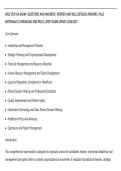
WGU D551 OA EXAM– QUESTIONS AND ANSWERS | VERIFIED AND WELL DETAILED ANSWERS | PLUS
RATIONALES | DOWNLOAD AND PASS | LATEST EXAM UPDATE 2026/2027
Core Domains
Leadership and Management Theories
Strategic Planning and Organizational Development
Financial Management and Resource Allocation
Human Resource Management and Talent Development
Legal and Regulatory Compliance in Healthcare
Ethical Decision-Making and Professional Standards
Quality Improvement and Patient Safety
Information Technology and Data-Driven Decision-Making
Healthcare Policy and Advocacy
Operations and Project Management
Introduction
This comprehensive examination is designed to rigorously assess the candidate's mastery of essential leadership and
management principles within a complex organizational environment. It evaluates foundational theories, strategic
,thinking, financial acumen, and the application of legal and ethical standards. The assessment incorporates multiple-
choice and scenario-based questions to measure both knowledge recall and the practical application of skills in real-
world decision-making. Candidates will be challenged to demonstrate their ability to analyze situations, prioritize
competing demands, and implement effective solutions that drive organizational excellence and ensure the delivery of
high-quality, safe, and ethical services. This exam is a critical tool for validating professional readiness and strategic
competence.
Section One: Questions 1–50
1. A leader is implementing a new strategic initiative and needs to ensure that all team members are committed
to the change. According to Kotter's 8-Step Change Model, which action is most critical to perform immediately
after establishing a sense of urgency?
A. Empowering broad-based action
B. Creating a guiding coalition
C. Developing a vision and strategy
D. Communicating the change vision
🟢 Correct Answer: B. Creating a guiding coalition
,🔴 Explanation: Kotter's model specifies that after establishing a sense of urgency, the next step is to form a
powerful guiding coalition to lead the change effort. This group has the credibility, skills, and connections to drive
the process forward.
2. A hospital is facing a budget deficit. The Chief Financial Officer (CFO) must decide between cutting staff in a
low-performing department or reducing funding for a new technology that would improve patient outcomes.
This scenario best exemplifies which type of conflict?
A. Intrapersonal conflict
B. Interpersonal conflict
C. Ethical dilemma
D. Resource allocation conflict
🟢 Correct Answer: D. Resource allocation conflict
🔴 Explanation: The scenario directly involves the difficult decision of how to distribute scarce resources (financial
capital) between two competing needs: staffing and technology. This is a classic resource allocation conflict.
, 3. An employee consistently submits reports that are superficially completed and contain errors. The manager
suspects this is due to a lack of effort rather than a lack of skill. According to the Situational Leadership Model,
which leadership style would be most appropriate for this employee?
A. Delegating
B. Selling
C. Participating
D. Telling
🟢 Correct Answer: D. Telling
🔴 Explanation: The employee shows low competence (inaccurate work) and likely low commitment (lack of effort).
The "Telling" or directing style involves high task direction and low relationship support, which is best for someone
who is unable and unwilling.
4. What is the primary purpose of a SWOT analysis in strategic planning?
A. To allocate financial resources for the upcoming fiscal year.
B. To evaluate an organization's internal strengths/weaknesses and external opportunities/threats.
RATIONALES | DOWNLOAD AND PASS | LATEST EXAM UPDATE 2026/2027
Core Domains
Leadership and Management Theories
Strategic Planning and Organizational Development
Financial Management and Resource Allocation
Human Resource Management and Talent Development
Legal and Regulatory Compliance in Healthcare
Ethical Decision-Making and Professional Standards
Quality Improvement and Patient Safety
Information Technology and Data-Driven Decision-Making
Healthcare Policy and Advocacy
Operations and Project Management
Introduction
This comprehensive examination is designed to rigorously assess the candidate's mastery of essential leadership and
management principles within a complex organizational environment. It evaluates foundational theories, strategic
,thinking, financial acumen, and the application of legal and ethical standards. The assessment incorporates multiple-
choice and scenario-based questions to measure both knowledge recall and the practical application of skills in real-
world decision-making. Candidates will be challenged to demonstrate their ability to analyze situations, prioritize
competing demands, and implement effective solutions that drive organizational excellence and ensure the delivery of
high-quality, safe, and ethical services. This exam is a critical tool for validating professional readiness and strategic
competence.
Section One: Questions 1–50
1. A leader is implementing a new strategic initiative and needs to ensure that all team members are committed
to the change. According to Kotter's 8-Step Change Model, which action is most critical to perform immediately
after establishing a sense of urgency?
A. Empowering broad-based action
B. Creating a guiding coalition
C. Developing a vision and strategy
D. Communicating the change vision
🟢 Correct Answer: B. Creating a guiding coalition
,🔴 Explanation: Kotter's model specifies that after establishing a sense of urgency, the next step is to form a
powerful guiding coalition to lead the change effort. This group has the credibility, skills, and connections to drive
the process forward.
2. A hospital is facing a budget deficit. The Chief Financial Officer (CFO) must decide between cutting staff in a
low-performing department or reducing funding for a new technology that would improve patient outcomes.
This scenario best exemplifies which type of conflict?
A. Intrapersonal conflict
B. Interpersonal conflict
C. Ethical dilemma
D. Resource allocation conflict
🟢 Correct Answer: D. Resource allocation conflict
🔴 Explanation: The scenario directly involves the difficult decision of how to distribute scarce resources (financial
capital) between two competing needs: staffing and technology. This is a classic resource allocation conflict.
, 3. An employee consistently submits reports that are superficially completed and contain errors. The manager
suspects this is due to a lack of effort rather than a lack of skill. According to the Situational Leadership Model,
which leadership style would be most appropriate for this employee?
A. Delegating
B. Selling
C. Participating
D. Telling
🟢 Correct Answer: D. Telling
🔴 Explanation: The employee shows low competence (inaccurate work) and likely low commitment (lack of effort).
The "Telling" or directing style involves high task direction and low relationship support, which is best for someone
who is unable and unwilling.
4. What is the primary purpose of a SWOT analysis in strategic planning?
A. To allocate financial resources for the upcoming fiscal year.
B. To evaluate an organization's internal strengths/weaknesses and external opportunities/threats.


