
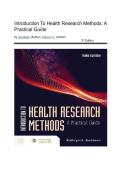
Introduction To Health Research Methods: A
Practical Guide
by Jacobsen (Author), Kathryn H. (Author)
3rd Edition
,TABLE OF CONTENTS
Chapter 1 The Health Research Process
STEP 1: IDENTIFYING A STUDY QUESTION
Chapter 2 Selecting a Research Question
Chapter 3 Reviewing the Literature
Chapter 4 Defining Specific Aims
Chapter 5 Professional Development
Chapter 6 Coauthoring
STEP 2: SELECTING A STUDY APPROACH
Chapter 7 Overview of Study Designs
Chapter 8 Case Series
Chapter 9 Cross-Sectional Studies
Chapter 10 Case-Control Studies
Chapter 11 Cohort Studies
Chapter 12 Experimental Studies
Chapter 13 Qualitative Studies
Chapter 14 Correlational Studies
Chapter 15 Synthesis Research
STEP 3: DESIGNING THE STUDY AND COLLECTING DATA
Chapter 16 Research Protocols
Chapter 17 Ethical Considerations
Chapter 18 Ethical Review and Approval
Chapter 19 Population Sampling
Chapter 20 Sample Size and Power
Chapter 21 Questionnaire Development
Chapter 22 Collecting Quantitative Data
Chapter 23 Collecting Qualitative Data
Chapter 24 Additional Assessments
, Chapter 25 Secondary Analyses
Chapter 26 Systematic Reviews and Meta-Analyses
Chapter 27 Writing Grant Proposals
STEP 4: ANALYZING DATA
Chapter 28 Data Management
Chapter 29 Descriptive Statistics
Chapter 30 Comparative Statistics
Chapter 31 Regression Analysis
Chapter 32 Qualitative Analysis
Chapter 33 Additional Analysis Tools
STEP 5: REPORTING FINDINGS
Chapter 34 Posters and Presentations
Chapter 35 Article Structure
Chapter 36 Citing
Chapter 37 Critically Revising
Chapter 38 Writing Success Strategies
Chapter 39 Reasons to Publish
Chapter 40 Selecting Target Journals
Chapter 41 Manuscript Submission
Chapter 42 Peer Review and Publication
, TEST BANK
Introduction to Health Research Methods, 3rd Edition
Kathryn H. Jacobsen (2021)
Chapters 1–42
Note: This comprehensive test bank includes Multiple Choice, True/False, Fill-in-
the-Blank, Short Answer, and Essay questions for each chapter. Answer keys are
provided after each chapter's questions.
CHAPTER 1: THE HEALTH RESEARCH PROCESS
Multiple Choice Questions
1. The first step in the health research process is typically:
a) Collecting data
b) Analyzing data
c) Identifying a study question
d) Writing the research report
2. Which of the following best describes health research?
a) A systematic process of inquiry designed to generate new knowledge about health
b) A random collection of health-related observations
c) An opinion-based assessment of health programs
d) A summary of previously published findings only
3. Which of the following is NOT typically considered a goal of health research?
a) Describing health patterns in populations
b) Identifying risk factors for disease
c) Evaluating the effectiveness of interventions
d) Replacing clinical judgment entirely
4. The research process is best described as:
a) A linear, one-time event
b) A cyclical and iterative process
c) A process that ends after data collection
d) A process that does not require planning
Practical Guide
by Jacobsen (Author), Kathryn H. (Author)
3rd Edition
,TABLE OF CONTENTS
Chapter 1 The Health Research Process
STEP 1: IDENTIFYING A STUDY QUESTION
Chapter 2 Selecting a Research Question
Chapter 3 Reviewing the Literature
Chapter 4 Defining Specific Aims
Chapter 5 Professional Development
Chapter 6 Coauthoring
STEP 2: SELECTING A STUDY APPROACH
Chapter 7 Overview of Study Designs
Chapter 8 Case Series
Chapter 9 Cross-Sectional Studies
Chapter 10 Case-Control Studies
Chapter 11 Cohort Studies
Chapter 12 Experimental Studies
Chapter 13 Qualitative Studies
Chapter 14 Correlational Studies
Chapter 15 Synthesis Research
STEP 3: DESIGNING THE STUDY AND COLLECTING DATA
Chapter 16 Research Protocols
Chapter 17 Ethical Considerations
Chapter 18 Ethical Review and Approval
Chapter 19 Population Sampling
Chapter 20 Sample Size and Power
Chapter 21 Questionnaire Development
Chapter 22 Collecting Quantitative Data
Chapter 23 Collecting Qualitative Data
Chapter 24 Additional Assessments
, Chapter 25 Secondary Analyses
Chapter 26 Systematic Reviews and Meta-Analyses
Chapter 27 Writing Grant Proposals
STEP 4: ANALYZING DATA
Chapter 28 Data Management
Chapter 29 Descriptive Statistics
Chapter 30 Comparative Statistics
Chapter 31 Regression Analysis
Chapter 32 Qualitative Analysis
Chapter 33 Additional Analysis Tools
STEP 5: REPORTING FINDINGS
Chapter 34 Posters and Presentations
Chapter 35 Article Structure
Chapter 36 Citing
Chapter 37 Critically Revising
Chapter 38 Writing Success Strategies
Chapter 39 Reasons to Publish
Chapter 40 Selecting Target Journals
Chapter 41 Manuscript Submission
Chapter 42 Peer Review and Publication
, TEST BANK
Introduction to Health Research Methods, 3rd Edition
Kathryn H. Jacobsen (2021)
Chapters 1–42
Note: This comprehensive test bank includes Multiple Choice, True/False, Fill-in-
the-Blank, Short Answer, and Essay questions for each chapter. Answer keys are
provided after each chapter's questions.
CHAPTER 1: THE HEALTH RESEARCH PROCESS
Multiple Choice Questions
1. The first step in the health research process is typically:
a) Collecting data
b) Analyzing data
c) Identifying a study question
d) Writing the research report
2. Which of the following best describes health research?
a) A systematic process of inquiry designed to generate new knowledge about health
b) A random collection of health-related observations
c) An opinion-based assessment of health programs
d) A summary of previously published findings only
3. Which of the following is NOT typically considered a goal of health research?
a) Describing health patterns in populations
b) Identifying risk factors for disease
c) Evaluating the effectiveness of interventions
d) Replacing clinical judgment entirely
4. The research process is best described as:
a) A linear, one-time event
b) A cyclical and iterative process
c) A process that ends after data collection
d) A process that does not require planning


