
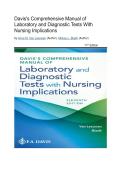
Davis's Comprehensive Manual of
Laboratory and Diagnostic Tests With
Nursing Implications
by Anne M. Van Leeuwen (Author), Mickey L. Bladh (Author)
11th Edition
,TABLE OF CONTENTS
,Test Bank: Davis's Comprehensive Manual of Laboratory
and Diagnostic Tests With Nursing Implications, 11th
Edition (Van Leeuwen, 2025)
Topics 1–11
TOPIC 1: INTRODUCTION TO LABORATORY AND
DIAGNOSTIC TESTING
Multiple Choice Questions
1. The nurse understands that the primary purpose of laboratory and
diagnostic testing is to:
A) Replace the physician's clinical judgment
B) Provide objective data to support clinical decision-making
C) Eliminate the need for physical assessment
D) Serve as the sole basis for medical diagnosis
Answer: B
Rationale: Laboratory and diagnostic tests provide objective data that
supplement the history and physical examination to support clinical
decision-making. They do not replace clinical judgment or physical
assessment and are rarely the sole basis for diagnosis.
2. Which of the following best describes a "critical value" (panic value)
in laboratory testing?
A) A value that falls within the normal reference range
B) A value slightly outside the reference range requiring routine follow-
up
, C) A life-threatening value that requires immediate notification of the
healthcare provider
D) A value that indicates the specimen was improperly collected
Answer: C
Rationale: Critical (panic) values are results that are so far outside the
normal range that they represent a life-threatening situation requiring
immediate notification of the healthcare provider and potential
intervention.
3. When reviewing laboratory results, the nurse notes that a patient's
value falls outside the reference range. The nurse should first:
A) Immediately administer medication to correct the value
B) Consider the result in the context of the patient's clinical condition
C) Discard the result as a laboratory error
D) Repeat the test without informing the provider
Answer: B
Rationale: Values outside the reference range must be interpreted in the
clinical context of the individual patient, including age, sex, diet,
medications, hydration status, and clinical condition before any action is
taken.
4. Reference ranges for laboratory tests are typically established
based on:
A) A single patient's values over time
B) Values from 95% of the healthy population tested
C) The healthcare provider's clinical preference
D) International standardized values that never change
Laboratory and Diagnostic Tests With
Nursing Implications
by Anne M. Van Leeuwen (Author), Mickey L. Bladh (Author)
11th Edition
,TABLE OF CONTENTS
,Test Bank: Davis's Comprehensive Manual of Laboratory
and Diagnostic Tests With Nursing Implications, 11th
Edition (Van Leeuwen, 2025)
Topics 1–11
TOPIC 1: INTRODUCTION TO LABORATORY AND
DIAGNOSTIC TESTING
Multiple Choice Questions
1. The nurse understands that the primary purpose of laboratory and
diagnostic testing is to:
A) Replace the physician's clinical judgment
B) Provide objective data to support clinical decision-making
C) Eliminate the need for physical assessment
D) Serve as the sole basis for medical diagnosis
Answer: B
Rationale: Laboratory and diagnostic tests provide objective data that
supplement the history and physical examination to support clinical
decision-making. They do not replace clinical judgment or physical
assessment and are rarely the sole basis for diagnosis.
2. Which of the following best describes a "critical value" (panic value)
in laboratory testing?
A) A value that falls within the normal reference range
B) A value slightly outside the reference range requiring routine follow-
up
, C) A life-threatening value that requires immediate notification of the
healthcare provider
D) A value that indicates the specimen was improperly collected
Answer: C
Rationale: Critical (panic) values are results that are so far outside the
normal range that they represent a life-threatening situation requiring
immediate notification of the healthcare provider and potential
intervention.
3. When reviewing laboratory results, the nurse notes that a patient's
value falls outside the reference range. The nurse should first:
A) Immediately administer medication to correct the value
B) Consider the result in the context of the patient's clinical condition
C) Discard the result as a laboratory error
D) Repeat the test without informing the provider
Answer: B
Rationale: Values outside the reference range must be interpreted in the
clinical context of the individual patient, including age, sex, diet,
medications, hydration status, and clinical condition before any action is
taken.
4. Reference ranges for laboratory tests are typically established
based on:
A) A single patient's values over time
B) Values from 95% of the healthy population tested
C) The healthcare provider's clinical preference
D) International standardized values that never change


