
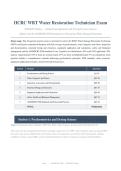
IICRC WRT Water Restoration Technician Exam
2026/2027 Edition — 84 Real Exam Questions with Verified Correct Answers
Aligned with the ANSI/IICRC S500 Standard for Professional Water Damage Restoration
Exam scope. This 84-question practice exam is structured to mirror the IICRC Water Damage Restoration Technician
(WRT) certification examination blueprint, with full coverage of psychrometrics, water categories and classes, inspection
and documentation, structural drying and extraction, equipment application and calculations, safety and biohazard
management, and the ANSI/IICRC S500 standard of care. Cognitive level distribution: 30% recall, 50% application, 20%
analysis. Approximately 70% of items are scenario-based; 25% are direct recall/identification; 5% are calculations. Each
question includes a comprehensive rationale addressing psychrometric principles, S500 standards, safety protocols,
equipment application principles, and professional best practices.
Section Domain Questions
1 Psychrometrics and Drying Science Q1-18
2 Water Categories and Classes Q19-28
3 Inspection, Assessment, and Documentation Q29-40
4 Structural Drying and Extraction Q41-54
5 Equipment Application and Calculations Q55-66
6 Safety, Health, and Biohazard Management Q67-76
7 ANSI/IICRC S500 Standards and Professional Practices Q77-84
TOTAL 84 Questions
Section 1: Psychrometrics and Drying Science
Scope: Psychrometric Chart, Humidity, GPP, Dew Point, Vapor Pressure, & Evaporation Principles (Q1-18)
This section tests the foundational psychrometric principles required of every WRT: relative humidity, grains per pound (GPP),
dew point, vapor pressure differentials as the primary driver of evaporation, psychrometric chart interpretation, enthalpy,
equilibrium moisture content (EMC), and the operational differences between refrigerant and desiccant dehumidifiers.
Page 1 | ANSI/IICRC S500 — 2026/2027 Edition
,IICRC WRT Water Restoration Technician Exam — 2026/2027 Edition — 84 Real Exam Questions
Q1: Which condition BEST describes relative humidity (RH)?
A. The total amount of water vapor in the air measured in grains per pound (GPP).
B. The ratio of the actual water vapor present in air to the maximum water vapor the air can hold at that
temperature, expressed as a percentage.
C. The temperature at which water vapor in the air begins to condense onto a surface.
D. The pressure exerted by water vapor molecules against a hygroscopic material.
Correct Answer: B
Rationale: Per the psychrometric principles in the ANSI/IICRC S500 Reference Guide, RH is a temperature-dependent ratio
expressed as a percentage; it tells the restorer how close the air is to saturation but does not by itself describe the actual
moisture load (that requires GPP or vapor pressure). Options A, C, and D describe GPP, dew point, and vapor pressure
respectively — three distinct psychrometric properties that are often confused with RH on the WRT exam.
Q2: A restoration technician measures the indoor conditions at 70°F and 50% RH. Using the psychrometric
chart, what does this information alone allow the technician to determine?
A. The dew point, GPP, and vapor pressure — all psychrometric values can be derived from any two known
properties on the chart.
B. Only the dew point; GPP requires a separate humidity instrument.
C. Only the grains per pound (GPP); vapor pressure requires a special pressure gauge.
D. Nothing useful without also measuring barometric pressure.
Correct Answer: A
Rationale: The psychrometric chart is a graphical representation of the thermodynamic properties of moist air. Knowing any
two independent properties (e.g., dry-bulb temperature and RH) fixes the state point and allows the technician to read dew
point, wet-bulb, humidity ratio (GPP), vapor pressure, and enthalpy. This is the foundational skill of psychrometric chart
interpretation tested on the WRT exam.
Q3: Which statement about grains per pound (GPP) is CORRECT?
A. GPP measures the weight of moisture per cubic foot of air.
B. GPP is the humidity ratio expressed in grains (1 pound = 7,000 grains) of water vapor per pound of dry
air.
C. GPP and relative humidity are interchangeable measurements.
D. GPP always increases as temperature increases, even when no moisture is added to the air.
Correct Answer: B
Rationale: GPP is the humidity ratio expressed in grains per pound of dry air (7,000 grains = 1 pound), and it is the most
useful metric for tracking actual moisture removal during a drying project. Unlike RH, GPP is independent of temperature; if
no moisture is added or removed, GPP stays constant even as temperature changes. Options A, C, and D reflect common
psychrometric misunderstandings tested on the WRT exam.
Page 2 | ANSI/IICRC S500 — 2026/2027 Edition
,IICRC WRT Water Restoration Technician Exam — 2026/2027 Edition — 84 Real Exam Questions
Q4: A technician records indoor conditions of 80°F and 60% RH. Outdoor conditions are 70°F and 70%
RH. Which statement is TRUE based on psychrometric principles?
A. The outdoor GPP is higher than the indoor GPP, so an open drying system would slow drying.
B. The outdoor GPP is lower than the indoor GPP, so opening the structure would replace humid indoor
air with drier outdoor air and accelerate drying.
C. Because the outdoor RH is higher, the outdoor air must contain more moisture than indoor air.
D. GPP cannot be determined from temperature and RH readings alone.
Correct Answer: B
Rationale: Indoor air at 80°F/60% RH contains roughly 77 GPP, while outdoor air at 70°F/70% RH contains roughly 62
GPP. Because GPP, not RH, determines the actual moisture load in the air, exchanging indoor for outdoor air will lower the
indoor vapor pressure and accelerate evaporation. This is the principle behind the open drying system. Choice C reflects the
common RH-vs-GPP confusion; choice D is incorrect because the psychrometric chart fixes GPP from any two known
properties.
Q5: Why is dew point a more reliable indicator than RH for predicting condensation on cool building
surfaces?
A. Dew point is independent of barometric pressure changes.
B. Dew point is the temperature at which RH reaches 100% and condensation begins; it remains stable for
a given moisture load regardless of dry-bulb temperature changes.
C. Dew point measures GPP directly, while RH does not.
D. Dew point only applies to outdoor conditions.
Correct Answer: B
Rationale: Dew point is the temperature at which the air becomes saturated (100% RH) and water begins to condense.
Because dew point tracks the absolute moisture load (humidity ratio), it changes only when moisture is added or removed —
not when the dry-bulb temperature changes. A cool window, duct, or wall surface at or below the dew point will condense
moisture, a critical consideration when drying humid structural cavities.
Q6: Which statement about vapor pressure and evaporation is CORRECT?
A. Moisture moves from areas of low vapor pressure to areas of high vapor pressure.
B. Moisture moves from areas of high vapor pressure to areas of low vapor pressure; the differential
between the wet material and the surrounding air is the primary driving force of evaporation.
C. Vapor pressure only exists inside closed drying systems.
D. Vapor pressure is unrelated to drying rate.
Correct Answer: B
Rationale: Per S500 Reference Guide principles, evaporation is driven by the vapor pressure differential between the wet
material surface (high vapor pressure) and the surrounding air (lower vapor pressure). Dehumidifiers and air movers work
together to lower the vapor pressure of the air (low GPP) and continually replace the boundary layer of saturated air with
drier air, maintaining the differential that drives continued evaporation.
Page 3 | ANSI/IICRC S500 — 2026/2027 Edition
, IICRC WRT Water Restoration Technician Exam — 2026/2027 Edition — 84 Real Exam Questions
Q7: At which entering-air condition does a refrigerant dehumidifier typically remove the MOST moisture
per hour?
A. 90°F and 30% RH.
B. 80°F and 60% RH (AHAM rating conditions).
C. 50°F and 40% RH.
D. 60°F and 20% RH.
Correct Answer: B
Rationale: Refrigerant dehumidifiers are rated by the Association of Home Appliance Manufacturers (AHAM) at 80°F and
60% RH, the condition at which they perform at their peak moisture-removal capacity. As the air cools and dries, the
evaporator coil becomes less efficient and the unit removes progressively less water — which is why low-grain refrigerant
(LGR) units were developed to extend effective drying down to lower GPP levels.
Q8: What is the primary advantage of a desiccant dehumidifier over a refrigerant dehumidifier?
A. Desiccants perform better at high temperatures (above 90°F).
B. Desiccants can produce very low GPP output air regardless of inlet temperature, making them effective
in cold, very dry, or Class 4 drying situations.
C. Desiccants always use less electricity than refrigerant units.
D. Desiccants remove more pints per day at AHAM conditions than LGRs.
Correct Answer: B
Rationale: Desiccant dehumidifiers use a chemical adsorbent (typically silica gel) to remove moisture directly from the air,
bypassing the dew-point limitation of refrigerant coils. They can deliver process air with GPP below 20 even at low inlet
temperatures, making them the preferred choice for Class 4 specialty drying, large commercial structures, or
cold-environment applications where refrigerant units lose efficiency.
Q9: Equilibrium moisture content (EMC) is BEST described as:
A. The maximum moisture content a hygroscopic material can hold before catastrophic damage.
B. The moisture content at which a hygroscopic material neither gains nor loses moisture at a given
ambient temperature and RH.
C. The moisture content at which visible mold growth begins.
D. The moisture content at which a material is considered dry.
Correct Answer: B
Rationale: EMC is the moisture content a hygroscopic material reaches when it is in dynamic balance with the surrounding
air at a given temperature and RH. The drying goal is typically to return affected materials to their pre-loss EMC, which
often is approximated by comparison with similar dry materials elsewhere in the structure. EMC explains why drying must
continue even after the air appears stable, as moisture continues to migrate from material to air until equilibrium is reached.
Page 4 | ANSI/IICRC S500 — 2026/2027 Edition
2026/2027 Edition — 84 Real Exam Questions with Verified Correct Answers
Aligned with the ANSI/IICRC S500 Standard for Professional Water Damage Restoration
Exam scope. This 84-question practice exam is structured to mirror the IICRC Water Damage Restoration Technician
(WRT) certification examination blueprint, with full coverage of psychrometrics, water categories and classes, inspection
and documentation, structural drying and extraction, equipment application and calculations, safety and biohazard
management, and the ANSI/IICRC S500 standard of care. Cognitive level distribution: 30% recall, 50% application, 20%
analysis. Approximately 70% of items are scenario-based; 25% are direct recall/identification; 5% are calculations. Each
question includes a comprehensive rationale addressing psychrometric principles, S500 standards, safety protocols,
equipment application principles, and professional best practices.
Section Domain Questions
1 Psychrometrics and Drying Science Q1-18
2 Water Categories and Classes Q19-28
3 Inspection, Assessment, and Documentation Q29-40
4 Structural Drying and Extraction Q41-54
5 Equipment Application and Calculations Q55-66
6 Safety, Health, and Biohazard Management Q67-76
7 ANSI/IICRC S500 Standards and Professional Practices Q77-84
TOTAL 84 Questions
Section 1: Psychrometrics and Drying Science
Scope: Psychrometric Chart, Humidity, GPP, Dew Point, Vapor Pressure, & Evaporation Principles (Q1-18)
This section tests the foundational psychrometric principles required of every WRT: relative humidity, grains per pound (GPP),
dew point, vapor pressure differentials as the primary driver of evaporation, psychrometric chart interpretation, enthalpy,
equilibrium moisture content (EMC), and the operational differences between refrigerant and desiccant dehumidifiers.
Page 1 | ANSI/IICRC S500 — 2026/2027 Edition
,IICRC WRT Water Restoration Technician Exam — 2026/2027 Edition — 84 Real Exam Questions
Q1: Which condition BEST describes relative humidity (RH)?
A. The total amount of water vapor in the air measured in grains per pound (GPP).
B. The ratio of the actual water vapor present in air to the maximum water vapor the air can hold at that
temperature, expressed as a percentage.
C. The temperature at which water vapor in the air begins to condense onto a surface.
D. The pressure exerted by water vapor molecules against a hygroscopic material.
Correct Answer: B
Rationale: Per the psychrometric principles in the ANSI/IICRC S500 Reference Guide, RH is a temperature-dependent ratio
expressed as a percentage; it tells the restorer how close the air is to saturation but does not by itself describe the actual
moisture load (that requires GPP or vapor pressure). Options A, C, and D describe GPP, dew point, and vapor pressure
respectively — three distinct psychrometric properties that are often confused with RH on the WRT exam.
Q2: A restoration technician measures the indoor conditions at 70°F and 50% RH. Using the psychrometric
chart, what does this information alone allow the technician to determine?
A. The dew point, GPP, and vapor pressure — all psychrometric values can be derived from any two known
properties on the chart.
B. Only the dew point; GPP requires a separate humidity instrument.
C. Only the grains per pound (GPP); vapor pressure requires a special pressure gauge.
D. Nothing useful without also measuring barometric pressure.
Correct Answer: A
Rationale: The psychrometric chart is a graphical representation of the thermodynamic properties of moist air. Knowing any
two independent properties (e.g., dry-bulb temperature and RH) fixes the state point and allows the technician to read dew
point, wet-bulb, humidity ratio (GPP), vapor pressure, and enthalpy. This is the foundational skill of psychrometric chart
interpretation tested on the WRT exam.
Q3: Which statement about grains per pound (GPP) is CORRECT?
A. GPP measures the weight of moisture per cubic foot of air.
B. GPP is the humidity ratio expressed in grains (1 pound = 7,000 grains) of water vapor per pound of dry
air.
C. GPP and relative humidity are interchangeable measurements.
D. GPP always increases as temperature increases, even when no moisture is added to the air.
Correct Answer: B
Rationale: GPP is the humidity ratio expressed in grains per pound of dry air (7,000 grains = 1 pound), and it is the most
useful metric for tracking actual moisture removal during a drying project. Unlike RH, GPP is independent of temperature; if
no moisture is added or removed, GPP stays constant even as temperature changes. Options A, C, and D reflect common
psychrometric misunderstandings tested on the WRT exam.
Page 2 | ANSI/IICRC S500 — 2026/2027 Edition
,IICRC WRT Water Restoration Technician Exam — 2026/2027 Edition — 84 Real Exam Questions
Q4: A technician records indoor conditions of 80°F and 60% RH. Outdoor conditions are 70°F and 70%
RH. Which statement is TRUE based on psychrometric principles?
A. The outdoor GPP is higher than the indoor GPP, so an open drying system would slow drying.
B. The outdoor GPP is lower than the indoor GPP, so opening the structure would replace humid indoor
air with drier outdoor air and accelerate drying.
C. Because the outdoor RH is higher, the outdoor air must contain more moisture than indoor air.
D. GPP cannot be determined from temperature and RH readings alone.
Correct Answer: B
Rationale: Indoor air at 80°F/60% RH contains roughly 77 GPP, while outdoor air at 70°F/70% RH contains roughly 62
GPP. Because GPP, not RH, determines the actual moisture load in the air, exchanging indoor for outdoor air will lower the
indoor vapor pressure and accelerate evaporation. This is the principle behind the open drying system. Choice C reflects the
common RH-vs-GPP confusion; choice D is incorrect because the psychrometric chart fixes GPP from any two known
properties.
Q5: Why is dew point a more reliable indicator than RH for predicting condensation on cool building
surfaces?
A. Dew point is independent of barometric pressure changes.
B. Dew point is the temperature at which RH reaches 100% and condensation begins; it remains stable for
a given moisture load regardless of dry-bulb temperature changes.
C. Dew point measures GPP directly, while RH does not.
D. Dew point only applies to outdoor conditions.
Correct Answer: B
Rationale: Dew point is the temperature at which the air becomes saturated (100% RH) and water begins to condense.
Because dew point tracks the absolute moisture load (humidity ratio), it changes only when moisture is added or removed —
not when the dry-bulb temperature changes. A cool window, duct, or wall surface at or below the dew point will condense
moisture, a critical consideration when drying humid structural cavities.
Q6: Which statement about vapor pressure and evaporation is CORRECT?
A. Moisture moves from areas of low vapor pressure to areas of high vapor pressure.
B. Moisture moves from areas of high vapor pressure to areas of low vapor pressure; the differential
between the wet material and the surrounding air is the primary driving force of evaporation.
C. Vapor pressure only exists inside closed drying systems.
D. Vapor pressure is unrelated to drying rate.
Correct Answer: B
Rationale: Per S500 Reference Guide principles, evaporation is driven by the vapor pressure differential between the wet
material surface (high vapor pressure) and the surrounding air (lower vapor pressure). Dehumidifiers and air movers work
together to lower the vapor pressure of the air (low GPP) and continually replace the boundary layer of saturated air with
drier air, maintaining the differential that drives continued evaporation.
Page 3 | ANSI/IICRC S500 — 2026/2027 Edition
, IICRC WRT Water Restoration Technician Exam — 2026/2027 Edition — 84 Real Exam Questions
Q7: At which entering-air condition does a refrigerant dehumidifier typically remove the MOST moisture
per hour?
A. 90°F and 30% RH.
B. 80°F and 60% RH (AHAM rating conditions).
C. 50°F and 40% RH.
D. 60°F and 20% RH.
Correct Answer: B
Rationale: Refrigerant dehumidifiers are rated by the Association of Home Appliance Manufacturers (AHAM) at 80°F and
60% RH, the condition at which they perform at their peak moisture-removal capacity. As the air cools and dries, the
evaporator coil becomes less efficient and the unit removes progressively less water — which is why low-grain refrigerant
(LGR) units were developed to extend effective drying down to lower GPP levels.
Q8: What is the primary advantage of a desiccant dehumidifier over a refrigerant dehumidifier?
A. Desiccants perform better at high temperatures (above 90°F).
B. Desiccants can produce very low GPP output air regardless of inlet temperature, making them effective
in cold, very dry, or Class 4 drying situations.
C. Desiccants always use less electricity than refrigerant units.
D. Desiccants remove more pints per day at AHAM conditions than LGRs.
Correct Answer: B
Rationale: Desiccant dehumidifiers use a chemical adsorbent (typically silica gel) to remove moisture directly from the air,
bypassing the dew-point limitation of refrigerant coils. They can deliver process air with GPP below 20 even at low inlet
temperatures, making them the preferred choice for Class 4 specialty drying, large commercial structures, or
cold-environment applications where refrigerant units lose efficiency.
Q9: Equilibrium moisture content (EMC) is BEST described as:
A. The maximum moisture content a hygroscopic material can hold before catastrophic damage.
B. The moisture content at which a hygroscopic material neither gains nor loses moisture at a given
ambient temperature and RH.
C. The moisture content at which visible mold growth begins.
D. The moisture content at which a material is considered dry.
Correct Answer: B
Rationale: EMC is the moisture content a hygroscopic material reaches when it is in dynamic balance with the surrounding
air at a given temperature and RH. The drying goal is typically to return affected materials to their pre-loss EMC, which
often is approximated by comparison with similar dry materials elsewhere in the structure. EMC explains why drying must
continue even after the air appears stable, as moisture continues to migrate from material to air until equilibrium is reached.
Page 4 | ANSI/IICRC S500 — 2026/2027 Edition


