
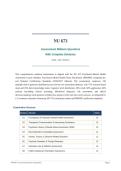
NU 673
Assessment Midterm Questions
With Complete Solutions
Edition
This comprehensive midterm examination is aligned with the NU 673 Psychiatric-Mental Health
Assessment Course Syllabus, Psychiatric-Mental Health Nurse Practitioner (PMHNP) Competencies,
and National Certification Standards (2026/2027 Edition). The examination comprises 120
multiple-choice questions distributed across eleven core assessment domains, with 75% scenario-based
items and 25% direct-knowledge items. Cognitive level distribution: 20% recall, 50% application, 30%
analysis (including clinical reasoning, differential diagnosis, risk assessment, and ethical
decision-making). Each question includes four options (A-D) with one correct answer, accompanied by
a 2-4 sentence rationale referencing NU 673 curriculum content and PMHNP certification standards.
Examination Structure
Section Domain Items
S1 Foundations of Psychiatric-Mental Health Assessment 15
S2 Therapeutic Communication & Interviewing Techniques 15
S3 Psychiatric History & Mental Status Examination (MSE) 15
S4 Mood Disorders & Suicidality Assessment 12
S5 Anxiety, Trauma, & Stressor-Related Disorders 12
S6 Psychotic Disorders & Thought Disorders 10
S7 Substance Use & Addiction Assessment 10
S8 Child & Adolescent Psychiatric Assessment 10
PMHNP Course Examination Preparation Page 1
,NU 673 Assessment Midterm Examination | 2026/2027 Edition
S9 Geriatric & Neurocognitive Assessment 10
S10 Personality Disorders & Behavioral Assessment 6
S11 Risk Assessment, Safety, & Crisis Intervention 5
TOTAL 120
Special Inclusions
• 15 comprehensive case study questions (complex patient presentations)
• 10 questions on risk assessment (suicide, violence, self-harm, abuse reporting)
• 10 questions on differential diagnosis and diagnostic formulation
PMHNP Course Examination Preparation | Aligned with DSM-5 & NONPF Core Competencies
PMHNP Course Examination Preparation Page 2
,NU 673 Assessment Midterm Examination | 2026/2027 Edition
Section 1: Foundations of Psychiatric-Mental Health Assessment
Q1: A PMHNP is assessing a 42-year-old patient presenting with fatigue, irritability, abdominal pain,
recent job loss, social isolation, and a family history of depression. The PMHNP integrates biological
vulnerability, psychological stressors, and social context into the diagnostic formulation. Which
theoretical framework BEST guides this comprehensive assessment?
A. Biomedical model focusing on neurochemical imbalance only
B. Strictly psychoanalytic model emphasizing unconscious conflict
C. Biopsychosocial model integrating biological, psychological, and social domains [CORRECT]
D. Cognitive-behavioral model targeting distorted thought patterns only
Correct Answer: C
Rationale: The biopsychosocial model (Engel, 1977) is the cornerstone framework taught in NU 673 for
comprehensive psychiatric assessment, integrating biological (genetics, neurochemistry), psychological (coping,
cognition), and social (relationships, occupation) domains. The biomedical model ignores psychosocial
contributors; psychoanalytic and CBT models, while clinically useful, do not encompass the full integrative
assessment expected of PMHNP competency-based practice.
Q2: A 28-year-old Vietnamese-American woman presents with somatic complaints of 'weakness' and
'ntu siang' (a culturally-bound idiom) but no clear medical etiology. To understand her cultural
context and avoid pathologizing normal cultural experiences, which DSM-5 tool should the PMHNP
prioritize during the interview?
A. Mini-Mental State Examination (MMSE)
B. DSM-5 Cultural Formulation Interview (CFI) [CORRECT]
C. Hamilton Anxiety Rating Scale (HAM-A)
D. Personality Assessment Inventory (PAI)
Correct Answer: B
Rationale: The DSM-5 Cultural Formulation Interview is a semi-structured instrument taught in NU 673 to elicit
cultural identity, illness narratives (including idioms of distress like 'ntu siang'), psychosocial stressors, and
cultural features of the clinician-patient relationship. MMSE assesses cognition, HAM-A measures anxiety
severity, and PAI is a personality inventory — none assess cultural context.
Q3: A PMHNP is beginning an assessment with a 35-year-old woman who discloses a history of
childhood sexual abuse. The patient becomes tearful and states, 'I've never told anyone the details.'
Which trauma-informed care principle should guide the PMHNP's response at this moment?
A. Immediately obtain a detailed forensic account for documentation purposes
B. Pause, validate the disclosure, and explain the patient controls the pace and depth of disclosure
[CORRECT]
C. Redirect the interview to current symptoms to avoid emotional dysregulation
D. Refer the patient to a trauma specialist before completing the assessment
PMHNP Course Examination Preparation Page 3
, NU 673 Assessment Midterm Examination | 2026/2027 Edition
Correct Answer: B
Rationale: Trauma-informed care emphasizes safety, trustworthiness, choice, collaboration, and empowerment
(SAMHSA's 6 principles). The PMHNP should never force disclosure, redirect away from trauma, or refer
prematurely — instead, the patient controls the pace. Forced detailed recall risks re-traumatization, which
violates trauma-informed principles central to NU 673 curriculum.
Q4: A PMHNP is developing a treatment plan with a 50-year-old man with schizophrenia. The
PMHNP actively incorporates the patient's goals (returning to part-time work, rebuilding family
relationships) rather than focusing exclusively on symptom reduction. Which assessment approach
does this exemplify?
A. Medical model assessment
B. Recovery-oriented, strengths-based assessment [CORRECT]
C. Deficit-focused diagnostic assessment
D. Risk-stratified surveillance assessment
Correct Answer: B
Rationale: The recovery-oriented approach (SAMHSA, 2012) emphasizes hope, person-driven goals, strengths,
and meaningful role functioning rather than symptom eradication alone. NU 673 teaches PMHNPs to assess
protective factors, personal goals, and functional strengths alongside symptoms — distinct from the deficit-focused
medical model and from pure risk surveillance.
Q5: During an initial assessment, a patient with treatment-resistant depression tells the PMHNP,
'You're the only one who has ever really listened to me — you remind me of my favorite aunt.' The
PMHNP recognizes this as an early sign of:
A. Malingering and secondary gain
B. Transference — patient unconsciously redirecting feelings toward the clinician [CORRECT]
C. Genuine therapeutic alliance based on shared values
D. Borderline personality splitting behavior
Correct Answer: B
Rationale: Transference is the unconscious redirection of feelings from past significant relationships onto the
clinician (Freud; modernized in psychodynamic and recovery-oriented assessment). Recognizing transference
early allows the PMHNP to use it therapeutically rather than interpret it as genuine alliance, malingering, or
splitting. NU 673 emphasizes awareness of transference and countertransference as essential to maintaining
therapeutic boundaries.
Q6: A PMHNP notices she feels unusually irritated and critical toward a patient with borderline
personality disorder who frequently calls between sessions. She finds herself wanting to terminate
care. The PMHNP's recognition of these feelings and decision to seek supervision exemplifies which
competency?
A. Avoidance of patient care responsibilities
B. Recognition and management of countertransference [CORRECT]
PMHNP Course Examination Preparation Page 4
Assessment Midterm Questions
With Complete Solutions
Edition
This comprehensive midterm examination is aligned with the NU 673 Psychiatric-Mental Health
Assessment Course Syllabus, Psychiatric-Mental Health Nurse Practitioner (PMHNP) Competencies,
and National Certification Standards (2026/2027 Edition). The examination comprises 120
multiple-choice questions distributed across eleven core assessment domains, with 75% scenario-based
items and 25% direct-knowledge items. Cognitive level distribution: 20% recall, 50% application, 30%
analysis (including clinical reasoning, differential diagnosis, risk assessment, and ethical
decision-making). Each question includes four options (A-D) with one correct answer, accompanied by
a 2-4 sentence rationale referencing NU 673 curriculum content and PMHNP certification standards.
Examination Structure
Section Domain Items
S1 Foundations of Psychiatric-Mental Health Assessment 15
S2 Therapeutic Communication & Interviewing Techniques 15
S3 Psychiatric History & Mental Status Examination (MSE) 15
S4 Mood Disorders & Suicidality Assessment 12
S5 Anxiety, Trauma, & Stressor-Related Disorders 12
S6 Psychotic Disorders & Thought Disorders 10
S7 Substance Use & Addiction Assessment 10
S8 Child & Adolescent Psychiatric Assessment 10
PMHNP Course Examination Preparation Page 1
,NU 673 Assessment Midterm Examination | 2026/2027 Edition
S9 Geriatric & Neurocognitive Assessment 10
S10 Personality Disorders & Behavioral Assessment 6
S11 Risk Assessment, Safety, & Crisis Intervention 5
TOTAL 120
Special Inclusions
• 15 comprehensive case study questions (complex patient presentations)
• 10 questions on risk assessment (suicide, violence, self-harm, abuse reporting)
• 10 questions on differential diagnosis and diagnostic formulation
PMHNP Course Examination Preparation | Aligned with DSM-5 & NONPF Core Competencies
PMHNP Course Examination Preparation Page 2
,NU 673 Assessment Midterm Examination | 2026/2027 Edition
Section 1: Foundations of Psychiatric-Mental Health Assessment
Q1: A PMHNP is assessing a 42-year-old patient presenting with fatigue, irritability, abdominal pain,
recent job loss, social isolation, and a family history of depression. The PMHNP integrates biological
vulnerability, psychological stressors, and social context into the diagnostic formulation. Which
theoretical framework BEST guides this comprehensive assessment?
A. Biomedical model focusing on neurochemical imbalance only
B. Strictly psychoanalytic model emphasizing unconscious conflict
C. Biopsychosocial model integrating biological, psychological, and social domains [CORRECT]
D. Cognitive-behavioral model targeting distorted thought patterns only
Correct Answer: C
Rationale: The biopsychosocial model (Engel, 1977) is the cornerstone framework taught in NU 673 for
comprehensive psychiatric assessment, integrating biological (genetics, neurochemistry), psychological (coping,
cognition), and social (relationships, occupation) domains. The biomedical model ignores psychosocial
contributors; psychoanalytic and CBT models, while clinically useful, do not encompass the full integrative
assessment expected of PMHNP competency-based practice.
Q2: A 28-year-old Vietnamese-American woman presents with somatic complaints of 'weakness' and
'ntu siang' (a culturally-bound idiom) but no clear medical etiology. To understand her cultural
context and avoid pathologizing normal cultural experiences, which DSM-5 tool should the PMHNP
prioritize during the interview?
A. Mini-Mental State Examination (MMSE)
B. DSM-5 Cultural Formulation Interview (CFI) [CORRECT]
C. Hamilton Anxiety Rating Scale (HAM-A)
D. Personality Assessment Inventory (PAI)
Correct Answer: B
Rationale: The DSM-5 Cultural Formulation Interview is a semi-structured instrument taught in NU 673 to elicit
cultural identity, illness narratives (including idioms of distress like 'ntu siang'), psychosocial stressors, and
cultural features of the clinician-patient relationship. MMSE assesses cognition, HAM-A measures anxiety
severity, and PAI is a personality inventory — none assess cultural context.
Q3: A PMHNP is beginning an assessment with a 35-year-old woman who discloses a history of
childhood sexual abuse. The patient becomes tearful and states, 'I've never told anyone the details.'
Which trauma-informed care principle should guide the PMHNP's response at this moment?
A. Immediately obtain a detailed forensic account for documentation purposes
B. Pause, validate the disclosure, and explain the patient controls the pace and depth of disclosure
[CORRECT]
C. Redirect the interview to current symptoms to avoid emotional dysregulation
D. Refer the patient to a trauma specialist before completing the assessment
PMHNP Course Examination Preparation Page 3
, NU 673 Assessment Midterm Examination | 2026/2027 Edition
Correct Answer: B
Rationale: Trauma-informed care emphasizes safety, trustworthiness, choice, collaboration, and empowerment
(SAMHSA's 6 principles). The PMHNP should never force disclosure, redirect away from trauma, or refer
prematurely — instead, the patient controls the pace. Forced detailed recall risks re-traumatization, which
violates trauma-informed principles central to NU 673 curriculum.
Q4: A PMHNP is developing a treatment plan with a 50-year-old man with schizophrenia. The
PMHNP actively incorporates the patient's goals (returning to part-time work, rebuilding family
relationships) rather than focusing exclusively on symptom reduction. Which assessment approach
does this exemplify?
A. Medical model assessment
B. Recovery-oriented, strengths-based assessment [CORRECT]
C. Deficit-focused diagnostic assessment
D. Risk-stratified surveillance assessment
Correct Answer: B
Rationale: The recovery-oriented approach (SAMHSA, 2012) emphasizes hope, person-driven goals, strengths,
and meaningful role functioning rather than symptom eradication alone. NU 673 teaches PMHNPs to assess
protective factors, personal goals, and functional strengths alongside symptoms — distinct from the deficit-focused
medical model and from pure risk surveillance.
Q5: During an initial assessment, a patient with treatment-resistant depression tells the PMHNP,
'You're the only one who has ever really listened to me — you remind me of my favorite aunt.' The
PMHNP recognizes this as an early sign of:
A. Malingering and secondary gain
B. Transference — patient unconsciously redirecting feelings toward the clinician [CORRECT]
C. Genuine therapeutic alliance based on shared values
D. Borderline personality splitting behavior
Correct Answer: B
Rationale: Transference is the unconscious redirection of feelings from past significant relationships onto the
clinician (Freud; modernized in psychodynamic and recovery-oriented assessment). Recognizing transference
early allows the PMHNP to use it therapeutically rather than interpret it as genuine alliance, malingering, or
splitting. NU 673 emphasizes awareness of transference and countertransference as essential to maintaining
therapeutic boundaries.
Q6: A PMHNP notices she feels unusually irritated and critical toward a patient with borderline
personality disorder who frequently calls between sessions. She finds herself wanting to terminate
care. The PMHNP's recognition of these feelings and decision to seek supervision exemplifies which
competency?
A. Avoidance of patient care responsibilities
B. Recognition and management of countertransference [CORRECT]
PMHNP Course Examination Preparation Page 4


