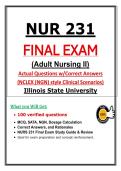
NUR 231
FINAL EXAM
(Adult Nursing II)
Actual Questions w/Correct Answers
(NCLEX (NGN) style Clinical Scenarios)
Illinois State University
What you Will Get:
• 100 verified questions
• MCQ, SATA, NGN, Dosage Calculation
• Correct Answers, and Rationales
• NURS 231 Final Exam Study Guide & Review
• Ideal for exam preparation and concept reinforcement.
,Table of Contents
NUR 231 FINAL EXAM .......................................................... 2
NURS 231 Final Exam Study Guide and Review Notes .............. 38
NUR 231 FINAL EXAM
1. A client develops acute kidney injury after a prolonged episode of severe hypotension.
Which category of AKI is most consistent with this cause?
A. Prerenal AKI
B. Intrarenal AKI
C. Postrenal AKI
D. Chronic pyelonephritis
Correct Answer:
A. Prerenal AKI
Expert Rationale:
Prerenal AKI results from a perfusion problem. Reduced blood flow to the kidneys decreases
filtration before direct nephron damage or urinary outflow obstruction occurs.
2. An older adult is admitted with lethargy, new urinary incontinence, anorexia, and a
low-grade fever. Which problem should the nurse consider?
A. Lower urinary tract infection
B. Testicular torsion
C. Fibromyalgia flare
D. Gout attack
Correct Answer:
A. Lower urinary tract infection
,Expert Rationale:
Older adults may lack classic dysuria and urgency. Nonspecific findings such as altered level of
consciousness, lethargy, anorexia, new incontinence, and low-grade fever can occur with a
UTI.
3. Which finding is most consistent with benign prostatic hyperplasia (BPH)?
A. Recurrent urinary retention and obstructive voiding symptoms
B. Sudden severe unilateral testicular pain
C. Painless enlargement of one testicle
D. Butterfly-shaped facial rash
Correct Answer:
A. Recurrent urinary retention and obstructive voiding symptoms
Expert Rationale:
BPH is a noncancerous enlargement of the prostate that produces obstructive and irritative
urinary symptoms and may lead to urinary retention, recurrent UTIs, and azotemia.
4. Which assessment finding is characteristic of systemic lupus erythematosus (SLE)?
A. Butterfly-shaped erythematous rash across the nose and cheeks
B. Painless testicular enlargement
C. Bright red urine with clots after TURP
D. Painless enlarging prostate
Correct Answer:
A. Butterfly-shaped erythematous rash across the nose and cheeks
Expert Rationale:
SLE can cause a butterfly-shaped red rash across the nose and cheeks along with fever,
malaise, weight loss, oral ulcers, Raynaud phenomenon, arthritis, and joint pain.
5. Which teaching point best supports HIV prevention?
A. Avoid sharing needles and practice safer sex
, B. Stop HIV testing after one negative test
C. Use antibiotics before all sexual activity
D. Delay post-exposure prophylaxis for one week
Correct Answer:
A. Avoid sharing needles and practice safer sex
Expert Rationale:
HIV prevention includes safer sexual practices, avoiding shared needles, routine testing, PrEP
for appropriate clients, and PEP after a potential exposure.
6. The nurse is caring for a client with an indwelling urinary catheter. Which actions help
prevent catheter-associated urinary tract infection? Select all that apply.
A. Use strict aseptic technique for catheter insertion
B. Maintain a closed drainage system
C. Keep the drainage bag below the bladder
D. Perform daily perineal care with soap and water
E. Disconnect the drainage tubing routinely to rinse it
F. Secure the catheter to reduce movement
Correct Answers:
A, B, C, D, F
Expert Rationale:
CAUTI prevention includes aseptic insertion, a closed system, keeping the bag below bladder
level, meticulous daily perineal care, and securing the catheter. Routine disconnection
increases contamination risk.
7. Which type of urinary stone accounts for the largest proportion of urinary calculi?
A. Calcium stone
B. Struvite stone
C. Uric acid stone
D. Cystine stone
Correct Answer:
A. Calcium stone
Expert Rationale:
Calcium stones account for approximately 75% of urinary calculi. Struvite, uric acid, and cystine
stones occur less frequently.
FINAL EXAM
(Adult Nursing II)
Actual Questions w/Correct Answers
(NCLEX (NGN) style Clinical Scenarios)
Illinois State University
What you Will Get:
• 100 verified questions
• MCQ, SATA, NGN, Dosage Calculation
• Correct Answers, and Rationales
• NURS 231 Final Exam Study Guide & Review
• Ideal for exam preparation and concept reinforcement.
,Table of Contents
NUR 231 FINAL EXAM .......................................................... 2
NURS 231 Final Exam Study Guide and Review Notes .............. 38
NUR 231 FINAL EXAM
1. A client develops acute kidney injury after a prolonged episode of severe hypotension.
Which category of AKI is most consistent with this cause?
A. Prerenal AKI
B. Intrarenal AKI
C. Postrenal AKI
D. Chronic pyelonephritis
Correct Answer:
A. Prerenal AKI
Expert Rationale:
Prerenal AKI results from a perfusion problem. Reduced blood flow to the kidneys decreases
filtration before direct nephron damage or urinary outflow obstruction occurs.
2. An older adult is admitted with lethargy, new urinary incontinence, anorexia, and a
low-grade fever. Which problem should the nurse consider?
A. Lower urinary tract infection
B. Testicular torsion
C. Fibromyalgia flare
D. Gout attack
Correct Answer:
A. Lower urinary tract infection
,Expert Rationale:
Older adults may lack classic dysuria and urgency. Nonspecific findings such as altered level of
consciousness, lethargy, anorexia, new incontinence, and low-grade fever can occur with a
UTI.
3. Which finding is most consistent with benign prostatic hyperplasia (BPH)?
A. Recurrent urinary retention and obstructive voiding symptoms
B. Sudden severe unilateral testicular pain
C. Painless enlargement of one testicle
D. Butterfly-shaped facial rash
Correct Answer:
A. Recurrent urinary retention and obstructive voiding symptoms
Expert Rationale:
BPH is a noncancerous enlargement of the prostate that produces obstructive and irritative
urinary symptoms and may lead to urinary retention, recurrent UTIs, and azotemia.
4. Which assessment finding is characteristic of systemic lupus erythematosus (SLE)?
A. Butterfly-shaped erythematous rash across the nose and cheeks
B. Painless testicular enlargement
C. Bright red urine with clots after TURP
D. Painless enlarging prostate
Correct Answer:
A. Butterfly-shaped erythematous rash across the nose and cheeks
Expert Rationale:
SLE can cause a butterfly-shaped red rash across the nose and cheeks along with fever,
malaise, weight loss, oral ulcers, Raynaud phenomenon, arthritis, and joint pain.
5. Which teaching point best supports HIV prevention?
A. Avoid sharing needles and practice safer sex
, B. Stop HIV testing after one negative test
C. Use antibiotics before all sexual activity
D. Delay post-exposure prophylaxis for one week
Correct Answer:
A. Avoid sharing needles and practice safer sex
Expert Rationale:
HIV prevention includes safer sexual practices, avoiding shared needles, routine testing, PrEP
for appropriate clients, and PEP after a potential exposure.
6. The nurse is caring for a client with an indwelling urinary catheter. Which actions help
prevent catheter-associated urinary tract infection? Select all that apply.
A. Use strict aseptic technique for catheter insertion
B. Maintain a closed drainage system
C. Keep the drainage bag below the bladder
D. Perform daily perineal care with soap and water
E. Disconnect the drainage tubing routinely to rinse it
F. Secure the catheter to reduce movement
Correct Answers:
A, B, C, D, F
Expert Rationale:
CAUTI prevention includes aseptic insertion, a closed system, keeping the bag below bladder
level, meticulous daily perineal care, and securing the catheter. Routine disconnection
increases contamination risk.
7. Which type of urinary stone accounts for the largest proportion of urinary calculi?
A. Calcium stone
B. Struvite stone
C. Uric acid stone
D. Cystine stone
Correct Answer:
A. Calcium stone
Expert Rationale:
Calcium stones account for approximately 75% of urinary calculi. Struvite, uric acid, and cystine
stones occur less frequently.