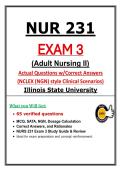
NUR 231
EXAM 3
(Adult Nursing II)
Actual Questions w/Correct Answers
(NCLEX (NGN) style Clinical Scenarios)
Illinois State University
What you Will Get:
• 65 verified questions
• MCQ, SATA, NGN, Dosage Calculation
• Correct Answers, and Rationales
• NURS 231 Exam 3 Study Guide & Review
• Ideal for exam preparation and concept reinforcement.
,Table of Contents
NUR 231 EXAM 3 ................................................................................... 2
NURS 231 Exam 3 Study Guide & Review .................................................22
NUR 231 EXAM 3
1. A client develops sudden dyspnea, tachypnea, and pleuritic chest pain after orthopedic
surgery. The nurse suspects a pulmonary embolism. Which diagnostic study is commonly
used to help find or rule out a pulmonary embolism?
A. Chest x-ray
B. Ventilation-perfusion (V/Q) lung scan
C. Sputum culture
D. Bone scan
Correct Answer: B. Ventilation-perfusion (V/Q) lung scan
Expert Rationale:
A V/Q lung scan is commonly used in the evaluation of pulmonary embolism. Other studies that
,may be used include spiral CT, pulmonary angiography, ECG, ABGs, D-dimer testing, and chest
imaging.
--------------------------------------------------------------------
2. Which assessment finding is an early manifestation of hypoxemia?
A. Restlessness with increased respiratory rate and heart rate
B. Cyanosis with decreasing heart rate
C. Stupor with cardiac dysrhythmias
D. Decreased respiratory rate and blood pressure
Correct Answer: A. Restlessness with increased respiratory rate and heart rate
Expert Rationale:
Early hypoxemia may cause increased respiratory rate, heart rate, and blood pressure along with
restlessness, agitation, and pallor. Decreasing respiratory rate, confusion, cyanosis,
dysrhythmias, and stupor are later findings.
--------------------------------------------------------------------
3. A client with a femur fracture develops respiratory changes, confusion, and a petechial
rash 36 hours after injury. Which complication should the nurse suspect?
A. Compartment syndrome
B. Fat embolism syndrome
C. Atelectasis
D. Pleural effusion
Correct Answer: B. Fat embolism syndrome
Expert Rationale:
Fat embolism syndrome can occur 12 to 72 hours after orthopedic trauma. Its manifestations
include pulmonary changes, neurologic changes, and a petechial rash.
--------------------------------------------------------------------
4. A client with pneumonia has a productive cough and fever. Which diagnostic test helps
determine whether an infection is present in respiratory secretions?
A. Sputum culture
B. Bone densitometry
C. Urinalysis
D. Bone scan
Correct Answer: A. Sputum culture
Expert Rationale:
Sputum culture is used to identify the presence of respiratory infection. Pneumonia evaluation
may also include history and physical assessment, chest x-ray, and blood cultures.
--------------------------------------------------------------------
, 5. A client with a leg fracture reports severe increasing pain that is not relieved by
prescribed pain medication. Which complication is the priority concern?
A. Fat embolism syndrome
B. Compartment syndrome
C. Pleural effusion
D. Hypocalcemia
Correct Answer: B. Compartment syndrome
Expert Rationale:
Compartment syndrome results from increased pressure within a muscle compartment and can
severely compromise circulation and nerve function. Pain that is not relieved by pain medication
is a major warning sign.
--------------------------------------------------------------------
6. Which statement best describes the pathophysiology of diabetic ketoacidosis (DKA)?
A. Excess insulin causes rapid glucose storage in cells.
B. Lack of insulin increases fat breakdown and ketone production, leading to acidosis.
C. Excess sodium causes glucose to move into the urine.
D. Increased calcium causes metabolic alkalosis.
Correct Answer: B. Lack of insulin increases fat breakdown and ketone production,
leading to acidosis
Expert Rationale:
DKA occurs primarily in type 1 diabetes when insufficient insulin leads to increased fat breakdown
and ketone formation. Accumulation of ketone bodies produces metabolic acidosis, and the onset
is usually rapid.
--------------------------------------------------------------------
7. Which positioning intervention is appropriate after total hip arthroplasty?
A. Adduct the affected leg across the midline.
B. Use a wedge pillow to help prevent adduction.
C. Keep the knees crossed while sitting.
EXAM 3
(Adult Nursing II)
Actual Questions w/Correct Answers
(NCLEX (NGN) style Clinical Scenarios)
Illinois State University
What you Will Get:
• 65 verified questions
• MCQ, SATA, NGN, Dosage Calculation
• Correct Answers, and Rationales
• NURS 231 Exam 3 Study Guide & Review
• Ideal for exam preparation and concept reinforcement.
,Table of Contents
NUR 231 EXAM 3 ................................................................................... 2
NURS 231 Exam 3 Study Guide & Review .................................................22
NUR 231 EXAM 3
1. A client develops sudden dyspnea, tachypnea, and pleuritic chest pain after orthopedic
surgery. The nurse suspects a pulmonary embolism. Which diagnostic study is commonly
used to help find or rule out a pulmonary embolism?
A. Chest x-ray
B. Ventilation-perfusion (V/Q) lung scan
C. Sputum culture
D. Bone scan
Correct Answer: B. Ventilation-perfusion (V/Q) lung scan
Expert Rationale:
A V/Q lung scan is commonly used in the evaluation of pulmonary embolism. Other studies that
,may be used include spiral CT, pulmonary angiography, ECG, ABGs, D-dimer testing, and chest
imaging.
--------------------------------------------------------------------
2. Which assessment finding is an early manifestation of hypoxemia?
A. Restlessness with increased respiratory rate and heart rate
B. Cyanosis with decreasing heart rate
C. Stupor with cardiac dysrhythmias
D. Decreased respiratory rate and blood pressure
Correct Answer: A. Restlessness with increased respiratory rate and heart rate
Expert Rationale:
Early hypoxemia may cause increased respiratory rate, heart rate, and blood pressure along with
restlessness, agitation, and pallor. Decreasing respiratory rate, confusion, cyanosis,
dysrhythmias, and stupor are later findings.
--------------------------------------------------------------------
3. A client with a femur fracture develops respiratory changes, confusion, and a petechial
rash 36 hours after injury. Which complication should the nurse suspect?
A. Compartment syndrome
B. Fat embolism syndrome
C. Atelectasis
D. Pleural effusion
Correct Answer: B. Fat embolism syndrome
Expert Rationale:
Fat embolism syndrome can occur 12 to 72 hours after orthopedic trauma. Its manifestations
include pulmonary changes, neurologic changes, and a petechial rash.
--------------------------------------------------------------------
4. A client with pneumonia has a productive cough and fever. Which diagnostic test helps
determine whether an infection is present in respiratory secretions?
A. Sputum culture
B. Bone densitometry
C. Urinalysis
D. Bone scan
Correct Answer: A. Sputum culture
Expert Rationale:
Sputum culture is used to identify the presence of respiratory infection. Pneumonia evaluation
may also include history and physical assessment, chest x-ray, and blood cultures.
--------------------------------------------------------------------
, 5. A client with a leg fracture reports severe increasing pain that is not relieved by
prescribed pain medication. Which complication is the priority concern?
A. Fat embolism syndrome
B. Compartment syndrome
C. Pleural effusion
D. Hypocalcemia
Correct Answer: B. Compartment syndrome
Expert Rationale:
Compartment syndrome results from increased pressure within a muscle compartment and can
severely compromise circulation and nerve function. Pain that is not relieved by pain medication
is a major warning sign.
--------------------------------------------------------------------
6. Which statement best describes the pathophysiology of diabetic ketoacidosis (DKA)?
A. Excess insulin causes rapid glucose storage in cells.
B. Lack of insulin increases fat breakdown and ketone production, leading to acidosis.
C. Excess sodium causes glucose to move into the urine.
D. Increased calcium causes metabolic alkalosis.
Correct Answer: B. Lack of insulin increases fat breakdown and ketone production,
leading to acidosis
Expert Rationale:
DKA occurs primarily in type 1 diabetes when insufficient insulin leads to increased fat breakdown
and ketone formation. Accumulation of ketone bodies produces metabolic acidosis, and the onset
is usually rapid.
--------------------------------------------------------------------
7. Which positioning intervention is appropriate after total hip arthroplasty?
A. Adduct the affected leg across the midline.
B. Use a wedge pillow to help prevent adduction.
C. Keep the knees crossed while sitting.