
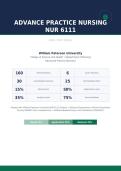
ADVANCE PRACTICE NURSING
NUR 6111
EXAM 1 QUESTIONS WITH COMPLETE SOLUTIONS
Edition
William Paterson University
College of Science and Health • Department of Nursing
Advanced Practice Nursing I
160 Total Questions 6 Exam Sections
30 Case-Based Scenarios 25 Dermatology Items
15% Recall Level 50% Application Level
35% Analysis Level 75% Scenario-Based
Aligned with William Paterson University NUR 6111 Syllabus • National Organization of Nurse Practitioner
Faculty (NONPF) Core Competencies • Evidence-Based Primary Care Standards (2026/2027)
Recall 15% Application 50% Analysis 35%
, Section 1: Health Assessment, Health Promotion, &
Differential Diagnosis
Q1: A 68-year-old woman presents for a comprehensive geriatric assessment. Which
of the following domains is MOST essential to include beyond a standard adult
history and physical?
A. Current medication list and recent laboratory values only
B. Functional status, cognitive assessment, fall risk, polypharmacy review, and
advance directives *[CORRECT]*
C. Family history of cardiovascular disease and 10-year ASCVD risk calculation
D. Review of systems organized by body system and a complete blood count
Correct Answer: B
Rationale: Comprehensive geriatric assessment (CGA) extends beyond the standard adult work-up
to evaluate functional status, cognition, fall risk, polypharmacy, nutrition, and goals of care. The
NUR 6111 curriculum and AGS Beers Criteria emphasize that this multidimensional evaluation is
the cornerstone of age-appropriate primary care. Options A, C, and D reflect routine adult
assessment and omit the geriatric-specific domains that drive clinical decision-making in older
adults.
Q2: When obtaining a health history from a 75-year-old patient with hearing
impairment, which communication strategy is MOST appropriate?
A. Speak loudly and slowly using a high-pitched voice to overcome presbycusis
B. Face the patient directly, lower vocal pitch, and allow extra time for responses
*[CORRECT]*
C. Conduct the interview in a brightly lit room with the patient seated facing away from
you
D. Use a family member as the primary historian to ensure accuracy of information
Correct Answer: B
Rationale: Presbycusis typically affects high-frequency tones first, so lowering vocal pitch and
facing the patient to allow lip-reading is the evidence-based approach. Speaking loudly distorts
consonants and may cause discomfort. The NUR 6111 health-assessment module emphasizes
patient-centered communication; using a family member as primary historian should be reserved
only for patients who lack capacity, not for those with sensory impairment.
Q3: A 55-year-old male presents for an annual wellness visit. According to USPSTF
recommendations, which screening is indicated at this age?
A. Annual prostate-specific antigen (PSA) testing for all men beginning at age 50
B. One-time abdominal aortic aneurysm (AAA) ultrasound for ever-smoker men
aged 65–75 *[CORRECT]*
C. Annual low-dose CT chest for lung cancer in never-smokers beginning at age 50
D. Routine bone-density screening for men beginning at age 50
Correct Answer: B
Rationale: USPSTF recommends a one-time abdominal aortic aneurysm ultrasound for men aged
65–75 who have ever smoked (Grade B). PSA screening is individualized (Grade C) rather than
routine. Low-dose CT lung screening applies to adults 50–80 with ≥20 pack-year history and
current smokers or quit <15 years. Routine DEXA screening for men is not recommended at age 50
unless risk factors are present.
,NUR 6111 Advanced Practice Nursing I | Exam 1 Practice Examination William Paterson University • 2026/2027 Edition
Q4: Which of the following represents the correct sequence of the nursing process
framework taught in NUR 6111?
A. Diagnosis → Assessment → Planning → Implementation → Evaluation
B. Assessment → Diagnosis → Planning → Implementation → Evaluation
*[CORRECT]*
C. Assessment → Planning → Diagnosis → Implementation → Evaluation
D. Planning → Assessment → Diagnosis → Evaluation → Implementation
Correct Answer: B
Rationale: The nursing process follows a sequential five-step framework: Assessment, Diagnosis,
Planning, Implementation, and Evaluation (ADPIE). This structure guides clinical decision-making
and SOAP documentation throughout the NUR 6111 curriculum. Reordering these steps disrupts
the systematic approach to patient care and may lead to interventions not based on a complete
assessment or accurate diagnosis.
Q5: A 42-year-old female presents with fatigue, pallor, and menorrhagia. Which
component of the SOAP note best represents the Assessment portion?
A. "Patient reports heavy menstrual periods for 6 months with 8–10 pads daily"
B. "Hemoglobin 9.2 g/dL, MCV 76 fL, ferritin 8 ng/mL"
C. "Iron-deficiency anemia secondary to menorrhagia; rule out other GI sources"
*[CORRECT]*
D. "Start oral ferrous sulfate 325 mg three times daily with vitamin C"
Correct Answer: C
Rationale: The Assessment portion of a SOAP note contains the differential diagnosis, clinical
interpretation, and problem list derived from the subjective and objective data. Option C represents
a diagnostic conclusion. Option A is Subjective (patient report), Option B is Objective (laboratory
data), and Option D is the Plan (intervention). NUR 6111 emphasizes accurate SOAP documentation
to reflect clinical reasoning.
Q6: A nurse practitioner is preparing to perform a comprehensive physical
examination on a 70-year-old patient. Which technique should be used FIRST in
abdominal assessment?
A. Percussion to assess organ size and identify masses
B. Auscultation to evaluate bowel sounds before manipulation
C. Palpation to identify tenderness and organomegaly
D. Inspection to observe contour, scars, and visible peristalsis *[CORRECT]*
Correct Answer: D
Rationale: Abdominal examination follows the sequence of inspection, auscultation, percussion,
and palpation (a departure from the usual inspection-palpation-percussion-auscultation order used
elsewhere). Inspection comes first to observe contour, scars, and visible peristalsis before any
manipulation that could alter findings. Auscultation precedes percussion and palpation because the
latter can stimulate bowel sounds, producing false results.
Q7: A 65-year-old male is being evaluated for fall risk. Which validated tool does NUR
6111 recommend for fall risk screening in community-dwelling older adults?
A. Mini-Mental State Examination (MMSE)
B. Timed Up and Go (TUG) test *[CORRECT]*
C. Geriatric Depression Scale (GDS-15)
D. Get-Up-and-Go 30-second chair stand
Comprehensive Practice Exam • 160 Questions Page 3
, NUR 6111 Advanced Practice Nursing I | Exam 1 Practice Examination William Paterson University • 2026/2027 Edition
Correct Answer: B
Rationale: The Timed Up and Go (TUG) test is the recommended fall-risk screening tool: a time
>12 seconds indicates increased fall risk. MMSE assesses cognition, GDS-15 screens for
depression, and the 30-second chair stand measures lower-body strength. NUR 6111 geriatric
assessment content emphasizes annual fall-risk screening because falls are the leading cause of
injury and injury-related death in adults aged 65 and older.
Q8: According to USPSTF, at what age and frequency should colorectal cancer
screening begin for average-risk adults?
A. Age 40 with annual fecal immunochemical test (FIT)
B. Age 45 with screening continuing through age 75 *[CORRECT]*
C. Age 50 with colonoscopy every 5 years
D. Age 60 with annual FIT-DNA testing
Correct Answer: B
Rationale: USPSTF 2021 guidelines recommend colorectal cancer screening begin at age 45
(lowered from 50 based on rising incidence of early-onset CRC) and continue through age 75 for
average-risk adults. Screening from 76–85 is individualized based on prior screening and overall
health. Multiple modalities are acceptable: colonoscopy every 10 years, annual FIT, or stool
DNA-FIT every 1–3 years.
Q9: Which of the following findings on cardiovascular assessment of an 80-year-old
would be considered an EXPECTED age-related change rather than a pathological
finding?
A. Sustained systolic blood pressure >160 mmHg at rest
B. Fourth heart sound (S4) audible at the apex *[CORRECT]*
C. Holosystolic murmur at the lower left sternal border
D. Jugular venous distension 6 cm above the sternal angle
Correct Answer: B
Rationale: An S4 gallop is common in older adults due to increased ventricular stiffness from
age-related concentric hypertrophy and reduced compliance. Hypertension ≥160 is not normal at
any age. A holosystolic murmur suggests regurgitant disease (e.g., TR or MR) requiring workup.
Jugular venous distension >3–4 cm above the sternal angle suggests volume overload or heart
failure. NUR 6111 distinguishes expected aging changes from pathological findings to avoid over-
or under-diagnosis.
Q10: A 58-year-old female presents for a well-woman exam. She is healthy, has no
family history of breast cancer, and has had normal mammograms. According to
USPSTF, which screening approach is appropriate?
A. Annual mammography beginning at age 35 and continuing indefinitely
B. Biennial mammography from age 40 to 74, individualized thereafter
*[CORRECT]*
C. Annual mammography plus breast MRI starting at age 50
D. Clinical breast exam alone every 3 years without mammography
Correct Answer: B
Rationale: USPSTF recommends biennial mammography for women aged 40–74 at average risk
(2024 update lowered the start age from 50 to 40). After age 75, screening is individualized based
on life expectancy and patient preference. Breast MRI is reserved for high-risk women (e.g., BRCA
carriers). Clinical breast exam alone is insufficient for screening in this age group. NUR 6111
Comprehensive Practice Exam • 160 Questions Page 4
NUR 6111
EXAM 1 QUESTIONS WITH COMPLETE SOLUTIONS
Edition
William Paterson University
College of Science and Health • Department of Nursing
Advanced Practice Nursing I
160 Total Questions 6 Exam Sections
30 Case-Based Scenarios 25 Dermatology Items
15% Recall Level 50% Application Level
35% Analysis Level 75% Scenario-Based
Aligned with William Paterson University NUR 6111 Syllabus • National Organization of Nurse Practitioner
Faculty (NONPF) Core Competencies • Evidence-Based Primary Care Standards (2026/2027)
Recall 15% Application 50% Analysis 35%
, Section 1: Health Assessment, Health Promotion, &
Differential Diagnosis
Q1: A 68-year-old woman presents for a comprehensive geriatric assessment. Which
of the following domains is MOST essential to include beyond a standard adult
history and physical?
A. Current medication list and recent laboratory values only
B. Functional status, cognitive assessment, fall risk, polypharmacy review, and
advance directives *[CORRECT]*
C. Family history of cardiovascular disease and 10-year ASCVD risk calculation
D. Review of systems organized by body system and a complete blood count
Correct Answer: B
Rationale: Comprehensive geriatric assessment (CGA) extends beyond the standard adult work-up
to evaluate functional status, cognition, fall risk, polypharmacy, nutrition, and goals of care. The
NUR 6111 curriculum and AGS Beers Criteria emphasize that this multidimensional evaluation is
the cornerstone of age-appropriate primary care. Options A, C, and D reflect routine adult
assessment and omit the geriatric-specific domains that drive clinical decision-making in older
adults.
Q2: When obtaining a health history from a 75-year-old patient with hearing
impairment, which communication strategy is MOST appropriate?
A. Speak loudly and slowly using a high-pitched voice to overcome presbycusis
B. Face the patient directly, lower vocal pitch, and allow extra time for responses
*[CORRECT]*
C. Conduct the interview in a brightly lit room with the patient seated facing away from
you
D. Use a family member as the primary historian to ensure accuracy of information
Correct Answer: B
Rationale: Presbycusis typically affects high-frequency tones first, so lowering vocal pitch and
facing the patient to allow lip-reading is the evidence-based approach. Speaking loudly distorts
consonants and may cause discomfort. The NUR 6111 health-assessment module emphasizes
patient-centered communication; using a family member as primary historian should be reserved
only for patients who lack capacity, not for those with sensory impairment.
Q3: A 55-year-old male presents for an annual wellness visit. According to USPSTF
recommendations, which screening is indicated at this age?
A. Annual prostate-specific antigen (PSA) testing for all men beginning at age 50
B. One-time abdominal aortic aneurysm (AAA) ultrasound for ever-smoker men
aged 65–75 *[CORRECT]*
C. Annual low-dose CT chest for lung cancer in never-smokers beginning at age 50
D. Routine bone-density screening for men beginning at age 50
Correct Answer: B
Rationale: USPSTF recommends a one-time abdominal aortic aneurysm ultrasound for men aged
65–75 who have ever smoked (Grade B). PSA screening is individualized (Grade C) rather than
routine. Low-dose CT lung screening applies to adults 50–80 with ≥20 pack-year history and
current smokers or quit <15 years. Routine DEXA screening for men is not recommended at age 50
unless risk factors are present.
,NUR 6111 Advanced Practice Nursing I | Exam 1 Practice Examination William Paterson University • 2026/2027 Edition
Q4: Which of the following represents the correct sequence of the nursing process
framework taught in NUR 6111?
A. Diagnosis → Assessment → Planning → Implementation → Evaluation
B. Assessment → Diagnosis → Planning → Implementation → Evaluation
*[CORRECT]*
C. Assessment → Planning → Diagnosis → Implementation → Evaluation
D. Planning → Assessment → Diagnosis → Evaluation → Implementation
Correct Answer: B
Rationale: The nursing process follows a sequential five-step framework: Assessment, Diagnosis,
Planning, Implementation, and Evaluation (ADPIE). This structure guides clinical decision-making
and SOAP documentation throughout the NUR 6111 curriculum. Reordering these steps disrupts
the systematic approach to patient care and may lead to interventions not based on a complete
assessment or accurate diagnosis.
Q5: A 42-year-old female presents with fatigue, pallor, and menorrhagia. Which
component of the SOAP note best represents the Assessment portion?
A. "Patient reports heavy menstrual periods for 6 months with 8–10 pads daily"
B. "Hemoglobin 9.2 g/dL, MCV 76 fL, ferritin 8 ng/mL"
C. "Iron-deficiency anemia secondary to menorrhagia; rule out other GI sources"
*[CORRECT]*
D. "Start oral ferrous sulfate 325 mg three times daily with vitamin C"
Correct Answer: C
Rationale: The Assessment portion of a SOAP note contains the differential diagnosis, clinical
interpretation, and problem list derived from the subjective and objective data. Option C represents
a diagnostic conclusion. Option A is Subjective (patient report), Option B is Objective (laboratory
data), and Option D is the Plan (intervention). NUR 6111 emphasizes accurate SOAP documentation
to reflect clinical reasoning.
Q6: A nurse practitioner is preparing to perform a comprehensive physical
examination on a 70-year-old patient. Which technique should be used FIRST in
abdominal assessment?
A. Percussion to assess organ size and identify masses
B. Auscultation to evaluate bowel sounds before manipulation
C. Palpation to identify tenderness and organomegaly
D. Inspection to observe contour, scars, and visible peristalsis *[CORRECT]*
Correct Answer: D
Rationale: Abdominal examination follows the sequence of inspection, auscultation, percussion,
and palpation (a departure from the usual inspection-palpation-percussion-auscultation order used
elsewhere). Inspection comes first to observe contour, scars, and visible peristalsis before any
manipulation that could alter findings. Auscultation precedes percussion and palpation because the
latter can stimulate bowel sounds, producing false results.
Q7: A 65-year-old male is being evaluated for fall risk. Which validated tool does NUR
6111 recommend for fall risk screening in community-dwelling older adults?
A. Mini-Mental State Examination (MMSE)
B. Timed Up and Go (TUG) test *[CORRECT]*
C. Geriatric Depression Scale (GDS-15)
D. Get-Up-and-Go 30-second chair stand
Comprehensive Practice Exam • 160 Questions Page 3
, NUR 6111 Advanced Practice Nursing I | Exam 1 Practice Examination William Paterson University • 2026/2027 Edition
Correct Answer: B
Rationale: The Timed Up and Go (TUG) test is the recommended fall-risk screening tool: a time
>12 seconds indicates increased fall risk. MMSE assesses cognition, GDS-15 screens for
depression, and the 30-second chair stand measures lower-body strength. NUR 6111 geriatric
assessment content emphasizes annual fall-risk screening because falls are the leading cause of
injury and injury-related death in adults aged 65 and older.
Q8: According to USPSTF, at what age and frequency should colorectal cancer
screening begin for average-risk adults?
A. Age 40 with annual fecal immunochemical test (FIT)
B. Age 45 with screening continuing through age 75 *[CORRECT]*
C. Age 50 with colonoscopy every 5 years
D. Age 60 with annual FIT-DNA testing
Correct Answer: B
Rationale: USPSTF 2021 guidelines recommend colorectal cancer screening begin at age 45
(lowered from 50 based on rising incidence of early-onset CRC) and continue through age 75 for
average-risk adults. Screening from 76–85 is individualized based on prior screening and overall
health. Multiple modalities are acceptable: colonoscopy every 10 years, annual FIT, or stool
DNA-FIT every 1–3 years.
Q9: Which of the following findings on cardiovascular assessment of an 80-year-old
would be considered an EXPECTED age-related change rather than a pathological
finding?
A. Sustained systolic blood pressure >160 mmHg at rest
B. Fourth heart sound (S4) audible at the apex *[CORRECT]*
C. Holosystolic murmur at the lower left sternal border
D. Jugular venous distension 6 cm above the sternal angle
Correct Answer: B
Rationale: An S4 gallop is common in older adults due to increased ventricular stiffness from
age-related concentric hypertrophy and reduced compliance. Hypertension ≥160 is not normal at
any age. A holosystolic murmur suggests regurgitant disease (e.g., TR or MR) requiring workup.
Jugular venous distension >3–4 cm above the sternal angle suggests volume overload or heart
failure. NUR 6111 distinguishes expected aging changes from pathological findings to avoid over-
or under-diagnosis.
Q10: A 58-year-old female presents for a well-woman exam. She is healthy, has no
family history of breast cancer, and has had normal mammograms. According to
USPSTF, which screening approach is appropriate?
A. Annual mammography beginning at age 35 and continuing indefinitely
B. Biennial mammography from age 40 to 74, individualized thereafter
*[CORRECT]*
C. Annual mammography plus breast MRI starting at age 50
D. Clinical breast exam alone every 3 years without mammography
Correct Answer: B
Rationale: USPSTF recommends biennial mammography for women aged 40–74 at average risk
(2024 update lowered the start age from 50 to 40). After age 75, screening is individualized based
on life expectancy and patient preference. Breast MRI is reserved for high-risk women (e.g., BRCA
carriers). Clinical breast exam alone is insufficient for screening in this age group. NUR 6111
Comprehensive Practice Exam • 160 Questions Page 4


