

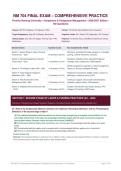
NM 704 FINAL EXAM – COMPREHENSIVE PRACTICE
Frontier Nursing University • Intrapartum & Postpartum Management • 2026/2027 Edition •
100 Questions
Course: NM 704 Intrapartum & Postpartum (FNU) Format: 100 NCLEX-Style Multiple-Choice Questions
Target Competency: $\ge 80\%$ (Mastery Benchmark) Cognitive Levels: 30% Recall, 50% Application, 20% Analysis
Clinical Scope: 2nd, 3rd & 4th Stages, Perineal Care, FHR, Features: Full Answer Keys, [CORRECT] Identifiers & Clinical
Medications Rationales
Domain Section Question Count Key Competencies Tested
Section 1: Second Stage of Labor & Pushing Definitions, prolonged 2nd stage, delayed vs. immediate
Practices (Q1 – Q20) 20 Questions (20.0%) pushing, cardinal movements, extension
Section 2: Perineal Management & Genital Episiotomy indications/risks, antenatal/intrapartum
Trauma (Q21 – Q35) 15 Questions (15.0%) massage, warm compresses, OASIS degrees
AMTSL components, expectant vs. active management,
Section 3: Third Stage of Labor (Q36 – Q50) 15 Questions (15.0%) Schultz vs. Duncan, prolonged 3rd stage
Section 4: Fourth Stage & Postpartum Postpartum assessments, bladder checks, Oxytocin vs.
Medications (Q51 – Q65) 15 Questions (15.0%) Methergine, Lidocaine toxicity (LAST)
Section 5: Fetal Assessment & Pain Continuous support, nitrous oxide contraindications,
Management (Q66 – Q80) 15 Questions (15.0%) waterbirth, epidural effects, FHR protocols
Section 6: Integrated Clinical Scenarios (Q81 Complex multi-domain case studies: dystocia, PPH,
– Q100) 20 Questions (20.0%) Category II/III tracings, OASIS repair
SECTION 1: SECOND STAGE OF LABOR & PUSHING PRACTICES (Q1 – Q20)
Definitions, Prolonged Second Stage Parameters, Delayed vs. Immediate Pushing, Cardinal Movements & Bladder Care
Q1. What is the fundamental difference between the traditional 'Biomedical Definition' and the 'Physiological
Definition' of the second stage of labor?
[A] The traditional biomedical definition defines the second stage as beginning at complete cervical dilation (10 cm)
and ending with the birth of the baby; the physiological definition begins with the onset of involuntary expulsive
bearing-down efforts (Ferguson reflex) and ends with the birth [CORRECT]
[B] The biomedical definition begins when contractions are 2 minutes apart; the physiological definition begins when water
breaks
[C] The biomedical definition applies only to cesarean births; the physiological definition applies only to home births
[D] There is no clinical distinction between biomedical and physiological definitions
Correct Answer: [A]
Rationale: The biomedical definition is anatomical (10 cm dilation to birth), whereas the physiological definition is functional, recognizing
that involuntary expulsive urges often begin before or after complete dilation.
FNU NM 704 Comprehensive Intrapartum & Postpartum Final Examination | 100 Questions Page 1 of 26
,NM 704 Final Exam: Intrapartum & Postpartum Management – Practice (2026/2027)
Q2. Under current ACOG clinical parameters, what time thresholds define a 'Prolonged Second Stage of
Labor' in a NULLIPAROUS woman with and without regional (epidural) anesthesia?
[A] Greater than 1 hour without epidural, or greater than 2 hours with epidural
[B] Greater than 2 hours without regional anesthesia, or greater than 3 hours with regional anesthesia (with modern
guidelines allowing up to 4 hours with an epidural if progress is continuing) [CORRECT]
[C] Greater than 4 hours without epidural, or greater than 6 hours with epidural
[D] Greater than 30 minutes regardless of anesthesia
Correct Answer: [B]
Rationale: A prolonged second stage in nulliparous women is traditionally defined as $> 2 ext{ hours}$ without regional anesthesia and
$> 3 ext{ hours}$ with regional anesthesia, allowing extension if maternal-fetal status is reassuring.
Q3. Under current ACOG parameters, what time thresholds define a 'Prolonged Second Stage of Labor' in a
MULTIPAROUS woman with and without regional anesthesia?
[A] Greater than 30 minutes without epidural, or greater than 1 hour with epidural
[B] Greater than 3 hours without epidural, or greater than 4 hours with epidural
[C] Greater than 1 hour without regional anesthesia, or greater than 2 hours with regional anesthesia (allowing up to 3
hours with an epidural if progressive descent occurs) [CORRECT]
[D] Multiparas are never diagnosed with a prolonged second stage
Correct Answer: [C]
Rationale: In multiparous women, second stage arrest/prolongation is defined as $> 1 ext{ hour}$ without regional anesthesia and $> 2
ext{ hours}$ with regional anesthesia.
Q4. What does current clinical evidence demonstrate regarding the outcomes of 'Delayed Pushing' (laboring
down / passive descent) compared to 'Immediate Pushing' in nulliparous women with epidural analgesia at
10 cm dilation?
[A] Delayed pushing shortens the total second stage duration by 50%
[B] Delayed pushing causes immediate fetal asphyxia in all cases
[C] Immediate pushing is proven to eliminate the need for cesarean delivery
[D] Delayed pushing significantly shortens the duration of active maternal pushing efforts, reduces maternal fatigue,
and decreases operative vaginal births, although it results in a longer overall second stage duration and may slightly
increase risks of intrapartum fever [CORRECT]
Correct Answer: [D]
Rationale: Laboring down allows uterine contractions to passively descend the fetal vertex, reducing active pushing time and maternal
exhaustion, despite lengthening total elapsed second-stage clock time.
Q5. Which bearing-down technique is considered evidence-based for preserving maternal hemodynamics,
optimizing fetal oxygenation, and protecting pelvic floor tissues during the second stage?
[A] Spontaneous (urge-driven), open-glottis bearing down with maternal exhalation and vocalization in response to
involuntary contraction surges [CORRECT]
[B] Closed-glottis (Valsalva) coached pushing with 10-to-15-second sustained breath holding and counting
[C] Pushing continuously between contractions
[D] Restricting all maternal expulsive effort until the head crowns
Correct Answer: [A]
Rationale: Spontaneous open-glottis pushing avoids the dangerous hemodynamic compromise and fetal acidemia associated with
sustained closed-glottis Valsalva pushing.
FNU NM 704 Comprehensive Intrapartum & Postpartum Final Examination | 100 Questions Page 2 of 26
, NM 704 Final Exam: Intrapartum & Postpartum Management – Practice (2026/2027)
Q6. Which specific 'Cardinal Movement of Labor' directly allows the fetal head to negotiate the pubic arch
and be born over the maternal perineum in a cephalic presentation?
[A] Internal rotation
[B] Extension [CORRECT]
[C] Restitution
[D] Flexion
Correct Answer: [B]
Rationale: As the flexed fetal occiput pivots beneath the subpubic arch, extension of the fetal head occurs, allowing the brow, face, and
chin to emerge sequentially over the perineum.
Q7. Why is systematic assessment and maintenance of an empty urinary bladder critical during the second
stage of labor?
[A] Because urine absorbs amniotic fluid through the bladder wall
[B] Because urine leakage contaminates the sterile field permanently
[C] Because a full, distended bladder acts as a physical mechanical obstruction in the anterior pelvis, hindering fetal
head descent, inhibiting uterine contractions, and increasing the risk of postpartum urinary retention [CORRECT]
[D] Because bladder filling stops fetal heart rate variability
Correct Answer: [C]
Rationale: A distended bladder physically impedes fetal descent into the lower pelvis, alters contraction vectors, and predisposes to
postpartum bladder atony.
Q8. What is the correct sequential order of the seven Cardinal Movements of Labor for a vertex fetus
navigating the maternal pelvis?
[A] Expulsion $ ightarrow$ Flexion $ ightarrow$ Extension $ ightarrow$ Internal Rotation $ ightarrow$ Descent $ ightarrow$
Engagement $ ightarrow$ Restitution
[B] Descent $ ightarrow$ Extension $ ightarrow$ Flexion $ ightarrow$ Engagement $ ightarrow$ Internal Rotation $ ightarrow$
Expulsion $ ightarrow$ Restitution
[C] Flexion $ ightarrow$ Internal Rotation $ ightarrow$ External Rotation $ ightarrow$ Extension $ ightarrow$ Descent $
ightarrow$ Engagement $ ightarrow$ Expulsion
[D] Engagement $ ightarrow$ Descent $ ightarrow$ Flexion $ ightarrow$ Internal Rotation $ ightarrow$ Extension $
ightarrow$ Restitution / External Rotation $ ightarrow$ Expulsion [CORRECT]
Correct Answer: [D]
Rationale: The classic cardinal movements progress sequentially: Engagement, Descent, Flexion, Internal Rotation, Extension,
Restitution/External Rotation, and Expulsion.
Q9. How does sustained closed-glottis (Valsalva) pushing negatively impact fetal status during the second
stage of labor?
[A] It dramatically increases maternal intrathoracic pressure, impairs venous return to the maternal heart, decreases
cardiac output and uteroplacental blood flow, and leads to fetal hypoxia and acidemia [CORRECT]
[B] It causes fetal hyperoxia
[C] It causes immediate closure of the fetal ductus arteriosus
[D] It prevents the fetal head from flexing
Correct Answer: [A]
Rationale: Valsalva maneuvers reduce maternal stroke volume and mean arterial pressure, sharply decreasing intervillous placental
perfusion and provoking fetal decelerations.
FNU NM 704 Comprehensive Intrapartum & Postpartum Final Examination | 100 Questions Page 3 of 26
Frontier Nursing University • Intrapartum & Postpartum Management • 2026/2027 Edition •
100 Questions
Course: NM 704 Intrapartum & Postpartum (FNU) Format: 100 NCLEX-Style Multiple-Choice Questions
Target Competency: $\ge 80\%$ (Mastery Benchmark) Cognitive Levels: 30% Recall, 50% Application, 20% Analysis
Clinical Scope: 2nd, 3rd & 4th Stages, Perineal Care, FHR, Features: Full Answer Keys, [CORRECT] Identifiers & Clinical
Medications Rationales
Domain Section Question Count Key Competencies Tested
Section 1: Second Stage of Labor & Pushing Definitions, prolonged 2nd stage, delayed vs. immediate
Practices (Q1 – Q20) 20 Questions (20.0%) pushing, cardinal movements, extension
Section 2: Perineal Management & Genital Episiotomy indications/risks, antenatal/intrapartum
Trauma (Q21 – Q35) 15 Questions (15.0%) massage, warm compresses, OASIS degrees
AMTSL components, expectant vs. active management,
Section 3: Third Stage of Labor (Q36 – Q50) 15 Questions (15.0%) Schultz vs. Duncan, prolonged 3rd stage
Section 4: Fourth Stage & Postpartum Postpartum assessments, bladder checks, Oxytocin vs.
Medications (Q51 – Q65) 15 Questions (15.0%) Methergine, Lidocaine toxicity (LAST)
Section 5: Fetal Assessment & Pain Continuous support, nitrous oxide contraindications,
Management (Q66 – Q80) 15 Questions (15.0%) waterbirth, epidural effects, FHR protocols
Section 6: Integrated Clinical Scenarios (Q81 Complex multi-domain case studies: dystocia, PPH,
– Q100) 20 Questions (20.0%) Category II/III tracings, OASIS repair
SECTION 1: SECOND STAGE OF LABOR & PUSHING PRACTICES (Q1 – Q20)
Definitions, Prolonged Second Stage Parameters, Delayed vs. Immediate Pushing, Cardinal Movements & Bladder Care
Q1. What is the fundamental difference between the traditional 'Biomedical Definition' and the 'Physiological
Definition' of the second stage of labor?
[A] The traditional biomedical definition defines the second stage as beginning at complete cervical dilation (10 cm)
and ending with the birth of the baby; the physiological definition begins with the onset of involuntary expulsive
bearing-down efforts (Ferguson reflex) and ends with the birth [CORRECT]
[B] The biomedical definition begins when contractions are 2 minutes apart; the physiological definition begins when water
breaks
[C] The biomedical definition applies only to cesarean births; the physiological definition applies only to home births
[D] There is no clinical distinction between biomedical and physiological definitions
Correct Answer: [A]
Rationale: The biomedical definition is anatomical (10 cm dilation to birth), whereas the physiological definition is functional, recognizing
that involuntary expulsive urges often begin before or after complete dilation.
FNU NM 704 Comprehensive Intrapartum & Postpartum Final Examination | 100 Questions Page 1 of 26
,NM 704 Final Exam: Intrapartum & Postpartum Management – Practice (2026/2027)
Q2. Under current ACOG clinical parameters, what time thresholds define a 'Prolonged Second Stage of
Labor' in a NULLIPAROUS woman with and without regional (epidural) anesthesia?
[A] Greater than 1 hour without epidural, or greater than 2 hours with epidural
[B] Greater than 2 hours without regional anesthesia, or greater than 3 hours with regional anesthesia (with modern
guidelines allowing up to 4 hours with an epidural if progress is continuing) [CORRECT]
[C] Greater than 4 hours without epidural, or greater than 6 hours with epidural
[D] Greater than 30 minutes regardless of anesthesia
Correct Answer: [B]
Rationale: A prolonged second stage in nulliparous women is traditionally defined as $> 2 ext{ hours}$ without regional anesthesia and
$> 3 ext{ hours}$ with regional anesthesia, allowing extension if maternal-fetal status is reassuring.
Q3. Under current ACOG parameters, what time thresholds define a 'Prolonged Second Stage of Labor' in a
MULTIPAROUS woman with and without regional anesthesia?
[A] Greater than 30 minutes without epidural, or greater than 1 hour with epidural
[B] Greater than 3 hours without epidural, or greater than 4 hours with epidural
[C] Greater than 1 hour without regional anesthesia, or greater than 2 hours with regional anesthesia (allowing up to 3
hours with an epidural if progressive descent occurs) [CORRECT]
[D] Multiparas are never diagnosed with a prolonged second stage
Correct Answer: [C]
Rationale: In multiparous women, second stage arrest/prolongation is defined as $> 1 ext{ hour}$ without regional anesthesia and $> 2
ext{ hours}$ with regional anesthesia.
Q4. What does current clinical evidence demonstrate regarding the outcomes of 'Delayed Pushing' (laboring
down / passive descent) compared to 'Immediate Pushing' in nulliparous women with epidural analgesia at
10 cm dilation?
[A] Delayed pushing shortens the total second stage duration by 50%
[B] Delayed pushing causes immediate fetal asphyxia in all cases
[C] Immediate pushing is proven to eliminate the need for cesarean delivery
[D] Delayed pushing significantly shortens the duration of active maternal pushing efforts, reduces maternal fatigue,
and decreases operative vaginal births, although it results in a longer overall second stage duration and may slightly
increase risks of intrapartum fever [CORRECT]
Correct Answer: [D]
Rationale: Laboring down allows uterine contractions to passively descend the fetal vertex, reducing active pushing time and maternal
exhaustion, despite lengthening total elapsed second-stage clock time.
Q5. Which bearing-down technique is considered evidence-based for preserving maternal hemodynamics,
optimizing fetal oxygenation, and protecting pelvic floor tissues during the second stage?
[A] Spontaneous (urge-driven), open-glottis bearing down with maternal exhalation and vocalization in response to
involuntary contraction surges [CORRECT]
[B] Closed-glottis (Valsalva) coached pushing with 10-to-15-second sustained breath holding and counting
[C] Pushing continuously between contractions
[D] Restricting all maternal expulsive effort until the head crowns
Correct Answer: [A]
Rationale: Spontaneous open-glottis pushing avoids the dangerous hemodynamic compromise and fetal acidemia associated with
sustained closed-glottis Valsalva pushing.
FNU NM 704 Comprehensive Intrapartum & Postpartum Final Examination | 100 Questions Page 2 of 26
, NM 704 Final Exam: Intrapartum & Postpartum Management – Practice (2026/2027)
Q6. Which specific 'Cardinal Movement of Labor' directly allows the fetal head to negotiate the pubic arch
and be born over the maternal perineum in a cephalic presentation?
[A] Internal rotation
[B] Extension [CORRECT]
[C] Restitution
[D] Flexion
Correct Answer: [B]
Rationale: As the flexed fetal occiput pivots beneath the subpubic arch, extension of the fetal head occurs, allowing the brow, face, and
chin to emerge sequentially over the perineum.
Q7. Why is systematic assessment and maintenance of an empty urinary bladder critical during the second
stage of labor?
[A] Because urine absorbs amniotic fluid through the bladder wall
[B] Because urine leakage contaminates the sterile field permanently
[C] Because a full, distended bladder acts as a physical mechanical obstruction in the anterior pelvis, hindering fetal
head descent, inhibiting uterine contractions, and increasing the risk of postpartum urinary retention [CORRECT]
[D] Because bladder filling stops fetal heart rate variability
Correct Answer: [C]
Rationale: A distended bladder physically impedes fetal descent into the lower pelvis, alters contraction vectors, and predisposes to
postpartum bladder atony.
Q8. What is the correct sequential order of the seven Cardinal Movements of Labor for a vertex fetus
navigating the maternal pelvis?
[A] Expulsion $ ightarrow$ Flexion $ ightarrow$ Extension $ ightarrow$ Internal Rotation $ ightarrow$ Descent $ ightarrow$
Engagement $ ightarrow$ Restitution
[B] Descent $ ightarrow$ Extension $ ightarrow$ Flexion $ ightarrow$ Engagement $ ightarrow$ Internal Rotation $ ightarrow$
Expulsion $ ightarrow$ Restitution
[C] Flexion $ ightarrow$ Internal Rotation $ ightarrow$ External Rotation $ ightarrow$ Extension $ ightarrow$ Descent $
ightarrow$ Engagement $ ightarrow$ Expulsion
[D] Engagement $ ightarrow$ Descent $ ightarrow$ Flexion $ ightarrow$ Internal Rotation $ ightarrow$ Extension $
ightarrow$ Restitution / External Rotation $ ightarrow$ Expulsion [CORRECT]
Correct Answer: [D]
Rationale: The classic cardinal movements progress sequentially: Engagement, Descent, Flexion, Internal Rotation, Extension,
Restitution/External Rotation, and Expulsion.
Q9. How does sustained closed-glottis (Valsalva) pushing negatively impact fetal status during the second
stage of labor?
[A] It dramatically increases maternal intrathoracic pressure, impairs venous return to the maternal heart, decreases
cardiac output and uteroplacental blood flow, and leads to fetal hypoxia and acidemia [CORRECT]
[B] It causes fetal hyperoxia
[C] It causes immediate closure of the fetal ductus arteriosus
[D] It prevents the fetal head from flexing
Correct Answer: [A]
Rationale: Valsalva maneuvers reduce maternal stroke volume and mean arterial pressure, sharply decreasing intervillous placental
perfusion and provoking fetal decelerations.
FNU NM 704 Comprehensive Intrapartum & Postpartum Final Examination | 100 Questions Page 3 of 26


