

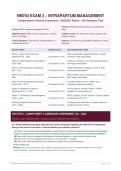
NM704 EXAM 3 – INTRAPARTUM MANAGEMENT
Comprehensive Practice Examination • 2026/2027 Edition • 200 Questions Total
Format: 200 Multiple-Choice Questions (Comprehensive
Course: NM704 Intrapartum Management (FNU) Bank)
Modules Tested: Module 6 (Labor Progression), 7 (Fetal & Cognitive Levels: 30% Recall, 50% Clinical Judgment, 20%
Pain), 8 (3rd Stage) Complex Analysis
Clinical Standards: Current ACOG / ACNM Guidelines & Features: Full Answer Keys, [CORRECT] Identifiers & Clinical
Evidence-Based Care Rationales
Domain Section Question Count Key Competencies Tested
Section 1: Labor Onset & Admission Labor onset definition, delayed admission, Leopold's
Assessment (Q1 – Q25) 25 Questions (12.5%) maneuvers, GBS triage, SROM
Section 2: Labor Progression & Management Friedman vs. Zhang (5-6 cm), OP positioning, pushing
(Q26 – Q50) 25 Questions (12.5%) techniques, laboring down
Section 3: Fetal Assessment & Monitoring ACOG FHR protocols, Category I/II/III, IA vs. EFM,
(Q51 – Q70) 20 Questions (10.0%) tachysystole, decelerations
Section 4: Pain Management in Labor (Q71 – Epidural effects, nitrous oxide protocols, continuous
Q90) 20 Questions (10.0%) labor support, sterile water
Section 5: Perineal Management & Genital Laceration degrees (1st-4th / OASIS), warm
Trauma (Q91 – Q115) 25 Questions (12.5%) compresses, episiotomy guidelines
Section 6: Amniotomy & Rupture of Ferning, nitrazine, AmniSure PAMG-1, AROM
Membranes (Q116 – Q135) 20 Questions (10.0%) prerequisites, cord prolapse risks
Section 7: Third Stage of Labor Management AMTSL, Oxytocin 10 IU IM, Schultz vs. Duncan, delayed
(Q136 – Q160) 25 Questions (12.5%) cord clamping, PPH (4 Ts)
Section 8: Integrated Clinical Scenarios 5 comprehensive case studies + complex intrapartum
(Q161 – Q200) 40 Questions (20.0%) emergencies (LAST, TOLAC)
SECTION 1: LABOR ONSET & ADMISSION ASSESSMENT (Q1 – Q25)
Definition of Labor, Delayed Admission, Anticipatory Guidance & Admission Exam Components
Q1. Which statement accurately describes the clinical consensus regarding the definition and diagnostic
timing of the onset of true labor in clinical midwifery and obstetric practice?
[A] There is no universal consensus definition for labor onset; it is clinically recognized as a retrospective diagnosis
based on regular painful uterine contractions resulting in progressive cervical effacement and dilation [CORRECT]
[B] Labor onset is an exact prospective physiological timestamp triggered by a single maternal hormone surge
[C] Labor onset can only be diagnosed once the cervix has reached 6 cm of dilation
[D] Labor onset is defined exclusively as the spontaneous rupture of the amniotic membranes
Correct Answer: [A]
Rationale: Clinical evidence and professional guidelines emphasize that labor onset is a retrospective diagnosis with no single
consensus definition, characterized by regular contractions that result in cervical change.
FNU NM704 Advanced Maternal-Newborn Nursing Practice Exam | 200 Questions Total Page 1 of 51
,NM704 Exam 3: Intrapartum Management – Comprehensive Practice (2026/2027)
Q2. According to evidence-based intrapartum care guidelines (ACOG and ACNM), what clinical outcome is
directly associated with delaying admission to the hospital or birth center until the woman is in active labor?
[A] Increased rates of neonatal intensive care unit (NICU) admissions
[B] Significantly lower rates of unnecessary medical interventions, including reduced cesarean delivery rates,
decreased synthetic oxytocin augmentation, and less epidural analgesia [CORRECT]
[C] Significantly increased risk of primary postpartum hemorrhage
[D] Higher incidence of chorioamnionitis and maternal sepsis
Correct Answer: [B]
Rationale: Evidence consistently demonstrates that triaging and supporting women at home during latent labor and delaying formal
admission until active labor reduces the cascade of interventions, including cesareans.
Q3. A nulliparous woman at 39 weeks gestation calls the birth center reporting contractions every 6 to 8
minutes lasting 35 seconds, mild in intensity. Cervical examination 2 hours ago in triage was 2 cm dilated,
50% effaced, and -2 station. What is the most appropriate evidence-based anticipatory guidance?
[A] Instruct her to report immediately for hospital admission and artificial rupture of membranes
[B] Prescribe oral terbutaline to halt contractions immediately
[C] Provide reassurance, recommend non-pharmacologic comfort measures (warm bath, hydration, light nourishment,
position changes), and encourage remaining at home until contractions are stronger, closer, and regular [CORRECT]
[D] Admit her immediately for intravenous oxytocin augmentation
Correct Answer: [C]
Rationale: Latent labor is best managed in the home environment with supportive anticipatory guidance, hydration, rest, and comfort
measures, avoiding premature admission.
Q4. When performing the initial admission assessment on a laboring patient, which prenatal laboratory result
requires immediate intrapartum antibiotic prophylaxis (IAP) to prevent early-onset neonatal sepsis?
[A] Rubella immune status
[B] Negative Hepatitis B surface antigen (HBsAg)
[C] Rh-positive blood type with negative antibody screen
[D] Positive maternal rectovaginal Group B Streptococcus (GBS) screening culture obtained at 36 to 37 weeks
gestation [CORRECT]
Correct Answer: [D]
Rationale: A positive GBS screening culture at 36 0/7 to 37 6/7 weeks mandates intrapartum antibiotic prophylaxis (typically IV Penicillin
G or Ampicillin) initiated at the time of labor onset or membrane rupture.
Q5. What is the primary clinical objective of performing Leopold's maneuvers during the initial intrapartum
admission physical examination?
[A] To determine fetal lie, presentation, presenting part, position, degree of descent/engagement, and optimal location
for auscultating the fetal heart rate [CORRECT]
[B] To estimate the precise volume of amniotic fluid index (AFI)
[C] To measure the electrical voltage of uterine contractions
[D] To diagnose maternal pelvic inlet diagonal conjugate measurements
Correct Answer: [A]
Rationale: Leopold's maneuvers systematically identify fetal lie, presentation, position, engagement, and locate the fetal back to optimize
fetal heart rate auscultation.
FNU NM704 Advanced Maternal-Newborn Nursing Practice Exam | 200 Questions Total Page 2 of 51
,NM704 Exam 3: Intrapartum Management – Comprehensive Practice (2026/2027)
Q6. During Leopold's maneuvers, the midwife palpates a soft, irregular, non-ballottable mass in the uterine
fundus, a smooth continuous resistance along the maternal left side, and a hard, round, ballottable mass
above the symphysis pubis. How should this presentation be documented?
[A] Breech presentation with fetal back on the right
[B] Cephalic (vertex) presentation with fetal back on the maternal left (Left Occiput Anterior/Transverse) [CORRECT]
[C] Transverse lie with fetal head in the left flank
[D] Face presentation with posterior mentum
Correct Answer: [B]
Rationale: A hard, round, ballottable presenting part over the symphysis pubis confirms a cephalic presentation, while the smooth
contour in the left quadrant indicates the fetal back is on the maternal left.
Q7. What is the Third Maneuver of Leopold (Pawlik's grip) specifically designed to assess during the physical
examination?
[A] The location of the fetal small parts and extremities in the lateral abdomen
[B] The presence of a fetal limb in the uterine fundus
[C] The presenting part in the lower maternal pelvis and whether it is engaged or freely movable above the pelvic brim
[CORRECT]
[D] The exact bishop score of the cervix
Correct Answer: [C]
Rationale: Pawlik's grip grasps the lower maternal abdomen above the pubic symphysis to identify the presenting part and determine
whether it is floating or engaged in the pelvic inlet.
Q8. Which of the following dietary recommendations represents the current evidence-based standard of care
for a healthy, low-risk woman in spontaneous active labor?
[A] Strict NPO (nothing by mouth) with zero fluid intake to ensure an empty stomach
[B] Mandatory continuous nasogastric tube feeding
[C] High-fat solid meals every 2 hours
[D] Nutritional intake and oral hydration according to maternal appetite ('diet as tolerated', clear fluids, light
carbohydrate snacks) [CORRECT]
Correct Answer: [D]
Rationale: ACOG and ACNM evidence-based guidelines support light food intake and clear liquids as tolerated for low-risk laboring
women, recognizing that strict NPO does not guarantee an empty stomach and increases ketosis.
Q9. A G2P1 woman at 40 weeks gestation presents to the labor unit reporting that her water broke 3 hours
ago. What are the four essential clinical characteristics of the fluid that the midwife must assess and
document immediately?
[A] Time of rupture, color, clarity/presence of meconium or blood, and odor of the amniotic fluid [CORRECT]
[B] Temperature, viscosity, glucose level, and sodium content
[C] Specific gravity, protein concentration, albumin ratio, and platelet count
[D] Volume in exact milliliters, calcium level, hematocrit, and fetal gender
Correct Answer: [A]
Rationale: Documenting the precise time of rupture, color (clear vs. meconium-stained), consistency, and odor (foul indicating
chorioamnionitis) is critical for managing infection and fetal well-being.
FNU NM704 Advanced Maternal-Newborn Nursing Practice Exam | 200 Questions Total Page 3 of 51
, NM704 Exam 3: Intrapartum Management – Comprehensive Practice (2026/2027)
Q10. Why is it clinically important to assess maternal deep tendon reflexes and check for visual disturbances
or headache during the intrapartum admission assessment?
[A] To evaluate the woman's pain tolerance threshold
[B] To screen for underlying hypertensive disorders of pregnancy and neurological irritability indicative of severe
preeclampsia [CORRECT]
[C] To determine if the patient has an active pelvic floor infection
[D] To predict the speed of second-stage descent
Correct Answer: [B]
Rationale: Hyperreflexia (3+ or 4+ reflexes with clonus), persistent headache, and scotomata are hallmark signs of neurological
excitability associated with preeclampsia with severe features.
Q11. During manual palpation of uterine contractions on admission, how does the clinician assess
contraction 'intensity' without an intrauterine pressure catheter (IUPC)?
[A] By asking the patient to rate her pain from 1 to 10
[B] By observing the height of the external tocodynamometer waveform
[C] By palpating the uterine fundus with the fingertips during the peak of a contraction: mild feels like the tip of the
nose, moderate feels like the chin, and strong feels like the forehead [CORRECT]
[D] By measuring the maternal blood pressure during each contraction
Correct Answer: [C]
Rationale: Manual fingertip palpation over the fundus grades contraction peak firmness: compressible like the nose (mild), moderately
firm like the chin (moderate), and non-indentable like the forehead (strong).
Q12. A multiparous woman arrives at triage stating, 'I feel immense rectal pressure and need to have a bowel
movement right now.' What is the midwife's immediate priority clinical action?
[A] Offer her a bedpan and leave the room to give her privacy
[B] Administer an intravenous dose of fentanyl for pain control
[C] Send a clean-catch urine specimen to the laboratory
[D] Perform an immediate sterile vaginal examination to assess for complete cervical dilation and imminent fetal
delivery [CORRECT]
Correct Answer: [D]
Rationale: An intense urge to bear down or feeling of rectal pressure in a multipara strongly suggests complete cervical dilation and low
fetal station; immediate vaginal assessment is indicated.
Q13. When taking the obstetric history during an intrapartum admission, what specific detail regarding prior
uterine surgery is critical in assessing a woman's candidacy for a Trial of Labor After Cesarean (TOLAC)?
[A] The type and location of the uterine hysterotomy scar (e.g., low transverse vs. classical/vertical or T-incision)
[CORRECT]
[B] The type of skin incision (horizontal vs. vertical)
[C] The brand of sutures used to close the abdominal fascia
[D] Whether the prior cesarean was performed under general anesthesia
Correct Answer: [A]
Rationale: The uterine scar type determines uterine rupture risk; a low transverse incision is eligible for TOLAC, whereas prior classical
or T-shaped uterine incisions carry high rupture risks and are contraindicated.
FNU NM704 Advanced Maternal-Newborn Nursing Practice Exam | 200 Questions Total Page 4 of 51
Comprehensive Practice Examination • 2026/2027 Edition • 200 Questions Total
Format: 200 Multiple-Choice Questions (Comprehensive
Course: NM704 Intrapartum Management (FNU) Bank)
Modules Tested: Module 6 (Labor Progression), 7 (Fetal & Cognitive Levels: 30% Recall, 50% Clinical Judgment, 20%
Pain), 8 (3rd Stage) Complex Analysis
Clinical Standards: Current ACOG / ACNM Guidelines & Features: Full Answer Keys, [CORRECT] Identifiers & Clinical
Evidence-Based Care Rationales
Domain Section Question Count Key Competencies Tested
Section 1: Labor Onset & Admission Labor onset definition, delayed admission, Leopold's
Assessment (Q1 – Q25) 25 Questions (12.5%) maneuvers, GBS triage, SROM
Section 2: Labor Progression & Management Friedman vs. Zhang (5-6 cm), OP positioning, pushing
(Q26 – Q50) 25 Questions (12.5%) techniques, laboring down
Section 3: Fetal Assessment & Monitoring ACOG FHR protocols, Category I/II/III, IA vs. EFM,
(Q51 – Q70) 20 Questions (10.0%) tachysystole, decelerations
Section 4: Pain Management in Labor (Q71 – Epidural effects, nitrous oxide protocols, continuous
Q90) 20 Questions (10.0%) labor support, sterile water
Section 5: Perineal Management & Genital Laceration degrees (1st-4th / OASIS), warm
Trauma (Q91 – Q115) 25 Questions (12.5%) compresses, episiotomy guidelines
Section 6: Amniotomy & Rupture of Ferning, nitrazine, AmniSure PAMG-1, AROM
Membranes (Q116 – Q135) 20 Questions (10.0%) prerequisites, cord prolapse risks
Section 7: Third Stage of Labor Management AMTSL, Oxytocin 10 IU IM, Schultz vs. Duncan, delayed
(Q136 – Q160) 25 Questions (12.5%) cord clamping, PPH (4 Ts)
Section 8: Integrated Clinical Scenarios 5 comprehensive case studies + complex intrapartum
(Q161 – Q200) 40 Questions (20.0%) emergencies (LAST, TOLAC)
SECTION 1: LABOR ONSET & ADMISSION ASSESSMENT (Q1 – Q25)
Definition of Labor, Delayed Admission, Anticipatory Guidance & Admission Exam Components
Q1. Which statement accurately describes the clinical consensus regarding the definition and diagnostic
timing of the onset of true labor in clinical midwifery and obstetric practice?
[A] There is no universal consensus definition for labor onset; it is clinically recognized as a retrospective diagnosis
based on regular painful uterine contractions resulting in progressive cervical effacement and dilation [CORRECT]
[B] Labor onset is an exact prospective physiological timestamp triggered by a single maternal hormone surge
[C] Labor onset can only be diagnosed once the cervix has reached 6 cm of dilation
[D] Labor onset is defined exclusively as the spontaneous rupture of the amniotic membranes
Correct Answer: [A]
Rationale: Clinical evidence and professional guidelines emphasize that labor onset is a retrospective diagnosis with no single
consensus definition, characterized by regular contractions that result in cervical change.
FNU NM704 Advanced Maternal-Newborn Nursing Practice Exam | 200 Questions Total Page 1 of 51
,NM704 Exam 3: Intrapartum Management – Comprehensive Practice (2026/2027)
Q2. According to evidence-based intrapartum care guidelines (ACOG and ACNM), what clinical outcome is
directly associated with delaying admission to the hospital or birth center until the woman is in active labor?
[A] Increased rates of neonatal intensive care unit (NICU) admissions
[B] Significantly lower rates of unnecessary medical interventions, including reduced cesarean delivery rates,
decreased synthetic oxytocin augmentation, and less epidural analgesia [CORRECT]
[C] Significantly increased risk of primary postpartum hemorrhage
[D] Higher incidence of chorioamnionitis and maternal sepsis
Correct Answer: [B]
Rationale: Evidence consistently demonstrates that triaging and supporting women at home during latent labor and delaying formal
admission until active labor reduces the cascade of interventions, including cesareans.
Q3. A nulliparous woman at 39 weeks gestation calls the birth center reporting contractions every 6 to 8
minutes lasting 35 seconds, mild in intensity. Cervical examination 2 hours ago in triage was 2 cm dilated,
50% effaced, and -2 station. What is the most appropriate evidence-based anticipatory guidance?
[A] Instruct her to report immediately for hospital admission and artificial rupture of membranes
[B] Prescribe oral terbutaline to halt contractions immediately
[C] Provide reassurance, recommend non-pharmacologic comfort measures (warm bath, hydration, light nourishment,
position changes), and encourage remaining at home until contractions are stronger, closer, and regular [CORRECT]
[D] Admit her immediately for intravenous oxytocin augmentation
Correct Answer: [C]
Rationale: Latent labor is best managed in the home environment with supportive anticipatory guidance, hydration, rest, and comfort
measures, avoiding premature admission.
Q4. When performing the initial admission assessment on a laboring patient, which prenatal laboratory result
requires immediate intrapartum antibiotic prophylaxis (IAP) to prevent early-onset neonatal sepsis?
[A] Rubella immune status
[B] Negative Hepatitis B surface antigen (HBsAg)
[C] Rh-positive blood type with negative antibody screen
[D] Positive maternal rectovaginal Group B Streptococcus (GBS) screening culture obtained at 36 to 37 weeks
gestation [CORRECT]
Correct Answer: [D]
Rationale: A positive GBS screening culture at 36 0/7 to 37 6/7 weeks mandates intrapartum antibiotic prophylaxis (typically IV Penicillin
G or Ampicillin) initiated at the time of labor onset or membrane rupture.
Q5. What is the primary clinical objective of performing Leopold's maneuvers during the initial intrapartum
admission physical examination?
[A] To determine fetal lie, presentation, presenting part, position, degree of descent/engagement, and optimal location
for auscultating the fetal heart rate [CORRECT]
[B] To estimate the precise volume of amniotic fluid index (AFI)
[C] To measure the electrical voltage of uterine contractions
[D] To diagnose maternal pelvic inlet diagonal conjugate measurements
Correct Answer: [A]
Rationale: Leopold's maneuvers systematically identify fetal lie, presentation, position, engagement, and locate the fetal back to optimize
fetal heart rate auscultation.
FNU NM704 Advanced Maternal-Newborn Nursing Practice Exam | 200 Questions Total Page 2 of 51
,NM704 Exam 3: Intrapartum Management – Comprehensive Practice (2026/2027)
Q6. During Leopold's maneuvers, the midwife palpates a soft, irregular, non-ballottable mass in the uterine
fundus, a smooth continuous resistance along the maternal left side, and a hard, round, ballottable mass
above the symphysis pubis. How should this presentation be documented?
[A] Breech presentation with fetal back on the right
[B] Cephalic (vertex) presentation with fetal back on the maternal left (Left Occiput Anterior/Transverse) [CORRECT]
[C] Transverse lie with fetal head in the left flank
[D] Face presentation with posterior mentum
Correct Answer: [B]
Rationale: A hard, round, ballottable presenting part over the symphysis pubis confirms a cephalic presentation, while the smooth
contour in the left quadrant indicates the fetal back is on the maternal left.
Q7. What is the Third Maneuver of Leopold (Pawlik's grip) specifically designed to assess during the physical
examination?
[A] The location of the fetal small parts and extremities in the lateral abdomen
[B] The presence of a fetal limb in the uterine fundus
[C] The presenting part in the lower maternal pelvis and whether it is engaged or freely movable above the pelvic brim
[CORRECT]
[D] The exact bishop score of the cervix
Correct Answer: [C]
Rationale: Pawlik's grip grasps the lower maternal abdomen above the pubic symphysis to identify the presenting part and determine
whether it is floating or engaged in the pelvic inlet.
Q8. Which of the following dietary recommendations represents the current evidence-based standard of care
for a healthy, low-risk woman in spontaneous active labor?
[A] Strict NPO (nothing by mouth) with zero fluid intake to ensure an empty stomach
[B] Mandatory continuous nasogastric tube feeding
[C] High-fat solid meals every 2 hours
[D] Nutritional intake and oral hydration according to maternal appetite ('diet as tolerated', clear fluids, light
carbohydrate snacks) [CORRECT]
Correct Answer: [D]
Rationale: ACOG and ACNM evidence-based guidelines support light food intake and clear liquids as tolerated for low-risk laboring
women, recognizing that strict NPO does not guarantee an empty stomach and increases ketosis.
Q9. A G2P1 woman at 40 weeks gestation presents to the labor unit reporting that her water broke 3 hours
ago. What are the four essential clinical characteristics of the fluid that the midwife must assess and
document immediately?
[A] Time of rupture, color, clarity/presence of meconium or blood, and odor of the amniotic fluid [CORRECT]
[B] Temperature, viscosity, glucose level, and sodium content
[C] Specific gravity, protein concentration, albumin ratio, and platelet count
[D] Volume in exact milliliters, calcium level, hematocrit, and fetal gender
Correct Answer: [A]
Rationale: Documenting the precise time of rupture, color (clear vs. meconium-stained), consistency, and odor (foul indicating
chorioamnionitis) is critical for managing infection and fetal well-being.
FNU NM704 Advanced Maternal-Newborn Nursing Practice Exam | 200 Questions Total Page 3 of 51
, NM704 Exam 3: Intrapartum Management – Comprehensive Practice (2026/2027)
Q10. Why is it clinically important to assess maternal deep tendon reflexes and check for visual disturbances
or headache during the intrapartum admission assessment?
[A] To evaluate the woman's pain tolerance threshold
[B] To screen for underlying hypertensive disorders of pregnancy and neurological irritability indicative of severe
preeclampsia [CORRECT]
[C] To determine if the patient has an active pelvic floor infection
[D] To predict the speed of second-stage descent
Correct Answer: [B]
Rationale: Hyperreflexia (3+ or 4+ reflexes with clonus), persistent headache, and scotomata are hallmark signs of neurological
excitability associated with preeclampsia with severe features.
Q11. During manual palpation of uterine contractions on admission, how does the clinician assess
contraction 'intensity' without an intrauterine pressure catheter (IUPC)?
[A] By asking the patient to rate her pain from 1 to 10
[B] By observing the height of the external tocodynamometer waveform
[C] By palpating the uterine fundus with the fingertips during the peak of a contraction: mild feels like the tip of the
nose, moderate feels like the chin, and strong feels like the forehead [CORRECT]
[D] By measuring the maternal blood pressure during each contraction
Correct Answer: [C]
Rationale: Manual fingertip palpation over the fundus grades contraction peak firmness: compressible like the nose (mild), moderately
firm like the chin (moderate), and non-indentable like the forehead (strong).
Q12. A multiparous woman arrives at triage stating, 'I feel immense rectal pressure and need to have a bowel
movement right now.' What is the midwife's immediate priority clinical action?
[A] Offer her a bedpan and leave the room to give her privacy
[B] Administer an intravenous dose of fentanyl for pain control
[C] Send a clean-catch urine specimen to the laboratory
[D] Perform an immediate sterile vaginal examination to assess for complete cervical dilation and imminent fetal
delivery [CORRECT]
Correct Answer: [D]
Rationale: An intense urge to bear down or feeling of rectal pressure in a multipara strongly suggests complete cervical dilation and low
fetal station; immediate vaginal assessment is indicated.
Q13. When taking the obstetric history during an intrapartum admission, what specific detail regarding prior
uterine surgery is critical in assessing a woman's candidacy for a Trial of Labor After Cesarean (TOLAC)?
[A] The type and location of the uterine hysterotomy scar (e.g., low transverse vs. classical/vertical or T-incision)
[CORRECT]
[B] The type of skin incision (horizontal vs. vertical)
[C] The brand of sutures used to close the abdominal fascia
[D] Whether the prior cesarean was performed under general anesthesia
Correct Answer: [A]
Rationale: The uterine scar type determines uterine rupture risk; a low transverse incision is eligible for TOLAC, whereas prior classical
or T-shaped uterine incisions carry high rupture risks and are contraindicated.
FNU NM704 Advanced Maternal-Newborn Nursing Practice Exam | 200 Questions Total Page 4 of 51


