

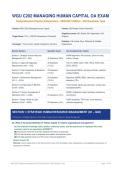
WGU C202 MANAGING HUMAN CAPITAL OA EXAM
Comprehensive Practice Examination • 2026/2027 Edition • 200 Questions Total
Course: WGU C202 Managing Human Capital Format: 200 Multiple-Choice Questions
Cognitive Levels: 30% Recall, 50% Application, 20%
Target Score: 75%+ (150/200 Competency Threshold) Analysis
Features: Full Answer Keys, Rationale & Detailed
Coverage: 7 Core Human Capital Competency Domains Explanations
Domain Section Question Count Key Competencies Tested
Section 1: Strategic Human Resource SHRM alignment, HR functions, Ulrich's 4 roles,
Management (Q1 – Q40) 40 Questions (20%) culture, change
Section 2: Legal and Regulatory 35 Questions Title VII, ADEA, ADA, FLSA, FMLA, 4/5ths Rule,
Requirements (Q41 – Q75) (17.5%) EEOC, BFOQ
Section 3: Talent Acquisition & Workforce 35 Questions Job analysis/KSAOs, recruiting methods, selection
Planning (Q76 – Q110) (17.5%) validity/reliability
Section 4: Performance Management 25 Questions Appraisals (BARS, MBO), rater bias, progressive
(Q111 – Q135) (12.5%) discipline, PIPs
Section 5: Compensation & Benefits 25 Questions Total rewards, equity, pay structures, compa-ratio,
(Q136 – Q160) (12.5%) mandated benefits
Section 6: Training, Development & ADDIE, Kirkpatrick model, Herzberg, Expectancy,
Motivation (Q161 – Q180) 20 Questions (10%) commitment
Section 7: Safety, Health & Labor OSHA standards, TIPS rules, union elections,
Relations (Q181 – Q200) 20 Questions (10%) collective bargaining
SECTION 1: STRATEGIC HUMAN RESOURCE MANAGEMENT (Q1 – Q40)
40 Questions | Strategic Alignment, Ulrich Model, Organizational Culture & Change Management
Q1. What is the formal definition of 'Human Capital' in modern organizational management?
[A] The collective knowledge, skills, abilities, intellectual assets, and life experiences of employees that create
economic value for an organization [CORRECT]
[B] The physical machinery and office equipment owned by a corporation
[C] The total monetary value of employee stock options and retirement plans
[D] The legal corporate structure of the human resources department
Correct Answer: [A]
Rationale: Human capital refers to the total economic value of the knowledge, skills, competencies, and capabilities possessed by an
organization's workforce.
WGU C202 Objective Assessment (OA) Practice Exam | 200 Questions Total Page 1 of 44
,WGU C202: Managing Human Capital OA Exam – Comprehensive Practice (2026/2027)
Q2. What is the primary overarching goal of Strategic Human Resource Management (SHRM)?
[A] To process payroll and administrative benefits at the lowest operational cost
[B] To systematically align all human resource strategies, policies, and functional practices with the long-term
strategic business goals and competitive objectives of the organization [CORRECT]
[C] To enforce strict hierarchical obedience and military discipline across all departments
[D] To eliminate the need for line managers in talent evaluation
Correct Answer: [B]
Rationale: SHRM focuses on the horizontal and vertical integration of HR practices with organizational business strategies to achieve
sustainable competitive advantage.
Q3. In Dave Ulrich's Human Resource Roles Model, which role is primarily responsible for aligning HR
strategies, initiatives, and talent capabilities directly with corporate business goals?
[A] Administrative Expert
[B] Employee Champion
[C] Strategic Partner [CORRECT]
[D] Compliance Officer
Correct Answer: [C]
Rationale: The Strategic Partner role focuses on aligning HR policies and talent strategies directly with the overarching strategic business
objectives of the enterprise.
Q4. In Dave Ulrich's HR Model, which role is responsible for leading cultural transformation, overcoming
employee resistance, and building organizational capacity for continuous adaptation?
[A] Administrative Expert
[B] Employee Advocate
[C] Payroll Controller
[D] Change Agent [CORRECT]
Correct Answer: [D]
Rationale: The Change Agent role focuses on facilitating cultural change, managing organizational transitions, and embedding change
management capabilities.
Q5. In Dave Ulrich's HR Model, which role focuses on increasing employee engagement, representing
workforce concerns to executive leadership, and boosting morale and commitment?
[A] Employee Champion (Employee Advocate) [CORRECT]
[B] Administrative Expert
[C] Strategic Partner
[D] Financial Auditor
Correct Answer: [A]
Rationale: The Employee Champion (Advocate) role ensures employee voices are heard, managing day-to-day workforce needs and
fostering high organizational commitment.
Q6. In Dave Ulrich's HR Model, which role is focused on streamlining administrative infrastructure,
automating core HR processes, and delivering efficient operational services?
[A] Change Agent
[B] Administrative Expert [CORRECT]
[C] Strategic Partner
[D] Talent Sourcing Specialist
Correct Answer: [B]
Rationale: The Administrative Expert role designs and delivers efficient HR systems, re-engineering administrative processes to
maximize cost efficiency.
WGU C202 Objective Assessment (OA) Practice Exam | 200 Questions Total Page 2 of 44
,WGU C202: Managing Human Capital OA Exam – Comprehensive Practice (2026/2027)
Q7. Which of the following is a defining characteristic of a High-Performance Work System (HPWS)?
[A] Strict top-down hierarchical control with centralized decision-making
[B] Low wages with minimal employee benefits to minimize operational costs
[C] Extensive employee training, decentralized autonomous team decision-making, transparent information sharing,
and performance-based compensation [CORRECT]
[D] Rigid, narrow job descriptions with zero cross-functional collaboration
Correct Answer: [C]
Rationale: High-Performance Work Systems leverage selective hiring, comprehensive training, decentralized self-managed teams, and
pay-for-performance to drive organizational effectiveness.
Q8. In the Balanced Scorecard framework developed by Kaplan and Norton, which perspective focuses
specifically on employee competencies, satisfaction, retention, and corporate learning?
[A] Financial Perspective
[B] Customer Perspective
[C] Internal Business Process Perspective
[D] Learning and Growth Perspective [CORRECT]
Correct Answer: [D]
Rationale: The Learning and Growth perspective tracks human capital metrics, employee engagement, training effectiveness, and
institutional knowledge creation.
Q9. What is the definition of 'Organizational Culture' in human capital management?
[A] The shared values, beliefs, norms, assumptions, and behavioral patterns that guide how organizational members
interact, make decisions, and execute work [CORRECT]
[B] The legal bylaws filed with the state department of commerce
[C] The physical architectural layout of the corporate headquarters
[D] The formal organizational chart depicting reporting hierarchies
Correct Answer: [A]
Rationale: Organizational culture represents the shared underlying values, assumptions, and unwritten social norms that dictate
organizational behavior and climate.
Q10. How does 'Person-Organization (P-O) Fit' differ from 'Person-Job (P-J) Fit' during candidate evaluation?
[A] P-O fit evaluates technical coding ability; P-J fit evaluates credit history
[B] P-O fit evaluates the alignment between a candidate's personal values, personality, and the company's culture; P-J
fit assesses whether the candidate possesses the specific KSAOs required for the functional job duties [CORRECT]
[C] P-O fit applies only to executives; P-J fit applies only to hourly workers
[D] There is no difference between P-O and P-J fit
Correct Answer: [B]
Rationale: P-O fit matches an individual's core values and ethics with organizational culture, whereas P-J fit matches technical skills and
abilities with specific job specifications.
Q11. According to Michael Porter's generic business strategies, what HR strategy is most appropriate for a
firm pursuing a 'Cost Leadership' strategy?
[A] Investing heavily in experimental R&D; teams and decentralized creative autonomy
[B] Offering the highest base salaries in the industry regardless of market rates
[C] Designing standardized, highly efficient workflows, implementing cross-training for productivity, and focusing on
cost-effective talent acquisition and operational efficiency [CORRECT]
[D] Eliminating all performance appraisals
Correct Answer: [C]
Rationale: Cost leadership demands operational efficiency, standardized processes, cost control, and productivity-focused workforce
management.
WGU C202 Objective Assessment (OA) Practice Exam | 200 Questions Total Page 3 of 44
, WGU C202: Managing Human Capital OA Exam – Comprehensive Practice (2026/2027)
Q12. What HR strategy is most appropriate for an organization pursuing a 'Differentiation' business strategy
focused on product innovation and premium customer experiences?
[A] Standardizing jobs to repetitive, narrow assembly-line tasks
[B] Minimizing all employee training budgets
[C] Enforcing strict piece-rate compensation
[D] Recruiting highly creative, specialized talent, fostering broad skill development, rewarding innovation and
risk-taking, and encouraging collaborative teamwork [CORRECT]
Correct Answer: [D]
Rationale: A differentiation strategy requires flexible, innovative talent supported by long-term skill development, broad job designs, and
rewards for creative problem-solving.
Q13. What role does HR play when acting as an 'Internal Consultant' to department line managers?
[A] Providing diagnostic expertise, advising on organizational design, coaching leaders on performance issues, and
recommending evidence-based talent interventions [CORRECT]
[B] Taking over all operational management duties and managing daily customer orders
[C] Enforcing criminal penalties on underperforming staff
[D] Approving commercial banking loans for the finance department
Correct Answer: [A]
Rationale: As internal consultants, HR professionals collaborate with operational leaders to diagnose workflow issues, enhance team
dynamics, and implement human capital solutions.
Q14. How can human capital create a 'Sustainable Competitive Advantage' under the VRIO framework?
[A] By purchasing commercial off-the-shelf software available to all competitors
[B] When the workforce's collective capabilities are Valuable, Rare, Inimitable (difficult to copy), and Organized to
capture value [CORRECT]
[C] By outsourcing all core business functions to third-party offshore agencies
[D] By hiring only temporary contract workers
Correct Answer: [B]
Rationale: Under the VRIO framework, human capital generates sustained competitive advantage when employee skills are valuable,
scarce, hard to replicate, and effectively organized.
Q15. What is the primary function of an HR 'SWOT Analysis' during the strategic workforce planning
process?
[A] To audit employee expense reports for tax deductions
[B] To evaluate the mechanical safety of warehouse forklifts
[C] To identify internal HR Strengths and Weaknesses while evaluating external environmental Opportunities and
Threats affecting talent supply and labor markets [CORRECT]
[D] To conduct background credit checks on all job applicants
Correct Answer: [C]
Rationale: A SWOT analysis evaluates internal workforce capabilities (strengths/weaknesses) against external labor market dynamics,
economic trends, and competitor actions (opportunities/threats).
WGU C202 Objective Assessment (OA) Practice Exam | 200 Questions Total Page 4 of 44
Comprehensive Practice Examination • 2026/2027 Edition • 200 Questions Total
Course: WGU C202 Managing Human Capital Format: 200 Multiple-Choice Questions
Cognitive Levels: 30% Recall, 50% Application, 20%
Target Score: 75%+ (150/200 Competency Threshold) Analysis
Features: Full Answer Keys, Rationale & Detailed
Coverage: 7 Core Human Capital Competency Domains Explanations
Domain Section Question Count Key Competencies Tested
Section 1: Strategic Human Resource SHRM alignment, HR functions, Ulrich's 4 roles,
Management (Q1 – Q40) 40 Questions (20%) culture, change
Section 2: Legal and Regulatory 35 Questions Title VII, ADEA, ADA, FLSA, FMLA, 4/5ths Rule,
Requirements (Q41 – Q75) (17.5%) EEOC, BFOQ
Section 3: Talent Acquisition & Workforce 35 Questions Job analysis/KSAOs, recruiting methods, selection
Planning (Q76 – Q110) (17.5%) validity/reliability
Section 4: Performance Management 25 Questions Appraisals (BARS, MBO), rater bias, progressive
(Q111 – Q135) (12.5%) discipline, PIPs
Section 5: Compensation & Benefits 25 Questions Total rewards, equity, pay structures, compa-ratio,
(Q136 – Q160) (12.5%) mandated benefits
Section 6: Training, Development & ADDIE, Kirkpatrick model, Herzberg, Expectancy,
Motivation (Q161 – Q180) 20 Questions (10%) commitment
Section 7: Safety, Health & Labor OSHA standards, TIPS rules, union elections,
Relations (Q181 – Q200) 20 Questions (10%) collective bargaining
SECTION 1: STRATEGIC HUMAN RESOURCE MANAGEMENT (Q1 – Q40)
40 Questions | Strategic Alignment, Ulrich Model, Organizational Culture & Change Management
Q1. What is the formal definition of 'Human Capital' in modern organizational management?
[A] The collective knowledge, skills, abilities, intellectual assets, and life experiences of employees that create
economic value for an organization [CORRECT]
[B] The physical machinery and office equipment owned by a corporation
[C] The total monetary value of employee stock options and retirement plans
[D] The legal corporate structure of the human resources department
Correct Answer: [A]
Rationale: Human capital refers to the total economic value of the knowledge, skills, competencies, and capabilities possessed by an
organization's workforce.
WGU C202 Objective Assessment (OA) Practice Exam | 200 Questions Total Page 1 of 44
,WGU C202: Managing Human Capital OA Exam – Comprehensive Practice (2026/2027)
Q2. What is the primary overarching goal of Strategic Human Resource Management (SHRM)?
[A] To process payroll and administrative benefits at the lowest operational cost
[B] To systematically align all human resource strategies, policies, and functional practices with the long-term
strategic business goals and competitive objectives of the organization [CORRECT]
[C] To enforce strict hierarchical obedience and military discipline across all departments
[D] To eliminate the need for line managers in talent evaluation
Correct Answer: [B]
Rationale: SHRM focuses on the horizontal and vertical integration of HR practices with organizational business strategies to achieve
sustainable competitive advantage.
Q3. In Dave Ulrich's Human Resource Roles Model, which role is primarily responsible for aligning HR
strategies, initiatives, and talent capabilities directly with corporate business goals?
[A] Administrative Expert
[B] Employee Champion
[C] Strategic Partner [CORRECT]
[D] Compliance Officer
Correct Answer: [C]
Rationale: The Strategic Partner role focuses on aligning HR policies and talent strategies directly with the overarching strategic business
objectives of the enterprise.
Q4. In Dave Ulrich's HR Model, which role is responsible for leading cultural transformation, overcoming
employee resistance, and building organizational capacity for continuous adaptation?
[A] Administrative Expert
[B] Employee Advocate
[C] Payroll Controller
[D] Change Agent [CORRECT]
Correct Answer: [D]
Rationale: The Change Agent role focuses on facilitating cultural change, managing organizational transitions, and embedding change
management capabilities.
Q5. In Dave Ulrich's HR Model, which role focuses on increasing employee engagement, representing
workforce concerns to executive leadership, and boosting morale and commitment?
[A] Employee Champion (Employee Advocate) [CORRECT]
[B] Administrative Expert
[C] Strategic Partner
[D] Financial Auditor
Correct Answer: [A]
Rationale: The Employee Champion (Advocate) role ensures employee voices are heard, managing day-to-day workforce needs and
fostering high organizational commitment.
Q6. In Dave Ulrich's HR Model, which role is focused on streamlining administrative infrastructure,
automating core HR processes, and delivering efficient operational services?
[A] Change Agent
[B] Administrative Expert [CORRECT]
[C] Strategic Partner
[D] Talent Sourcing Specialist
Correct Answer: [B]
Rationale: The Administrative Expert role designs and delivers efficient HR systems, re-engineering administrative processes to
maximize cost efficiency.
WGU C202 Objective Assessment (OA) Practice Exam | 200 Questions Total Page 2 of 44
,WGU C202: Managing Human Capital OA Exam – Comprehensive Practice (2026/2027)
Q7. Which of the following is a defining characteristic of a High-Performance Work System (HPWS)?
[A] Strict top-down hierarchical control with centralized decision-making
[B] Low wages with minimal employee benefits to minimize operational costs
[C] Extensive employee training, decentralized autonomous team decision-making, transparent information sharing,
and performance-based compensation [CORRECT]
[D] Rigid, narrow job descriptions with zero cross-functional collaboration
Correct Answer: [C]
Rationale: High-Performance Work Systems leverage selective hiring, comprehensive training, decentralized self-managed teams, and
pay-for-performance to drive organizational effectiveness.
Q8. In the Balanced Scorecard framework developed by Kaplan and Norton, which perspective focuses
specifically on employee competencies, satisfaction, retention, and corporate learning?
[A] Financial Perspective
[B] Customer Perspective
[C] Internal Business Process Perspective
[D] Learning and Growth Perspective [CORRECT]
Correct Answer: [D]
Rationale: The Learning and Growth perspective tracks human capital metrics, employee engagement, training effectiveness, and
institutional knowledge creation.
Q9. What is the definition of 'Organizational Culture' in human capital management?
[A] The shared values, beliefs, norms, assumptions, and behavioral patterns that guide how organizational members
interact, make decisions, and execute work [CORRECT]
[B] The legal bylaws filed with the state department of commerce
[C] The physical architectural layout of the corporate headquarters
[D] The formal organizational chart depicting reporting hierarchies
Correct Answer: [A]
Rationale: Organizational culture represents the shared underlying values, assumptions, and unwritten social norms that dictate
organizational behavior and climate.
Q10. How does 'Person-Organization (P-O) Fit' differ from 'Person-Job (P-J) Fit' during candidate evaluation?
[A] P-O fit evaluates technical coding ability; P-J fit evaluates credit history
[B] P-O fit evaluates the alignment between a candidate's personal values, personality, and the company's culture; P-J
fit assesses whether the candidate possesses the specific KSAOs required for the functional job duties [CORRECT]
[C] P-O fit applies only to executives; P-J fit applies only to hourly workers
[D] There is no difference between P-O and P-J fit
Correct Answer: [B]
Rationale: P-O fit matches an individual's core values and ethics with organizational culture, whereas P-J fit matches technical skills and
abilities with specific job specifications.
Q11. According to Michael Porter's generic business strategies, what HR strategy is most appropriate for a
firm pursuing a 'Cost Leadership' strategy?
[A] Investing heavily in experimental R&D; teams and decentralized creative autonomy
[B] Offering the highest base salaries in the industry regardless of market rates
[C] Designing standardized, highly efficient workflows, implementing cross-training for productivity, and focusing on
cost-effective talent acquisition and operational efficiency [CORRECT]
[D] Eliminating all performance appraisals
Correct Answer: [C]
Rationale: Cost leadership demands operational efficiency, standardized processes, cost control, and productivity-focused workforce
management.
WGU C202 Objective Assessment (OA) Practice Exam | 200 Questions Total Page 3 of 44
, WGU C202: Managing Human Capital OA Exam – Comprehensive Practice (2026/2027)
Q12. What HR strategy is most appropriate for an organization pursuing a 'Differentiation' business strategy
focused on product innovation and premium customer experiences?
[A] Standardizing jobs to repetitive, narrow assembly-line tasks
[B] Minimizing all employee training budgets
[C] Enforcing strict piece-rate compensation
[D] Recruiting highly creative, specialized talent, fostering broad skill development, rewarding innovation and
risk-taking, and encouraging collaborative teamwork [CORRECT]
Correct Answer: [D]
Rationale: A differentiation strategy requires flexible, innovative talent supported by long-term skill development, broad job designs, and
rewards for creative problem-solving.
Q13. What role does HR play when acting as an 'Internal Consultant' to department line managers?
[A] Providing diagnostic expertise, advising on organizational design, coaching leaders on performance issues, and
recommending evidence-based talent interventions [CORRECT]
[B] Taking over all operational management duties and managing daily customer orders
[C] Enforcing criminal penalties on underperforming staff
[D] Approving commercial banking loans for the finance department
Correct Answer: [A]
Rationale: As internal consultants, HR professionals collaborate with operational leaders to diagnose workflow issues, enhance team
dynamics, and implement human capital solutions.
Q14. How can human capital create a 'Sustainable Competitive Advantage' under the VRIO framework?
[A] By purchasing commercial off-the-shelf software available to all competitors
[B] When the workforce's collective capabilities are Valuable, Rare, Inimitable (difficult to copy), and Organized to
capture value [CORRECT]
[C] By outsourcing all core business functions to third-party offshore agencies
[D] By hiring only temporary contract workers
Correct Answer: [B]
Rationale: Under the VRIO framework, human capital generates sustained competitive advantage when employee skills are valuable,
scarce, hard to replicate, and effectively organized.
Q15. What is the primary function of an HR 'SWOT Analysis' during the strategic workforce planning
process?
[A] To audit employee expense reports for tax deductions
[B] To evaluate the mechanical safety of warehouse forklifts
[C] To identify internal HR Strengths and Weaknesses while evaluating external environmental Opportunities and
Threats affecting talent supply and labor markets [CORRECT]
[D] To conduct background credit checks on all job applicants
Correct Answer: [C]
Rationale: A SWOT analysis evaluates internal workforce capabilities (strengths/weaknesses) against external labor market dynamics,
economic trends, and competitor actions (opportunities/threats).
WGU C202 Objective Assessment (OA) Practice Exam | 200 Questions Total Page 4 of 44


