

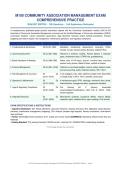
M100 COMMUNITY ASSOCIATION MANAGEMENT EXAM
COMPREHENSIVE PRACTICE
2026/2027 EDITION • 200 Questions • Full Explanatory Rationales
A comprehensive, publication-grade practice examination aligned with the Community Associations Institute (CAI) M-100
Essentials of Community Association Management curriculum and the Certified Manager of Community Associations (CMCA)
examination blueprint. Covers association governance, legal document hierarchy, board meeting procedures, financial
budgeting and reserve studies, risk management, maintenance operations, and regulatory compliance.
Exam Domain Section Questions Core Subject Matter & Management Competencies
1. Fundamentals & Governance 30 Qs (Q1–Q30) Mandatory membership, assessments, covenants, HOAs,
Condos, Co-ops, fiduciary duties, Business Judgment Rule
2. Governing Documents 35 Qs (Q31–Q65) Hierarchy of authority, CC&Rs;, Articles, Bylaws, 4 resolution
types, amendment votes, OTARD rule, grandfathering
3. Board Operations & Meetings 25 Qs (Q66–Q90) Notice rules (10–30 days), quorum, sunshine laws, executive
session limits, proxies, Robert's Rules, conflicts of interest
4. Financial Management 30 Qs (Q91–Q120) Historical vs zero-base budgets, reserve studies, balance sheet,
accrual accounting, audits, collection policies, IRS 1120-H
5. Risk Management & Insurance 20 Qs 4 risk strategies, CGL, D&O; (defense outside limits), Bare Walls
(Q121–Q140) vs Single Entity vs All-In, HO-6, umbrella, coinsurance
6. Operations & Maintenance 20 Qs 4 maintenance types, RFPs, retainage, mechanic's liens, bonds,
(Q141–Q160) indemnification, management plans, progressive discipline
7. Legal & Regulatory Compliance 20 Qs Fair Housing Act (7 classes), reasonable
(Q161–Q180) accommodations/modifications, ADA Title III, EEOC, FLSA,
record inspection
8. Integrated Scenarios 20 Qs Multi-domain synthesis: procedural defects, reserve liability,
(Q181–Q200) inspection rights, kickback ethics, open meetings, FHA animals
EXAM SPECIFICATIONS & INSTRUCTIONS
• Cognitive Distribution: 30% Recall (definitions, document hierarchy, statutory formulas), 50% Application (board decision
scenarios, maintenance management, budgeting), 20% Analysis (complex legal disputes, fiduciary evaluations, multi-domain
case synthesis).
• Format: 200 Multiple-Choice Questions (A–D, exactly one correct marked [CORRECT]) followed by official Answer Key and
Rationale.
• Passing Standard: 70% passing threshold (140/200 correct), matching CAI / CAMICB CMCA credentialing standards.
Turn the page to begin the examination.
M-100 Community Association Management & CMCA Examination (2026/2027 Edition) | Page 1
,Section 1: Community Association Fundamentals & Governance – Key Characteristics,
Types of Associations, Board Fiduciary Duties (30 questions)
Mandatory membership, lien-based assessments, covenants running with the land, planned communities (HOAs),
condominiums (airspace + undivided interest), cooperatives (stock + proprietary lease), fiduciary duties (care, loyalty,
obedience), business judgment rule, and master associations.
Q1: What are the three core legal characteristics common to ALL residential community associations?
A. Mandatory membership for all property owners, mandatory lien-based assessments to fund operations and
maintenance, and binding governing documents that run with the land [CORRECT]
B. Voluntary membership, optional monthly donations, and municipal zoning control
C. State ownership of land, elected city council management, and commercial retail requirements
D. Annual renewable lease agreements, corporate tenant voting rights, and federal property tax exemptions
Correct Answer: A
Rationale: All community associations require mandatory owner membership, mandatory lien-based assessments, and binding
recorded covenants running with the land.
Q2: How is real property ownership structured in a standard Planned Community (Homeowners Association /
HOA)?
A. The owner owns shares in a cooperative corporation and holds a proprietary lease
B. The owner owns their individual lot and home in fee simple, while the association owns the common areas and
amenities [CORRECT]
C. The owner owns their unit airspace plus an undivided percentage interest in the common elements
D. The local municipality owns all residential lots and leases them to homeowners
Correct Answer: B
Rationale: In a planned community, individual owners hold fee simple title to their lot and dwelling, and the association as a
corporate entity holds title to the common property.
Q3: How does property ownership in a Condominium differ fundamentally from that in a Planned Community?
A. Condominium owners hold no legal deed to any real property
B. Condominium owners lease their units directly from the state housing authority
C. A condominium owner holds exclusive fee title to their individual unit interior airspace plus an undivided fractional
interest in the common elements as a tenant in common [CORRECT]
D. The condominium association owns the unit interiors, while owners own the roofs and exterior siding
Correct Answer: C
Rationale: Condominium ownership consists of separate ownership of individual unit airspace combined with an undivided
percentage ownership of shared common elements.
Q4: In a Housing Cooperative (Co-op), what does an individual purchaser legally acquire?
A. Fee simple title to a specific lot and residential building
B. An undivided percentage interest in common elements only
C. A standard commercial sub-lease from a municipal housing authority
D. Shares of stock or membership certificate in a corporation that owns all real estate, accompanied by a proprietary
lease or occupancy agreement for a specific unit [CORRECT]
Correct Answer: D
Rationale: In a housing cooperative, the corporation owns the real property, and members purchase corporate stock granting
them a proprietary lease for their individual unit.
Q5: What is the primary legal definition and scope of the 'Duty of Care' owed by a community association board
member?
A. The obligation to exercise the degree of skill, prudence, diligence, and reasonable inquiry that an ordinarily
prudent person in a like position would exercise under similar circumstances [CORRECT]
M-100 Community Association Management & CMCA Examination (2026/2027 Edition) | Page 2
, B. A guarantee that all association investments will yield a profit
C. A requirement to follow every instruction given by individual homeowners
D. An obligation to provide 24-hour personal surveillance of common areas
Correct Answer: A
Rationale: The Duty of Care requires directors to make informed, diligent, and prudent business decisions in good faith, often
utilizing professional advisors when appropriate.
Q6: What constitutes a breach of the fiduciary 'Duty of Loyalty' by a community association board member?
A. Voting to raise monthly assessments to adequately fund the reserve account
B. Voting to award an association roof repair contract to a company owned by the board member's spouse without
disclosing the conflict of interest or recusing themselves [CORRECT]
C. Hiring an independent certified public accountant to audit financial records
D. Enforcing architectural guidelines uniformly against all homeowners
Correct Answer: B
Rationale: The Duty of Loyalty requires directors to act solely in the best interests of the association, prohibiting undisclosed
self-dealing, kickbacks, or personal financial conflicts.
Q7: What does the fiduciary 'Duty of Obedience' require of community association directors?
A. Blind adherence to whatever the association's management company suggests
B. Executing every resident petition regardless of legality
C. Complying with and enforcing all applicable federal, state, and local statutes, as well as remaining faithful to the
association's governing documents [CORRECT]
D. Voting unanimously on all board motions
Correct Answer: C
Rationale: The Duty of Obedience mandates that directors act within the scope of authority granted by governing documents and
adhere to all governing laws and corporate purposes.
Q8: What protection does the 'Business Judgment Rule' provide to community association board members?
A. Complete absolute immunity from criminal prosecution under all circumstances
B. Automatic reimbursement of personal legal defense costs in cases of willful fraud or embezzlement
C. The power to unilaterally modify the Declaration without an owner vote
D. Protection from personal liability for business decisions made in good faith, with reasonable care, within their
authorized powers, and with the honest belief that the action serves the association's best interests [CORRECT]
Correct Answer: D
Rationale: The Business Judgment Rule shields volunteer directors from personal liability for honest, informed business errors
made in good faith within the scope of their authority.
Q9: What is an 'Ultra Vires' act in the context of community association board governance?
A. An action or contract entered into by the board of directors that exceeds the legal scope of powers and authority
granted to the association by law or its governing documents [CORRECT]
B. A routine administrative action authorized by the bylaws
C. A special assessment approved unanimously by all property owners
D. A standard maintenance contract approved during an open board meeting
Correct Answer: A
Rationale: Ultra Vires refers to actions taken beyond the legal authority or power granted to the board by the association's
governing documents or state corporate statutes.
Q10: What is the overarching primary purpose of a community association as recognized by the Community
Associations Institute (CAI)?
A. To maximize corporate profits for third-party property management companies
B. To preserve, protect, and enhance property values, maintain common property, and foster a harmonious
residential community [CORRECT]
M-100 Community Association Management & CMCA Examination (2026/2027 Edition) | Page 3
, C. To eliminate all municipal property taxation for resident homeowners
D. To operate as a sovereign municipal police department
Correct Answer: B
Rationale: The core mission of a community association is to maintain common assets, preserve and enhance property values,
and promote community harmony.
Q11: What is a 'Master Association' (or Umbrella Association) in large-scale residential developments?
A. A single-family HOA that manages adjacent commercial shopping malls
B. A federal agency that regulates condominium insurance policies
C. An overarching community association that governs and maintains major shared infrastructure (e.g. main
boulevards, security gates, lakes) across multiple sub-associations [CORRECT]
D. A temporary association that dissolves once 50% of homes are sold
Correct Answer: C
Rationale: Master associations govern large, multi-neighborhood developments, overseeing shared amenities and master
infrastructure across several distinct sub-associations.
Q12: In a mixed-use community association, what property types are typically integrated under common
governance?
A. Residential units combined with commercial, retail, or office spaces sharing common structural elements or grounds
B. State parks combined with federal military reservations
C. Public airports combined with single-family residential homes
D. Farmland combined exclusively with industrial manufacturing plants [CORRECT]
Correct Answer: D
Rationale: Mixed-use associations combine residential living spaces with commercial or retail operations, requiring specialized
cost-allocation and governance rules.
Q13: Under the Housing for Older Persons Act (HOPA), what is the primary qualification for an 'Age-Restricted
(55+)' community exemption from familial status discrimination?
A. At least 80% of the occupied units must have at least one permanent resident who is 55 years of age or older, and
the association must adhere to published age-verification policies [CORRECT]
B. 100% of all residents must be over the age of 65
C. Children under 18 are prohibited from ever visiting the community
D. The association must be owned and operated by the federal government
Correct Answer: A
Rationale: HOPA requires that at least 80% of occupied units contain at least one person aged 55 or older, supported by formal
age-verification procedures and published policies.
Q14: What is the legal status of an incorporated community association in most states?
A. A municipal government body with criminal arrest powers
B. A non-profit (or not-for-profit) corporation formed under the state's non-profit corporate code [CORRECT]
C. A general commercial partnership with joint unlimited liability among all residents
D. A federal charitable foundation exempt from all state laws
Correct Answer: B
Rationale: Most community associations are incorporated as not-for-profit corporations under state corporate law, providing
corporate structure, bylaws, and limited liability.
Q15: Who is ultimately responsible for the overall governance, financial integrity, and policy enforcement of a
community association?
A. The professional community association manager
B. The developer's sales team
C. The elected Board of Directors [CORRECT]
M-100 Community Association Management & CMCA Examination (2026/2027 Edition) | Page 4
COMPREHENSIVE PRACTICE
2026/2027 EDITION • 200 Questions • Full Explanatory Rationales
A comprehensive, publication-grade practice examination aligned with the Community Associations Institute (CAI) M-100
Essentials of Community Association Management curriculum and the Certified Manager of Community Associations (CMCA)
examination blueprint. Covers association governance, legal document hierarchy, board meeting procedures, financial
budgeting and reserve studies, risk management, maintenance operations, and regulatory compliance.
Exam Domain Section Questions Core Subject Matter & Management Competencies
1. Fundamentals & Governance 30 Qs (Q1–Q30) Mandatory membership, assessments, covenants, HOAs,
Condos, Co-ops, fiduciary duties, Business Judgment Rule
2. Governing Documents 35 Qs (Q31–Q65) Hierarchy of authority, CC&Rs;, Articles, Bylaws, 4 resolution
types, amendment votes, OTARD rule, grandfathering
3. Board Operations & Meetings 25 Qs (Q66–Q90) Notice rules (10–30 days), quorum, sunshine laws, executive
session limits, proxies, Robert's Rules, conflicts of interest
4. Financial Management 30 Qs (Q91–Q120) Historical vs zero-base budgets, reserve studies, balance sheet,
accrual accounting, audits, collection policies, IRS 1120-H
5. Risk Management & Insurance 20 Qs 4 risk strategies, CGL, D&O; (defense outside limits), Bare Walls
(Q121–Q140) vs Single Entity vs All-In, HO-6, umbrella, coinsurance
6. Operations & Maintenance 20 Qs 4 maintenance types, RFPs, retainage, mechanic's liens, bonds,
(Q141–Q160) indemnification, management plans, progressive discipline
7. Legal & Regulatory Compliance 20 Qs Fair Housing Act (7 classes), reasonable
(Q161–Q180) accommodations/modifications, ADA Title III, EEOC, FLSA,
record inspection
8. Integrated Scenarios 20 Qs Multi-domain synthesis: procedural defects, reserve liability,
(Q181–Q200) inspection rights, kickback ethics, open meetings, FHA animals
EXAM SPECIFICATIONS & INSTRUCTIONS
• Cognitive Distribution: 30% Recall (definitions, document hierarchy, statutory formulas), 50% Application (board decision
scenarios, maintenance management, budgeting), 20% Analysis (complex legal disputes, fiduciary evaluations, multi-domain
case synthesis).
• Format: 200 Multiple-Choice Questions (A–D, exactly one correct marked [CORRECT]) followed by official Answer Key and
Rationale.
• Passing Standard: 70% passing threshold (140/200 correct), matching CAI / CAMICB CMCA credentialing standards.
Turn the page to begin the examination.
M-100 Community Association Management & CMCA Examination (2026/2027 Edition) | Page 1
,Section 1: Community Association Fundamentals & Governance – Key Characteristics,
Types of Associations, Board Fiduciary Duties (30 questions)
Mandatory membership, lien-based assessments, covenants running with the land, planned communities (HOAs),
condominiums (airspace + undivided interest), cooperatives (stock + proprietary lease), fiduciary duties (care, loyalty,
obedience), business judgment rule, and master associations.
Q1: What are the three core legal characteristics common to ALL residential community associations?
A. Mandatory membership for all property owners, mandatory lien-based assessments to fund operations and
maintenance, and binding governing documents that run with the land [CORRECT]
B. Voluntary membership, optional monthly donations, and municipal zoning control
C. State ownership of land, elected city council management, and commercial retail requirements
D. Annual renewable lease agreements, corporate tenant voting rights, and federal property tax exemptions
Correct Answer: A
Rationale: All community associations require mandatory owner membership, mandatory lien-based assessments, and binding
recorded covenants running with the land.
Q2: How is real property ownership structured in a standard Planned Community (Homeowners Association /
HOA)?
A. The owner owns shares in a cooperative corporation and holds a proprietary lease
B. The owner owns their individual lot and home in fee simple, while the association owns the common areas and
amenities [CORRECT]
C. The owner owns their unit airspace plus an undivided percentage interest in the common elements
D. The local municipality owns all residential lots and leases them to homeowners
Correct Answer: B
Rationale: In a planned community, individual owners hold fee simple title to their lot and dwelling, and the association as a
corporate entity holds title to the common property.
Q3: How does property ownership in a Condominium differ fundamentally from that in a Planned Community?
A. Condominium owners hold no legal deed to any real property
B. Condominium owners lease their units directly from the state housing authority
C. A condominium owner holds exclusive fee title to their individual unit interior airspace plus an undivided fractional
interest in the common elements as a tenant in common [CORRECT]
D. The condominium association owns the unit interiors, while owners own the roofs and exterior siding
Correct Answer: C
Rationale: Condominium ownership consists of separate ownership of individual unit airspace combined with an undivided
percentage ownership of shared common elements.
Q4: In a Housing Cooperative (Co-op), what does an individual purchaser legally acquire?
A. Fee simple title to a specific lot and residential building
B. An undivided percentage interest in common elements only
C. A standard commercial sub-lease from a municipal housing authority
D. Shares of stock or membership certificate in a corporation that owns all real estate, accompanied by a proprietary
lease or occupancy agreement for a specific unit [CORRECT]
Correct Answer: D
Rationale: In a housing cooperative, the corporation owns the real property, and members purchase corporate stock granting
them a proprietary lease for their individual unit.
Q5: What is the primary legal definition and scope of the 'Duty of Care' owed by a community association board
member?
A. The obligation to exercise the degree of skill, prudence, diligence, and reasonable inquiry that an ordinarily
prudent person in a like position would exercise under similar circumstances [CORRECT]
M-100 Community Association Management & CMCA Examination (2026/2027 Edition) | Page 2
, B. A guarantee that all association investments will yield a profit
C. A requirement to follow every instruction given by individual homeowners
D. An obligation to provide 24-hour personal surveillance of common areas
Correct Answer: A
Rationale: The Duty of Care requires directors to make informed, diligent, and prudent business decisions in good faith, often
utilizing professional advisors when appropriate.
Q6: What constitutes a breach of the fiduciary 'Duty of Loyalty' by a community association board member?
A. Voting to raise monthly assessments to adequately fund the reserve account
B. Voting to award an association roof repair contract to a company owned by the board member's spouse without
disclosing the conflict of interest or recusing themselves [CORRECT]
C. Hiring an independent certified public accountant to audit financial records
D. Enforcing architectural guidelines uniformly against all homeowners
Correct Answer: B
Rationale: The Duty of Loyalty requires directors to act solely in the best interests of the association, prohibiting undisclosed
self-dealing, kickbacks, or personal financial conflicts.
Q7: What does the fiduciary 'Duty of Obedience' require of community association directors?
A. Blind adherence to whatever the association's management company suggests
B. Executing every resident petition regardless of legality
C. Complying with and enforcing all applicable federal, state, and local statutes, as well as remaining faithful to the
association's governing documents [CORRECT]
D. Voting unanimously on all board motions
Correct Answer: C
Rationale: The Duty of Obedience mandates that directors act within the scope of authority granted by governing documents and
adhere to all governing laws and corporate purposes.
Q8: What protection does the 'Business Judgment Rule' provide to community association board members?
A. Complete absolute immunity from criminal prosecution under all circumstances
B. Automatic reimbursement of personal legal defense costs in cases of willful fraud or embezzlement
C. The power to unilaterally modify the Declaration without an owner vote
D. Protection from personal liability for business decisions made in good faith, with reasonable care, within their
authorized powers, and with the honest belief that the action serves the association's best interests [CORRECT]
Correct Answer: D
Rationale: The Business Judgment Rule shields volunteer directors from personal liability for honest, informed business errors
made in good faith within the scope of their authority.
Q9: What is an 'Ultra Vires' act in the context of community association board governance?
A. An action or contract entered into by the board of directors that exceeds the legal scope of powers and authority
granted to the association by law or its governing documents [CORRECT]
B. A routine administrative action authorized by the bylaws
C. A special assessment approved unanimously by all property owners
D. A standard maintenance contract approved during an open board meeting
Correct Answer: A
Rationale: Ultra Vires refers to actions taken beyond the legal authority or power granted to the board by the association's
governing documents or state corporate statutes.
Q10: What is the overarching primary purpose of a community association as recognized by the Community
Associations Institute (CAI)?
A. To maximize corporate profits for third-party property management companies
B. To preserve, protect, and enhance property values, maintain common property, and foster a harmonious
residential community [CORRECT]
M-100 Community Association Management & CMCA Examination (2026/2027 Edition) | Page 3
, C. To eliminate all municipal property taxation for resident homeowners
D. To operate as a sovereign municipal police department
Correct Answer: B
Rationale: The core mission of a community association is to maintain common assets, preserve and enhance property values,
and promote community harmony.
Q11: What is a 'Master Association' (or Umbrella Association) in large-scale residential developments?
A. A single-family HOA that manages adjacent commercial shopping malls
B. A federal agency that regulates condominium insurance policies
C. An overarching community association that governs and maintains major shared infrastructure (e.g. main
boulevards, security gates, lakes) across multiple sub-associations [CORRECT]
D. A temporary association that dissolves once 50% of homes are sold
Correct Answer: C
Rationale: Master associations govern large, multi-neighborhood developments, overseeing shared amenities and master
infrastructure across several distinct sub-associations.
Q12: In a mixed-use community association, what property types are typically integrated under common
governance?
A. Residential units combined with commercial, retail, or office spaces sharing common structural elements or grounds
B. State parks combined with federal military reservations
C. Public airports combined with single-family residential homes
D. Farmland combined exclusively with industrial manufacturing plants [CORRECT]
Correct Answer: D
Rationale: Mixed-use associations combine residential living spaces with commercial or retail operations, requiring specialized
cost-allocation and governance rules.
Q13: Under the Housing for Older Persons Act (HOPA), what is the primary qualification for an 'Age-Restricted
(55+)' community exemption from familial status discrimination?
A. At least 80% of the occupied units must have at least one permanent resident who is 55 years of age or older, and
the association must adhere to published age-verification policies [CORRECT]
B. 100% of all residents must be over the age of 65
C. Children under 18 are prohibited from ever visiting the community
D. The association must be owned and operated by the federal government
Correct Answer: A
Rationale: HOPA requires that at least 80% of occupied units contain at least one person aged 55 or older, supported by formal
age-verification procedures and published policies.
Q14: What is the legal status of an incorporated community association in most states?
A. A municipal government body with criminal arrest powers
B. A non-profit (or not-for-profit) corporation formed under the state's non-profit corporate code [CORRECT]
C. A general commercial partnership with joint unlimited liability among all residents
D. A federal charitable foundation exempt from all state laws
Correct Answer: B
Rationale: Most community associations are incorporated as not-for-profit corporations under state corporate law, providing
corporate structure, bylaws, and limited liability.
Q15: Who is ultimately responsible for the overall governance, financial integrity, and policy enforcement of a
community association?
A. The professional community association manager
B. The developer's sales team
C. The elected Board of Directors [CORRECT]
M-100 Community Association Management & CMCA Examination (2026/2027 Edition) | Page 4


