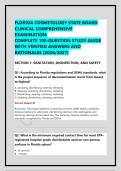
FLORIDA COSMETOLOGY STATE BOARD
CLINICAL COMPREHENSIVE
EXAMINATION:
COMPLETE 100-QUESTION STUDY GUIDE
WITH VERIFIED ANSWERS AND
RATIONALES (2026/2027)
SECTION 1: SANITATION, DISINFECTION, AND SAFETY
Q1: According to Florida regulations and OSHA standards, what
is the proper sequence of decontamination levels from lowest
to highest?
A. Sanitizing, disinfecting, cleaning, sterilizing
B. Cleaning, sanitizing, disinfecting, sterilizing
C. Disinfecting, cleaning, sanitizing, sterilizing
D. Cleaning, disinfecting, sanitizing, sterilizing
Correct answer: B
Rationale: The proper sequence is cleaning (removes visible debris), sanitizing
(reduces bacteria to safe levels), disinfecting (destroys most pathogens), and
sterilizing (destroys all microbial life). This hierarchy matches infection control
standards recognized by Florida and OSHA.
Q2: What is the minimum required contact time for most EPA-
registered hospital-grade disinfectants used on non-porous
surfaces in Florida salons?
A. 30 seconds
B. 1 minute
,C. 10 minutes
D. 24 hours
Correct answer: C
Rationale: Most EPA-registered hospital-grade disinfectants require a 10-minute
contact time on pre-cleaned, non-porous surfaces to achieve labeled efficacy against
bacteria, fungi, and viruses. Florida sanitation requirements mandate following
manufacturer contact time instructions precisely.
Q3: Under OSHA's Bloodborne Pathogens Standard, what must
an employer provide at no cost to employees who may be
exposed to blood or other potentially infectious materials?
A. Only gloves and training materials
B. Personal protective equipment (PPE), training, and hepatitis B vaccination
C. Only liability insurance coverage
D. Disposable towels and surface disinfectant only
Correct answer: B
Rationale: OSHA's Bloodborne Pathogens Standard requires employers to provide
PPE, annual training, and the hepatitis B vaccination series at no cost to employees
with occupational exposure risk. This matches federal workplace safety requirements
enforced in Florida salons.
Q4: How often should the shampoo bowl be sanitized?
A. At the beginning of each day
B. After each client
C. At the end of each day
D. Once per week
Correct answer: B
Rationale: The shampoo bowl must be sanitized after each client to prevent cross-
contamination and maintain proper salon hygiene standards required by Florida
regulations.
,Q5: What document must every Florida salon have readily
accessible that provides detailed information about chemical
hazards, handling procedures, and first aid measures?
A. Client service menu
B. Safety Data Sheet (SDS)
C. Employee handbook
D. Insurance policy declaration
Correct answer: B
Rationale: Florida regulations and OSHA's Hazard Communication Standard require
Safety Data Sheets (SDS) to be accessible to all employees for every chemical
product used in the salon. SDS documents contain critical hazard, handling, and
emergency response information.
Q6: HIV is spread only through direct contact with
bloodstream, not causal contact such as:
A. Shaking hands or kissing
B. Using contaminated implements
C. Blood-to-blood contact
D. Needle sticks
Correct answer: A
Rationale: HIV is transmitted through direct contact with infected blood or bodily
fluids, not through casual contact such as shaking hands or kissing. This
understanding is essential for maintaining proper professional boundaries and
infection control practices.
SECTION 2: HAIR STRUCTURE AND CHEMICAL SERVICES
, Q7: What is the medulla of the hair?
A. The outermost layer of the hair
B. The hair's pith or core; not all hair types have it; coarse hair generally does
C. The middle layer responsible for strength and elasticity
D. The pigment-containing layer of the hair
Correct answer: B
Rationale: The medulla is the innermost layer or pith of the hair shaft. It is not
present in all hair types and is most commonly found in coarse hair. The cuticle is the
outermost layer, and the cortex contains pigment and provides strength.
Q8: What gives flexibility and elasticity to the skin?
A. Collagen
B. Elastin
C. Keratin
D. Melanin
Correct answer: B
Rationale: Elastin is the protein fiber that gives skin its flexibility and elasticity,
allowing it to stretch and return to its original shape.
Q9: In which layer of the hair shaft is melanin located?
A. Cuticle
B. Cortex
C. Medulla
D. Follicle
Correct answer: B
Rationale: Melanin, the pigment that gives hair its natural color, is located in the
cortex layer of the hair shaft. The cortex is the middle layer responsible for strength,
elasticity, and color.
CLINICAL COMPREHENSIVE
EXAMINATION:
COMPLETE 100-QUESTION STUDY GUIDE
WITH VERIFIED ANSWERS AND
RATIONALES (2026/2027)
SECTION 1: SANITATION, DISINFECTION, AND SAFETY
Q1: According to Florida regulations and OSHA standards, what
is the proper sequence of decontamination levels from lowest
to highest?
A. Sanitizing, disinfecting, cleaning, sterilizing
B. Cleaning, sanitizing, disinfecting, sterilizing
C. Disinfecting, cleaning, sanitizing, sterilizing
D. Cleaning, disinfecting, sanitizing, sterilizing
Correct answer: B
Rationale: The proper sequence is cleaning (removes visible debris), sanitizing
(reduces bacteria to safe levels), disinfecting (destroys most pathogens), and
sterilizing (destroys all microbial life). This hierarchy matches infection control
standards recognized by Florida and OSHA.
Q2: What is the minimum required contact time for most EPA-
registered hospital-grade disinfectants used on non-porous
surfaces in Florida salons?
A. 30 seconds
B. 1 minute
,C. 10 minutes
D. 24 hours
Correct answer: C
Rationale: Most EPA-registered hospital-grade disinfectants require a 10-minute
contact time on pre-cleaned, non-porous surfaces to achieve labeled efficacy against
bacteria, fungi, and viruses. Florida sanitation requirements mandate following
manufacturer contact time instructions precisely.
Q3: Under OSHA's Bloodborne Pathogens Standard, what must
an employer provide at no cost to employees who may be
exposed to blood or other potentially infectious materials?
A. Only gloves and training materials
B. Personal protective equipment (PPE), training, and hepatitis B vaccination
C. Only liability insurance coverage
D. Disposable towels and surface disinfectant only
Correct answer: B
Rationale: OSHA's Bloodborne Pathogens Standard requires employers to provide
PPE, annual training, and the hepatitis B vaccination series at no cost to employees
with occupational exposure risk. This matches federal workplace safety requirements
enforced in Florida salons.
Q4: How often should the shampoo bowl be sanitized?
A. At the beginning of each day
B. After each client
C. At the end of each day
D. Once per week
Correct answer: B
Rationale: The shampoo bowl must be sanitized after each client to prevent cross-
contamination and maintain proper salon hygiene standards required by Florida
regulations.
,Q5: What document must every Florida salon have readily
accessible that provides detailed information about chemical
hazards, handling procedures, and first aid measures?
A. Client service menu
B. Safety Data Sheet (SDS)
C. Employee handbook
D. Insurance policy declaration
Correct answer: B
Rationale: Florida regulations and OSHA's Hazard Communication Standard require
Safety Data Sheets (SDS) to be accessible to all employees for every chemical
product used in the salon. SDS documents contain critical hazard, handling, and
emergency response information.
Q6: HIV is spread only through direct contact with
bloodstream, not causal contact such as:
A. Shaking hands or kissing
B. Using contaminated implements
C. Blood-to-blood contact
D. Needle sticks
Correct answer: A
Rationale: HIV is transmitted through direct contact with infected blood or bodily
fluids, not through casual contact such as shaking hands or kissing. This
understanding is essential for maintaining proper professional boundaries and
infection control practices.
SECTION 2: HAIR STRUCTURE AND CHEMICAL SERVICES
, Q7: What is the medulla of the hair?
A. The outermost layer of the hair
B. The hair's pith or core; not all hair types have it; coarse hair generally does
C. The middle layer responsible for strength and elasticity
D. The pigment-containing layer of the hair
Correct answer: B
Rationale: The medulla is the innermost layer or pith of the hair shaft. It is not
present in all hair types and is most commonly found in coarse hair. The cuticle is the
outermost layer, and the cortex contains pigment and provides strength.
Q8: What gives flexibility and elasticity to the skin?
A. Collagen
B. Elastin
C. Keratin
D. Melanin
Correct answer: B
Rationale: Elastin is the protein fiber that gives skin its flexibility and elasticity,
allowing it to stretch and return to its original shape.
Q9: In which layer of the hair shaft is melanin located?
A. Cuticle
B. Cortex
C. Medulla
D. Follicle
Correct answer: B
Rationale: Melanin, the pigment that gives hair its natural color, is located in the
cortex layer of the hair shaft. The cortex is the middle layer responsible for strength,
elasticity, and color.