

ARC 3613 MIDTERM EXAM UPDATED ACTUAL
QUESTIONS AND CORRECT ANSWERS
Question:
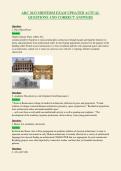
1. Paris Opera House
Answer:
Charles Gamier (Paris, 1860s-70s)
commissioned by Napoleon i) classical principles (central axis through facade and tripartite features) ii)
forms and proportions from architectural orders iii) developing appropriate character for the purpose of the
building (other French royal commissions) iv) clear circulation patterns with organized spaces (movement
as an interaction, central axis w main circ and cross axis with alt) v) typology (theatre) academic
classiscism
Question:
2. Academic Classicism (as a development from Renaissance)
Answer:
* Roots in Renaissance critique of medieval architecture (deficient in grace and proportion) * Found
solution of critique in ancient Roman architecture (geometry, space, proportions) * Resulted in proportions
from architectural orders and understandable space
- - arch went from a craft guild toan intellectuall activity as well as painting and sculpture. * The
development of the academy (organize professions, discuss theory, train young professionals)
Question:
3. Beaux Arts (academic classicism)
Answer:
the Ecole des Beaux-Arts in Paris propagated an academic tradition of classical architecture; it came to
represent an entire movement in early Modern architecture. It actually allowed for a variety of architectural
languages but stressed finding an architectural CHARACTER that was appropriate for each commission.
Resulting projects were often depicted by watercolor washes, and had clear yet beautiful circulation
patterns.
Question:
4. Arts and Crafts
,Answer:
a reform movement that proposed a revival of crafts (especially the minor arts, objectsactually produced by
the designer in a small workshop) as the agent for economic justice, social improve-ment and artistic
renewal. The works ideally looked like they were produced by hand, according to traditionalmethods.
They used local materials and followed local and traditional forms. The works often have a dis-tinctly
medieval character to them, demonstrating their connection to the Gothic Revival.
Question:
5. Red House
Answer:
Philip Webb (Bexley Heath, 1850s)
* commissioned for William Morris sources of vernacular architecture - medieval clay tile, brick designed
in conjunction with the craftsman for the project arts and crafts
Question:
6. Neoclassicism
Answer:
copy of classical design whereas academic classicism/ beaux arts was a creative reuse)
Question:
7. Picturesque
Answer:
i) non axial, non linear, lead by visual cues) ii) fictive history iii) eclectic sources (not greek or roman
mostly asian, ruins, or gothic)
Question:
8. Industrial Revolution
Answer:
* new materials (iron and glass) * urban areas in need for reform
Question:
9. William Morris
Answer:
Founder of the Arts and Crafts movement. This movement rejected mass production of products and
sought to revitalize careful hand production of goods. * through firm starting w furniture
, Question:
10. Rationalism
Answer:
a reaction to eclecticism, and a response to new materials and new building types. In a search for the
appropriate architecture for the modern era, Rationalists were often inspired by works of engineering.
Seeking to make use of new materials, they advocated studying and employing the capabilities of iron,
steel, sheet glass, and concrete. Seeking solutions to new building programs resulting from social and
economic developments, they sought straightforward, logical planning. In all of their efforts, they
advocated a building devoid of applied decoration and historical references.
repeatable forms fitting generalized needs
Question:
11. Structural Rationalism
Answer:
* rational use of material (qualities and capabilities) * efficient and exposed structural system visually
logica * spacial organization according to function * material properties
violet le duc
Question:
12. Crystal Palace
Answer:
Joseph Paxton, London, 1850s
built for the worlds fair - his design was chosen last minute bascillica type plan, tall cross axis to enclose
elm trees ridge and furrow system i) construction ii) structure iii) building rationalism
Question:
13. Gallerie De Machine
Answer:
Contamine & Duert (Paris, 1880)
worlds fair building iron and glass system ridge and furrow central axis, multiple floors, transverse axis,
secondary spaces socket to ground connections Rationalism
QUESTIONS AND CORRECT ANSWERS
Question:
1. Paris Opera House
Answer:
Charles Gamier (Paris, 1860s-70s)
commissioned by Napoleon i) classical principles (central axis through facade and tripartite features) ii)
forms and proportions from architectural orders iii) developing appropriate character for the purpose of the
building (other French royal commissions) iv) clear circulation patterns with organized spaces (movement
as an interaction, central axis w main circ and cross axis with alt) v) typology (theatre) academic
classiscism
Question:
2. Academic Classicism (as a development from Renaissance)
Answer:
* Roots in Renaissance critique of medieval architecture (deficient in grace and proportion) * Found
solution of critique in ancient Roman architecture (geometry, space, proportions) * Resulted in proportions
from architectural orders and understandable space
- - arch went from a craft guild toan intellectuall activity as well as painting and sculpture. * The
development of the academy (organize professions, discuss theory, train young professionals)
Question:
3. Beaux Arts (academic classicism)
Answer:
the Ecole des Beaux-Arts in Paris propagated an academic tradition of classical architecture; it came to
represent an entire movement in early Modern architecture. It actually allowed for a variety of architectural
languages but stressed finding an architectural CHARACTER that was appropriate for each commission.
Resulting projects were often depicted by watercolor washes, and had clear yet beautiful circulation
patterns.
Question:
4. Arts and Crafts
,Answer:
a reform movement that proposed a revival of crafts (especially the minor arts, objectsactually produced by
the designer in a small workshop) as the agent for economic justice, social improve-ment and artistic
renewal. The works ideally looked like they were produced by hand, according to traditionalmethods.
They used local materials and followed local and traditional forms. The works often have a dis-tinctly
medieval character to them, demonstrating their connection to the Gothic Revival.
Question:
5. Red House
Answer:
Philip Webb (Bexley Heath, 1850s)
* commissioned for William Morris sources of vernacular architecture - medieval clay tile, brick designed
in conjunction with the craftsman for the project arts and crafts
Question:
6. Neoclassicism
Answer:
copy of classical design whereas academic classicism/ beaux arts was a creative reuse)
Question:
7. Picturesque
Answer:
i) non axial, non linear, lead by visual cues) ii) fictive history iii) eclectic sources (not greek or roman
mostly asian, ruins, or gothic)
Question:
8. Industrial Revolution
Answer:
* new materials (iron and glass) * urban areas in need for reform
Question:
9. William Morris
Answer:
Founder of the Arts and Crafts movement. This movement rejected mass production of products and
sought to revitalize careful hand production of goods. * through firm starting w furniture
, Question:
10. Rationalism
Answer:
a reaction to eclecticism, and a response to new materials and new building types. In a search for the
appropriate architecture for the modern era, Rationalists were often inspired by works of engineering.
Seeking to make use of new materials, they advocated studying and employing the capabilities of iron,
steel, sheet glass, and concrete. Seeking solutions to new building programs resulting from social and
economic developments, they sought straightforward, logical planning. In all of their efforts, they
advocated a building devoid of applied decoration and historical references.
repeatable forms fitting generalized needs
Question:
11. Structural Rationalism
Answer:
* rational use of material (qualities and capabilities) * efficient and exposed structural system visually
logica * spacial organization according to function * material properties
violet le duc
Question:
12. Crystal Palace
Answer:
Joseph Paxton, London, 1850s
built for the worlds fair - his design was chosen last minute bascillica type plan, tall cross axis to enclose
elm trees ridge and furrow system i) construction ii) structure iii) building rationalism
Question:
13. Gallerie De Machine
Answer:
Contamine & Duert (Paris, 1880)
worlds fair building iron and glass system ridge and furrow central axis, multiple floors, transverse axis,
secondary spaces socket to ground connections Rationalism


