
• Wrong document? Swap it for free
  • Written by students who passed
  • Immediately available after payment
  • Read online or as PDF
Sell
Where do you study
Your language
Document preview thumbnail
Preview 3 out of 16 pages
Class notes

Physics notes ; , includes basic topics like physical quantities, scalars vectors, etc.

Document preview thumbnail
Preview 3 out of 16 pages

The notes begin with Physical Quantities, introducing the idea of quantities that can be measured and explaining how measurements are expressed using numerical values and units. The section establishes the foundation for understanding the rest of the topic. They then cover the distinction between Base Quantities and Derived Quantities. Base quantities are introduced as fundamental measurable quantities, while derived quantities are explained as quantities obtained from combinations of base quantities. Examples and units are used to make the distinction clear. A section on Conversions develops the ability to convert measurements between different units. This is important for solving numerical Physics problems, particularly when quantities need to be expressed in compatible units before calculations can be performed. The notes also contain a detailed section on Significant Figures, explaining how to identify the number of significant figures in measured values and how significant figures are handled when performing calculations. This helps students understand how precise a measurement actually is rather than treating every digit in a number as equally meaningful. Another topic covered is Magnitude, focusing on the size or numerical value of a physical quantity. This provides a basis for interpreting measurements and comparing quantities. The notes then introduce Scalars and Vectors, explaining the difference between quantities that have only magnitude and quantities that have both magnitude and direction. This section helps establish an important distinction used throughout Physics when describing quantities such as distance, displacement, speed, velocity, and force. A substantial part of the document is dedicated to Errors and Measurement Uncertainty. It explains that measurements are not perfectly exact and introduces the idea of errors and limitations in experimental measurements. This section develops an understanding of why measured values can differ from their true or accepted values and how measurement accuracy and precision should be considered. The document also covers the Screw Gauge, a precision measuring instrument used to measure very small dimensions. The notes explain the relevant concepts and calculations involved in using a screw gauge, followed by practice questions and exercises. These questions give students an opportunity to apply the method rather than simply memorize the procedure.

Content preview

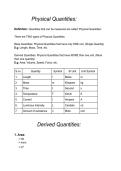
Physical Quantities:
Definition: Quantities that can be measured are called ‘Physical Quantities’.

There are TWO types of Physical Quantities:

Base Quantities: Physical Quantities that have only ONE unit. (Single Quantity)
E.g: Length, Mass, Time, etc.

Derived Quantities: Physical Quantities that have MORE than one unit. (More
than one quantity)
E.g: Area, Volume, Speed, Force, etc.


S.no Quantity Symbol SI Unit Unit Symbol

1. Length l Metre m

2. Mass m Kilogram kg

3. Time t Second s

4. Temperature T Kelvin K

5. Current I Ampere A

6. Luminous Intensity L Candela cd

7. Amount of substance n Mole mol


Derived Quantities:
1. Area:
= lxb
= mxm
= m²

,2. Volume:
= lxbxh
=mxmxm
= m³

3. Speed:
𝐷𝑖𝑠𝑡𝑎𝑛𝑐𝑒
=
𝑇𝑖𝑚𝑒
𝑚
=
𝑠
−1
= 𝑚𝑠

4. Acceleration:
𝑆𝑝𝑒𝑒𝑑
=
𝑇𝑖𝑚𝑒
𝑚/𝑠
=
𝑠
𝑚
= ÷s
𝑠
𝑚 1
= x
𝑠 𝑠
𝑚
= 2
𝑠
−2
= 𝑚𝑠


5. Momentum:
= mass x speed
−1
=𝑘𝑔 𝑚𝑠

, 6. Density:
𝑀𝑎𝑠𝑠
=
𝑉𝑜𝑙𝑢𝑚𝑒
𝑘𝑔
=
𝑚³
−3
= 𝑘𝑔 𝑚

7. Force:
= Mass x Acceleration
= Kg m/s²
−2
= 𝐾𝑔 𝑚𝑠

8. Pressure:
𝐹
=
𝐴
−2
𝐾𝑔 𝑚𝑠
= 2
𝑚
−2
𝐾𝑔 𝑠
=
𝑚
−1 −2
= 𝐾𝑔 𝑚 𝑠


Conversions:
1km = 1000m
1m = 100cm
1cm = 10mm

1kg = 1000g
1g = 1000mg

Document information

School year
3
Uploaded on
September 8, 2026
Number of pages
16
Written in
2026/2027
Type
Class notes
Professor(s)
Sir
Contains
Physics
$3.99

Wrong document? Swap it for free Within 14 days of purchase and before downloading, you can choose a different document. You can simply spend the amount again.
Written by students who passed
Immediately available after payment
Read online or as PDF

Sold
0
Followers
0
Items
1
Last sold
-


Why students choose Stuvia

Created by fellow students, verified by reviews

Quality you can trust: written by students who passed their tests and reviewed by others who've used these notes.

Didn't get what you expected? Choose another document

No worries! You can instantly pick a different document that better fits what you're looking for.

Pay as you like, start learning right away

No subscription, no commitments. Pay the way you're used to via credit card and download your PDF document instantly.

Student with book image

“Bought, downloaded, and aced it. It really can be that simple.”

Alisha Student

Working on your references?

Create accurate citations in APA, MLA and Harvard with our free citation generator.

Working on your references?

Frequently asked questions

