
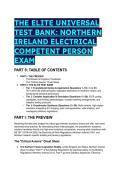
THE ELITE UNIVERSAL
TEST BANK: NORTHERN
IRELAND ELECTRICAL
COMPETENT PERSON
EXAM
PART 0: TABLE OF CONTENTS
1. PART I: THE PREVIEW
○ The Mission & Cognitive Translation
○ The "Critical Axioms" Cheat Sheet
2. PART II: THE ELITE TEST BANK
○ Tier 1: Foundational Syntax & Application (Questions 1–10): Core BS
7671:2018+A4:2026 principles, legislative distinctions in Northern Ireland, and
fundamental electrical parameters.
○ Tier 2: Complex Application & Simulation (Questions 11–20): EICR coding
paradigms, fault-finding methodologies, complex earthing arrangements, and
adaptive testing protocols.
○ Tier 3: Grandmaster Synthesis (Questions 21–30): Multi-variable, high-stakes
scenarios integrating EV charging, solar microgeneration, safe isolation, and
overlapping statutory regulations.
PART I: THE PREVIEW
Mastering this test bank bridges the critical gap between academic theory and elite, real-world
electrotechnical practice. By internalizing these methodologies, the practitioner's academic
mastery translates directly into high-level analytical competence, ensuring total compliance with
BS 7671:2018+A4:2026, the Electricity at Work Regulations (Northern Ireland) 1991, and
Northern Ireland's specific building and tenancy legislations.
The "Critical Axioms" Cheat Sheet
● The Northern Ireland Legislative Reality: Unlike England and Wales, Northern Ireland
does not utilize "Part P" of the Building Regulations for electrical safety; in the Building
Regulations (Northern Ireland) 2012, Part P governs Sanitary Appliances. Electrical
, competence is governed strictly under EAWR (NI) 1991 and BS 7671.
● The EICR Rental Mandate: Under the Electrical Safety Standards for Private Tenancies
Regulations (NI) 2024, rental properties require an Electrical Installation Condition Report
(EICR) every 5 years, with Code 2 (C2) and Code 1 (C1) defects strictly mandating
remediation within 28 days.
● The 250V DC IR Exception: Under BS 7671 Regulation 643.3, if Surge Protective
Devices (SPDs) or sensitive electronics cannot be easily disconnected, insulation
resistance testing MUST be conducted at 250V DC with the equipment in the circuit,
maintaining a 1.0 MΩ minimum.
● EV Charging on PME: BS 7671 Section 722 prohibits using a Protective Multiple
Earthing (TN-C-S) facility for outdoor EV chargers unless explicit open-PEN fault
protection (e.g., an integrated monitoring device or separate TT earth electrode) is
deployed.
● The Live Working Prohibition: EAWR (NI) 1991 Regulation 14 prohibits live working
unless three absolute legal conditions are simultaneously met: it must be unreasonable to
be dead, it must be reasonable to work live, and suitable precautions must be taken to
prevent injury.
PART II: THE ELITE TEST BANK
Tier 1: Foundational Syntax & Application
Q1: A landlord in Belfast has commissioned a periodic inspection of a private rental property.
During the inspection, the competent person identifies a Code 2 (C2) defect regarding a
degraded consumer unit. Based strictly on the Electrical Safety Standards for Private Tenancies
Regulations (Northern Ireland) 2024, what is the MAXIMUM statutory timeframe allowed for the
landlord to complete the required remedial work?
A) 14 days from the date of the inspection. B) 28 days from receiving the report, or a shorter
period if specified by the inspector. C) 30 days from the date the next tenant occupies the
premises. D) 6 months, aligning with standard UK-wide housing health and safety guidelines.
● Answer: B (28 days from receiving the report, or a shorter period if specified by the
inspector)
● Distractor Analysis:
○ A is incorrect: While 14 days is an aggressive internal policy for certain housing
associations, it is not the statutory mandate established by the NI Executive.
○ C is incorrect: The legislation mandates action based on the receipt of the report,
completely independent of tenant occupancy timelines, to prevent unsafe properties
from lingering on the rental market.
○ D is incorrect: This relies on a legacy assumption or a generalization; the 2024 NI
regulations strictly codify the 28-day rule for remedial works.
The Mentor's Analysis: Statutory deadlines in Northern Ireland are absolute legal ceilings, not
operational targets. The 2024 Private Tenancies Regulations brought NI into alignment with
stringent 5-year testing intervals, specifically codifying the 28-day remediation window for
Potentially Dangerous (C2) defects.
Classification Description NI Mandated Action
Code 1 (C1) Danger present Make safe immediately before
leaving site.
, Classification Description NI Mandated Action
Code 2 (C2) Potentially dangerous Remediate within 28 days (or
shorter if specified).
Code 3 (C3) Improvement recommended No statutory timeline; deemed
satisfactory.
By utilizing Current Legislative Frameworks, the practitioner bypasses the common trap of
applying outdated or generalized UK guidelines. Professional/Academic Intuition: Never
defer safety; a statutory 28-day remediation window is a legal mandate that begins the
moment the report is received.
Q2: An electrical contractor newly relocated from London to Derry is commissioned to rewire a
domestic kitchen. The contractor informs the client they must formally notify the local district
council building control under "Part P of the Building Regulations." Based on the Building
Regulations (Northern Ireland) 2012, why is this statement MATERIALLY INCORRECT?
A) In Northern Ireland, kitchen rewires are classed as non-notifiable minor works under Part P.
B) In Northern Ireland, Part P of the Building Regulations exclusively dictates standards for
Sanitary Appliances and unvented hot water systems, not electrical safety. C) The contractor
must notify NIE Networks directly rather than the local building control. D) Part P only applies to
new build properties in Northern Ireland, not existing domestic rewires.
● Answer: B (In Northern Ireland, Part P of the Building Regulations exclusively dictates
standards for Sanitary Appliances and unvented hot water systems, not electrical safety.)
● Distractor Analysis:
○ A is incorrect: This assumes Part P applies to electrical work in Northern Ireland. It
does not.
○ C is incorrect: NIE Networks handles grid connections and microgeneration
integration (G98/G99), not internal domestic wiring notifications.
○ D is incorrect: This is a total hallucination; Part P in Northern Ireland has nothing to
do with electrical safety regardless of the building's age.
The Mentor's Analysis: A master practitioner understands jurisdictional boundaries with
absolute clarity. While Part P governs electrical safety in England and Wales, the Building
Regulations (Northern Ireland) 2012 assign entirely different parameters to their nomenclature.
Regulation Part Focus in England & Wales Focus in Northern Ireland
Part P Electrical Safety in Dwellings Sanitary Appliances & Hot
Water Systems.
Part K Protection from falling/impact Ventilation.
Part N Glazing Drainage.
Electrical safety in Northern Ireland relies on adherence to BS 7671 and the overarching EAWR
(NI) 1991. By utilizing Jurisdictional Purity, the practitioner bypasses the common trap of blindly
applying cross-border regulations. Professional/Academic Intuition: Regulatory frameworks
are geographically isolated; assuming standard transferability across the UK is a critical
legal failure.
Q3: An electrician is tasked with replacing a damaged main switch inside a commercial
distribution board. To avoid disrupting the client's servers, the electrician considers working on
the equipment while it is live. Under Regulation 14 of the Electricity at Work Regulations
(Northern Ireland) 1991, which three conditions must ALL be met to legally justify live working?
A) The client formally demands it, insulated tools are used, and the worker is competent. B) The
voltage is under 50V AC, a dynamic risk assessment is signed, and a second person is present.
C) It is unreasonable in all circumstances for the conductor to be dead, it is reasonable to work
TEST BANK: NORTHERN
IRELAND ELECTRICAL
COMPETENT PERSON
EXAM
PART 0: TABLE OF CONTENTS
1. PART I: THE PREVIEW
○ The Mission & Cognitive Translation
○ The "Critical Axioms" Cheat Sheet
2. PART II: THE ELITE TEST BANK
○ Tier 1: Foundational Syntax & Application (Questions 1–10): Core BS
7671:2018+A4:2026 principles, legislative distinctions in Northern Ireland, and
fundamental electrical parameters.
○ Tier 2: Complex Application & Simulation (Questions 11–20): EICR coding
paradigms, fault-finding methodologies, complex earthing arrangements, and
adaptive testing protocols.
○ Tier 3: Grandmaster Synthesis (Questions 21–30): Multi-variable, high-stakes
scenarios integrating EV charging, solar microgeneration, safe isolation, and
overlapping statutory regulations.
PART I: THE PREVIEW
Mastering this test bank bridges the critical gap between academic theory and elite, real-world
electrotechnical practice. By internalizing these methodologies, the practitioner's academic
mastery translates directly into high-level analytical competence, ensuring total compliance with
BS 7671:2018+A4:2026, the Electricity at Work Regulations (Northern Ireland) 1991, and
Northern Ireland's specific building and tenancy legislations.
The "Critical Axioms" Cheat Sheet
● The Northern Ireland Legislative Reality: Unlike England and Wales, Northern Ireland
does not utilize "Part P" of the Building Regulations for electrical safety; in the Building
Regulations (Northern Ireland) 2012, Part P governs Sanitary Appliances. Electrical
, competence is governed strictly under EAWR (NI) 1991 and BS 7671.
● The EICR Rental Mandate: Under the Electrical Safety Standards for Private Tenancies
Regulations (NI) 2024, rental properties require an Electrical Installation Condition Report
(EICR) every 5 years, with Code 2 (C2) and Code 1 (C1) defects strictly mandating
remediation within 28 days.
● The 250V DC IR Exception: Under BS 7671 Regulation 643.3, if Surge Protective
Devices (SPDs) or sensitive electronics cannot be easily disconnected, insulation
resistance testing MUST be conducted at 250V DC with the equipment in the circuit,
maintaining a 1.0 MΩ minimum.
● EV Charging on PME: BS 7671 Section 722 prohibits using a Protective Multiple
Earthing (TN-C-S) facility for outdoor EV chargers unless explicit open-PEN fault
protection (e.g., an integrated monitoring device or separate TT earth electrode) is
deployed.
● The Live Working Prohibition: EAWR (NI) 1991 Regulation 14 prohibits live working
unless three absolute legal conditions are simultaneously met: it must be unreasonable to
be dead, it must be reasonable to work live, and suitable precautions must be taken to
prevent injury.
PART II: THE ELITE TEST BANK
Tier 1: Foundational Syntax & Application
Q1: A landlord in Belfast has commissioned a periodic inspection of a private rental property.
During the inspection, the competent person identifies a Code 2 (C2) defect regarding a
degraded consumer unit. Based strictly on the Electrical Safety Standards for Private Tenancies
Regulations (Northern Ireland) 2024, what is the MAXIMUM statutory timeframe allowed for the
landlord to complete the required remedial work?
A) 14 days from the date of the inspection. B) 28 days from receiving the report, or a shorter
period if specified by the inspector. C) 30 days from the date the next tenant occupies the
premises. D) 6 months, aligning with standard UK-wide housing health and safety guidelines.
● Answer: B (28 days from receiving the report, or a shorter period if specified by the
inspector)
● Distractor Analysis:
○ A is incorrect: While 14 days is an aggressive internal policy for certain housing
associations, it is not the statutory mandate established by the NI Executive.
○ C is incorrect: The legislation mandates action based on the receipt of the report,
completely independent of tenant occupancy timelines, to prevent unsafe properties
from lingering on the rental market.
○ D is incorrect: This relies on a legacy assumption or a generalization; the 2024 NI
regulations strictly codify the 28-day rule for remedial works.
The Mentor's Analysis: Statutory deadlines in Northern Ireland are absolute legal ceilings, not
operational targets. The 2024 Private Tenancies Regulations brought NI into alignment with
stringent 5-year testing intervals, specifically codifying the 28-day remediation window for
Potentially Dangerous (C2) defects.
Classification Description NI Mandated Action
Code 1 (C1) Danger present Make safe immediately before
leaving site.
, Classification Description NI Mandated Action
Code 2 (C2) Potentially dangerous Remediate within 28 days (or
shorter if specified).
Code 3 (C3) Improvement recommended No statutory timeline; deemed
satisfactory.
By utilizing Current Legislative Frameworks, the practitioner bypasses the common trap of
applying outdated or generalized UK guidelines. Professional/Academic Intuition: Never
defer safety; a statutory 28-day remediation window is a legal mandate that begins the
moment the report is received.
Q2: An electrical contractor newly relocated from London to Derry is commissioned to rewire a
domestic kitchen. The contractor informs the client they must formally notify the local district
council building control under "Part P of the Building Regulations." Based on the Building
Regulations (Northern Ireland) 2012, why is this statement MATERIALLY INCORRECT?
A) In Northern Ireland, kitchen rewires are classed as non-notifiable minor works under Part P.
B) In Northern Ireland, Part P of the Building Regulations exclusively dictates standards for
Sanitary Appliances and unvented hot water systems, not electrical safety. C) The contractor
must notify NIE Networks directly rather than the local building control. D) Part P only applies to
new build properties in Northern Ireland, not existing domestic rewires.
● Answer: B (In Northern Ireland, Part P of the Building Regulations exclusively dictates
standards for Sanitary Appliances and unvented hot water systems, not electrical safety.)
● Distractor Analysis:
○ A is incorrect: This assumes Part P applies to electrical work in Northern Ireland. It
does not.
○ C is incorrect: NIE Networks handles grid connections and microgeneration
integration (G98/G99), not internal domestic wiring notifications.
○ D is incorrect: This is a total hallucination; Part P in Northern Ireland has nothing to
do with electrical safety regardless of the building's age.
The Mentor's Analysis: A master practitioner understands jurisdictional boundaries with
absolute clarity. While Part P governs electrical safety in England and Wales, the Building
Regulations (Northern Ireland) 2012 assign entirely different parameters to their nomenclature.
Regulation Part Focus in England & Wales Focus in Northern Ireland
Part P Electrical Safety in Dwellings Sanitary Appliances & Hot
Water Systems.
Part K Protection from falling/impact Ventilation.
Part N Glazing Drainage.
Electrical safety in Northern Ireland relies on adherence to BS 7671 and the overarching EAWR
(NI) 1991. By utilizing Jurisdictional Purity, the practitioner bypasses the common trap of blindly
applying cross-border regulations. Professional/Academic Intuition: Regulatory frameworks
are geographically isolated; assuming standard transferability across the UK is a critical
legal failure.
Q3: An electrician is tasked with replacing a damaged main switch inside a commercial
distribution board. To avoid disrupting the client's servers, the electrician considers working on
the equipment while it is live. Under Regulation 14 of the Electricity at Work Regulations
(Northern Ireland) 1991, which three conditions must ALL be met to legally justify live working?
A) The client formally demands it, insulated tools are used, and the worker is competent. B) The
voltage is under 50V AC, a dynamic risk assessment is signed, and a second person is present.
C) It is unreasonable in all circumstances for the conductor to be dead, it is reasonable to work


