

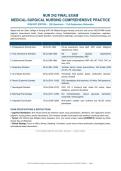
NUR 242 FINAL EXAM
MEDICAL-SURGICAL NURSING COMPREHENSIVE PRACTICE
2026/2027 EDITION • 200 Questions • Full Explanatory Rationales
Aligned with the Galen College of Nursing NUR 242 Medical-Surgical Nursing curriculum and current NCLEX-RN® clinical
judgment measurement model. Covers perioperative nursing, fluid/electrolytes, cardiovascular emergencies, respiratory
management, gastrointestinal and hepatic disorders, renal/endocrine pathology, neurological crises, clinical pharmacology, and
patient prioritization.
Domain Section Questions Core Med-Surg Competency Focus
1. Perioperative & Post-Op Care 25 Qs (Q1–Q25) Pre-op assessment, loose teeth, NPO insulin, Malignant
Hyperthermia, PACU
2. Fluid, Electrolyte & Acid-Base 30 Qs (Q26–Q55) NG suction alkalosis, hyperkalemia
(calcium/insulin/Kayexalate), ABG
3. Cardiovascular Disorders 25 Qs (Q56–Q80) Septic shock (norepinephrine, MAP ≥65), HIT, TACO, CVP, art
lines, ACS
4. Respiratory Disorders 25 Qs (Q81–Q105) Ventilator alarms, tension pneumothorax, VAP bundle (HOB
30–45°), PE, chest tubes
5. GI & Hepatic Disorders 25 Qs (Q106–Q130) Pancreatitis (fetal position, lipase), cholecystitis, lactulose,
stomas, GI bleed
6. Renal & Endocrine Disorders 25 Qs (Q131–Q155) CKD, hemodialysis fluid restriction, AV fistula, DKA potassium,
SIADH/DI
7. Neurological Disorders 15 Qs (Q156–Q170) GCS, ICP & Cushing's triad, stroke tPA criteria, status
epilepticus, autonomic dysreflexia
8. Med-Surg Pharmacology 15 Qs (Q171–Q185) KCl contraindications, calcium gluconate, dantrolene,
furosemide, reversal agents
9. Integrated Case Studies 15 Qs (Q186–Q200) Multi-system complex case synthesis and NCLEX clinical
prioritization
EXAM SPECIFICATIONS & INSTRUCTIONS
• Cognitive Distribution: 30% Recall (normal lab reference values, drug classifications, definitions), 50% Application (clinical
judgment, nursing actions, priority interventions), 20% Analysis (complex multi-system case synthesis, prioritizing client care).
• Format: 200 NCLEX-style Multiple-Choice Questions (A–D, one correct answer marked [CORRECT]) followed by official
Answer Key and Rationale.
• Clinical Strategy: Focus on ABCs (Airway, Breathing, Circulation), acute versus chronic prioritization, physiological safety,
and evidence-based interventions.
Turn the page to begin the examination. Good luck — achieve mastery.
NUR 242 Medical-Surgical Nursing Comprehensive Final Examination (2026/2027 Edition) | Page 1
,Section 1: Perioperative & Preoperative/Postoperative Care – Preoperative Assessment,
Intraoperative Complications, PACU Care, Malignant Hyperthermia (25 questions)
Preoperative risk screening (loose teeth, NPO insulin orders, allergy cross-reactivity), Malignant Hyperthermia recognition and
dantrolene therapy, PACU care, oliguria assessment, and VTE prevention.
Q1: During a preoperative assessment, the nurse notes that a client scheduled for general anesthesia has a loose
anterior incisor tooth. What is the priority nursing action?
A. Document the finding and immediately notify the anesthesia care provider of the potential airway and aspiration
risk [CORRECT]
B. Instruct the client to firmly bite down on a dry sterile gauze pad until surgery
C. Attempt to manually extract the tooth at the bedside before transport to the operating room
D. Reassure the client that dental status is irrelevant to endotracheal intubation
Correct Answer: A
Rationale: B loose tooth poses a severe aspiration risk during endotracheal intubation and extubation; notifying the anesthesia
provider allows for protective airway precautions and documentation.
Q2: A client with type 1 diabetes mellitus who is prescribed daily morning NPH insulin is admitted for an elective
surgical procedure and has been NPO since midnight. What is the priority nursing action regarding the morning
insulin dose?
A. Administer the full prescribed morning dose of NPH insulin as scheduled with a small sip of water
B. Contact the healthcare provider or surgeon to clarify the preoperative insulin administration orders [CORRECT]
C. Instruct the client to drink 8 ounces of orange juice and administer double the regular insulin dose
D. Withhold the insulin permanently and cancel the scheduled surgical procedure
Correct Answer: B
Rationale: Administering standard intermediate-acting insulin to an NPO patient can induce fatal intraoperative hypoglycemia,
while withholding it entirely can cause ketoacidosis; clarifying orders with the provider ensures safe glycemic management.
Q3: Which of the following clients scheduled for elective surgery has the highest risk factor for developing
postoperative Venous Thromboembolism (VTE)?
A. A 22-year-old athlete undergoing arthroscopic knee repair with no chronic medical conditions
B. A 30-year-old male undergoing excision of a benign lipoma under local anesthesia
C. A 45-year-old female taking oral estrogen contraceptives undergoing an open cholecystectomy [CORRECT]
D. A 50-year-old client with controlled hypertension undergoing cataract surgery
Correct Answer: C
Rationale: Oral estrogen contraceptives combined with major abdominal surgery and immobility dramatically increase
hypercoagulability and venous stasis (Virchow's triad), placing this client at highest risk for VTE.
Q4: While teaching a client scheduled for an exploratory laparotomy, the nurse demonstrates how to splint the
abdominal incision. What is the primary clinical rationale for postoperative incision splinting?
A. To completely eliminate the need for postoperative opioid analgesics
B. To restrict all movement of the diaphragm and thoracic cage
C. To prevent the development of surgical site bacterial wound infections
D. To reduce pain, support the suture line, and facilitate effective deep breathing and coughing to prevent atelectasis
[CORRECT]
Correct Answer: D
Rationale: Splinting the incision with a folded blanket or pillow reduces tension on abdominal sutures, alleviates pain during
coughing, and promotes alveolar expansion to prevent postoperative pulmonary complications.
Q5: During surgery under general anesthesia, the circulating nurse notes that the client's end-tidal carbon dioxide
(EtCO2) is rapidly rising, followed by masseter muscle rigidity and sinus tachycardia. What life-threatening
complication is occurring?
NUR 242 Medical-Surgical Nursing Comprehensive Final Examination (2026/2027 Edition) | Page 2
, A. Malignant Hyperthermia (MH) [CORRECT]
B. Anaphylactic reaction to intravenous antibiotics
C. Transfusion-associated circulatory overload
D. Severe neuroleptic malignant syndrome
Correct Answer: A
Rationale: Malignant hyperthermia is an inherited hypermetabolic skeletal muscle crisis triggered by volatile anesthetics and
succinylcholine; an unexplained rise in EtCO2 and jaw rigidity are classic early signs.
Q6: What is the definitive emergency pharmacological treatment that must be administered immediately upon
confirming a diagnosis of Malignant Hyperthermia?
A. Intravenous Epinephrine bolus
B. Intravenous Dantrolene sodium (2.5 mg/kg IV push) [CORRECT]
C. Subcutaneous Regular Insulin with Dextrose
D. Intramuscular Succinylcholine
Correct Answer: B
Rationale: Dantrolene sodium is a ryanodine receptor antagonist that inhibits calcium release from the sarcoplasmic reticulum,
arresting the hypermetabolic crisis of malignant hyperthermia.
Q7: In addition to administering dantrolene, which of the following emergency nursing interventions is indicated
during an acute episode of Malignant Hyperthermia?
A. Increase the concentration of inhalational isoflurane gas to deepen sedation
B. Apply warm forced-air blankets to maintain body heat
C. Discontinue all triggering volatile anesthetics and succinylcholine, and hyperventilate the client with 100% oxygen
[CORRECT]
D. Administer oral potassium chloride via nasogastric tube
Correct Answer: C
Rationale: Immediate management of MH requires halting triggering agents, flushing the anesthesia machine, hyperventilating
with 100% O2 to clear CO2, and initiating active cooling protocols.
Q8: A client in the Post-Anesthesia Care Unit (PACU) who underwent a total hip arthroplasty has a Foley catheter in
place. Over the last 2 hours, the total urinary output is 20 mL. What is the nurse's priority initial action?
A. Immediately double the intravenous infusion rate of 0.9% normal saline
B. Notify the surgeon that the client has acute renal failure requiring dialysis
C. Administer a prescribed IV bolus of furosemide
D. Check the catheter tubing for kinks or obstruction and assess the client for suprapubic bladder distention
[CORRECT]
Correct Answer: D
Rationale: Urine output <30 mL/hr (or <0.5 mL/kg/hr) requires immediate assessment of catheter patency and suprapubic
palpation/bladder scan to rule out mechanical obstruction before altering fluid orders.
Q9: A client who is being prepared for an elective colon resection states, 'I signed the consent form, but the
surgeon never explained what happens if they find cancer.' What is the appropriate nursing action?
A. Withhold preoperative sedatives and notify the surgeon to return to the client's bedside to explain the procedure
and address concerns [CORRECT]
B. Explain the potential cancer surgical staging and alternative chemotherapy options in detail to the client
C. Advise the client to sign the form anyway because it is merely a routine administrative formality
D. Instruct the client to look up the surgical procedure on the internet
Correct Answer: A
Rationale: Obtaining informed consent is the legal responsibility of the operating surgeon; the nurse must advocate for the client
by contacting the surgeon to clarify information prior to sedation.
NUR 242 Medical-Surgical Nursing Comprehensive Final Examination (2026/2027 Edition) | Page 3
, Q10: A preoperative client reports an allergy to bananas, avocados, and kiwis. The nurse recognizes that this food
allergy history is most strongly associated with a cross-reactive hypersensitivity to:
A. Penicillin antibiotics
B. Natural rubber latex products [CORRECT]
C. Intravenous iodinated radiopaque contrast
D. Opioid analgesics
Correct Answer: B
Rationale: Cross-reactivity exists between proteins in bananas, avocados, kiwis, and chestnuts with natural rubber latex; clients
with these food allergies require strict latex-safe precautions.
Q11: The nurse is caring for a postoperative client on day 1 following an open cholecystectomy. The client has an
oral temperature of 100.2°F (37.9°C) and diminished breath sounds in the bilateral lung bases. What is the most
likely cause?
A. Surgical site wound infection
B. Acute deep vein thrombosis
C. Postoperative atelectasis [CORRECT]
D. Urinary tract infection
Correct Answer: C
Rationale: Atelectasis (alveolar collapse) is the most common cause of mild low-grade fever and diminished basal breath sounds
in the first 24 to 48 hours postoperatively, managed with incentive spirometry.
Q12: How frequently should a postoperative client be instructed to perform Incentive Spirometry exercises while
awake to prevent respiratory complications?
A. 1 to 2 times every 4 hours
B. Once per day in the morning
C. Only if the client develops a severe productive cough
D. 10 times every hour while awake [CORRECT]
Correct Answer: D
Rationale: Incentive spirometry should be performed 10 times per hour while awake, using slow, sustained deep inspirations to
open collapsed alveoli and prevent atelectasis.
Q13: A client on postoperative day 3 following an exploratory laparotomy coughs violently and reports feeling a
'popping sensation' in the abdomen. The nurse observes loops of bowel protruding through the midline incision.
What is the immediate priority nursing action?
A. Cover the exposed viscera with sterile non-adherent dressings moistened with warm sterile normal saline, place
the client in low Fowler's with knees flexed, and call for emergency surgical assistance [CORRECT]
B. Gently push the exposed bowel loops back into the abdominal cavity using gloved hands
C. Apply a tight abdominal binder and encourage the client to walk to the bathroom
D. Instruct the client to drink 500 mL of water and lie completely prone
Correct Answer: A
Rationale: Wound evisceration requires immediate protection of exposed organs with sterile saline-soaked dressings, positioning
in low Fowler's with knees bent to reduce abdominal tension, and emergency surgical notification.
Q14: Which of the following clients in the Post-Anesthesia Care Unit (PACU) requires the most immediate
intervention by the registered nurse?
A. A client who is drowsy but awakens when their name is called and has an SpO2 of 96% on room air
B. A client following thyroidectomy who exhibits high-pitched inspiratory stridor and restlessness [CORRECT]
C. A client reporting surgical site pain rated 6 out of 10 on the numeric rating scale
D. A client with a heart rate of 78 bpm and blood pressure of 124/76 mm Hg
Correct Answer: B
NUR 242 Medical-Surgical Nursing Comprehensive Final Examination (2026/2027 Edition) | Page 4
MEDICAL-SURGICAL NURSING COMPREHENSIVE PRACTICE
2026/2027 EDITION • 200 Questions • Full Explanatory Rationales
Aligned with the Galen College of Nursing NUR 242 Medical-Surgical Nursing curriculum and current NCLEX-RN® clinical
judgment measurement model. Covers perioperative nursing, fluid/electrolytes, cardiovascular emergencies, respiratory
management, gastrointestinal and hepatic disorders, renal/endocrine pathology, neurological crises, clinical pharmacology, and
patient prioritization.
Domain Section Questions Core Med-Surg Competency Focus
1. Perioperative & Post-Op Care 25 Qs (Q1–Q25) Pre-op assessment, loose teeth, NPO insulin, Malignant
Hyperthermia, PACU
2. Fluid, Electrolyte & Acid-Base 30 Qs (Q26–Q55) NG suction alkalosis, hyperkalemia
(calcium/insulin/Kayexalate), ABG
3. Cardiovascular Disorders 25 Qs (Q56–Q80) Septic shock (norepinephrine, MAP ≥65), HIT, TACO, CVP, art
lines, ACS
4. Respiratory Disorders 25 Qs (Q81–Q105) Ventilator alarms, tension pneumothorax, VAP bundle (HOB
30–45°), PE, chest tubes
5. GI & Hepatic Disorders 25 Qs (Q106–Q130) Pancreatitis (fetal position, lipase), cholecystitis, lactulose,
stomas, GI bleed
6. Renal & Endocrine Disorders 25 Qs (Q131–Q155) CKD, hemodialysis fluid restriction, AV fistula, DKA potassium,
SIADH/DI
7. Neurological Disorders 15 Qs (Q156–Q170) GCS, ICP & Cushing's triad, stroke tPA criteria, status
epilepticus, autonomic dysreflexia
8. Med-Surg Pharmacology 15 Qs (Q171–Q185) KCl contraindications, calcium gluconate, dantrolene,
furosemide, reversal agents
9. Integrated Case Studies 15 Qs (Q186–Q200) Multi-system complex case synthesis and NCLEX clinical
prioritization
EXAM SPECIFICATIONS & INSTRUCTIONS
• Cognitive Distribution: 30% Recall (normal lab reference values, drug classifications, definitions), 50% Application (clinical
judgment, nursing actions, priority interventions), 20% Analysis (complex multi-system case synthesis, prioritizing client care).
• Format: 200 NCLEX-style Multiple-Choice Questions (A–D, one correct answer marked [CORRECT]) followed by official
Answer Key and Rationale.
• Clinical Strategy: Focus on ABCs (Airway, Breathing, Circulation), acute versus chronic prioritization, physiological safety,
and evidence-based interventions.
Turn the page to begin the examination. Good luck — achieve mastery.
NUR 242 Medical-Surgical Nursing Comprehensive Final Examination (2026/2027 Edition) | Page 1
,Section 1: Perioperative & Preoperative/Postoperative Care – Preoperative Assessment,
Intraoperative Complications, PACU Care, Malignant Hyperthermia (25 questions)
Preoperative risk screening (loose teeth, NPO insulin orders, allergy cross-reactivity), Malignant Hyperthermia recognition and
dantrolene therapy, PACU care, oliguria assessment, and VTE prevention.
Q1: During a preoperative assessment, the nurse notes that a client scheduled for general anesthesia has a loose
anterior incisor tooth. What is the priority nursing action?
A. Document the finding and immediately notify the anesthesia care provider of the potential airway and aspiration
risk [CORRECT]
B. Instruct the client to firmly bite down on a dry sterile gauze pad until surgery
C. Attempt to manually extract the tooth at the bedside before transport to the operating room
D. Reassure the client that dental status is irrelevant to endotracheal intubation
Correct Answer: A
Rationale: B loose tooth poses a severe aspiration risk during endotracheal intubation and extubation; notifying the anesthesia
provider allows for protective airway precautions and documentation.
Q2: A client with type 1 diabetes mellitus who is prescribed daily morning NPH insulin is admitted for an elective
surgical procedure and has been NPO since midnight. What is the priority nursing action regarding the morning
insulin dose?
A. Administer the full prescribed morning dose of NPH insulin as scheduled with a small sip of water
B. Contact the healthcare provider or surgeon to clarify the preoperative insulin administration orders [CORRECT]
C. Instruct the client to drink 8 ounces of orange juice and administer double the regular insulin dose
D. Withhold the insulin permanently and cancel the scheduled surgical procedure
Correct Answer: B
Rationale: Administering standard intermediate-acting insulin to an NPO patient can induce fatal intraoperative hypoglycemia,
while withholding it entirely can cause ketoacidosis; clarifying orders with the provider ensures safe glycemic management.
Q3: Which of the following clients scheduled for elective surgery has the highest risk factor for developing
postoperative Venous Thromboembolism (VTE)?
A. A 22-year-old athlete undergoing arthroscopic knee repair with no chronic medical conditions
B. A 30-year-old male undergoing excision of a benign lipoma under local anesthesia
C. A 45-year-old female taking oral estrogen contraceptives undergoing an open cholecystectomy [CORRECT]
D. A 50-year-old client with controlled hypertension undergoing cataract surgery
Correct Answer: C
Rationale: Oral estrogen contraceptives combined with major abdominal surgery and immobility dramatically increase
hypercoagulability and venous stasis (Virchow's triad), placing this client at highest risk for VTE.
Q4: While teaching a client scheduled for an exploratory laparotomy, the nurse demonstrates how to splint the
abdominal incision. What is the primary clinical rationale for postoperative incision splinting?
A. To completely eliminate the need for postoperative opioid analgesics
B. To restrict all movement of the diaphragm and thoracic cage
C. To prevent the development of surgical site bacterial wound infections
D. To reduce pain, support the suture line, and facilitate effective deep breathing and coughing to prevent atelectasis
[CORRECT]
Correct Answer: D
Rationale: Splinting the incision with a folded blanket or pillow reduces tension on abdominal sutures, alleviates pain during
coughing, and promotes alveolar expansion to prevent postoperative pulmonary complications.
Q5: During surgery under general anesthesia, the circulating nurse notes that the client's end-tidal carbon dioxide
(EtCO2) is rapidly rising, followed by masseter muscle rigidity and sinus tachycardia. What life-threatening
complication is occurring?
NUR 242 Medical-Surgical Nursing Comprehensive Final Examination (2026/2027 Edition) | Page 2
, A. Malignant Hyperthermia (MH) [CORRECT]
B. Anaphylactic reaction to intravenous antibiotics
C. Transfusion-associated circulatory overload
D. Severe neuroleptic malignant syndrome
Correct Answer: A
Rationale: Malignant hyperthermia is an inherited hypermetabolic skeletal muscle crisis triggered by volatile anesthetics and
succinylcholine; an unexplained rise in EtCO2 and jaw rigidity are classic early signs.
Q6: What is the definitive emergency pharmacological treatment that must be administered immediately upon
confirming a diagnosis of Malignant Hyperthermia?
A. Intravenous Epinephrine bolus
B. Intravenous Dantrolene sodium (2.5 mg/kg IV push) [CORRECT]
C. Subcutaneous Regular Insulin with Dextrose
D. Intramuscular Succinylcholine
Correct Answer: B
Rationale: Dantrolene sodium is a ryanodine receptor antagonist that inhibits calcium release from the sarcoplasmic reticulum,
arresting the hypermetabolic crisis of malignant hyperthermia.
Q7: In addition to administering dantrolene, which of the following emergency nursing interventions is indicated
during an acute episode of Malignant Hyperthermia?
A. Increase the concentration of inhalational isoflurane gas to deepen sedation
B. Apply warm forced-air blankets to maintain body heat
C. Discontinue all triggering volatile anesthetics and succinylcholine, and hyperventilate the client with 100% oxygen
[CORRECT]
D. Administer oral potassium chloride via nasogastric tube
Correct Answer: C
Rationale: Immediate management of MH requires halting triggering agents, flushing the anesthesia machine, hyperventilating
with 100% O2 to clear CO2, and initiating active cooling protocols.
Q8: A client in the Post-Anesthesia Care Unit (PACU) who underwent a total hip arthroplasty has a Foley catheter in
place. Over the last 2 hours, the total urinary output is 20 mL. What is the nurse's priority initial action?
A. Immediately double the intravenous infusion rate of 0.9% normal saline
B. Notify the surgeon that the client has acute renal failure requiring dialysis
C. Administer a prescribed IV bolus of furosemide
D. Check the catheter tubing for kinks or obstruction and assess the client for suprapubic bladder distention
[CORRECT]
Correct Answer: D
Rationale: Urine output <30 mL/hr (or <0.5 mL/kg/hr) requires immediate assessment of catheter patency and suprapubic
palpation/bladder scan to rule out mechanical obstruction before altering fluid orders.
Q9: A client who is being prepared for an elective colon resection states, 'I signed the consent form, but the
surgeon never explained what happens if they find cancer.' What is the appropriate nursing action?
A. Withhold preoperative sedatives and notify the surgeon to return to the client's bedside to explain the procedure
and address concerns [CORRECT]
B. Explain the potential cancer surgical staging and alternative chemotherapy options in detail to the client
C. Advise the client to sign the form anyway because it is merely a routine administrative formality
D. Instruct the client to look up the surgical procedure on the internet
Correct Answer: A
Rationale: Obtaining informed consent is the legal responsibility of the operating surgeon; the nurse must advocate for the client
by contacting the surgeon to clarify information prior to sedation.
NUR 242 Medical-Surgical Nursing Comprehensive Final Examination (2026/2027 Edition) | Page 3
, Q10: A preoperative client reports an allergy to bananas, avocados, and kiwis. The nurse recognizes that this food
allergy history is most strongly associated with a cross-reactive hypersensitivity to:
A. Penicillin antibiotics
B. Natural rubber latex products [CORRECT]
C. Intravenous iodinated radiopaque contrast
D. Opioid analgesics
Correct Answer: B
Rationale: Cross-reactivity exists between proteins in bananas, avocados, kiwis, and chestnuts with natural rubber latex; clients
with these food allergies require strict latex-safe precautions.
Q11: The nurse is caring for a postoperative client on day 1 following an open cholecystectomy. The client has an
oral temperature of 100.2°F (37.9°C) and diminished breath sounds in the bilateral lung bases. What is the most
likely cause?
A. Surgical site wound infection
B. Acute deep vein thrombosis
C. Postoperative atelectasis [CORRECT]
D. Urinary tract infection
Correct Answer: C
Rationale: Atelectasis (alveolar collapse) is the most common cause of mild low-grade fever and diminished basal breath sounds
in the first 24 to 48 hours postoperatively, managed with incentive spirometry.
Q12: How frequently should a postoperative client be instructed to perform Incentive Spirometry exercises while
awake to prevent respiratory complications?
A. 1 to 2 times every 4 hours
B. Once per day in the morning
C. Only if the client develops a severe productive cough
D. 10 times every hour while awake [CORRECT]
Correct Answer: D
Rationale: Incentive spirometry should be performed 10 times per hour while awake, using slow, sustained deep inspirations to
open collapsed alveoli and prevent atelectasis.
Q13: A client on postoperative day 3 following an exploratory laparotomy coughs violently and reports feeling a
'popping sensation' in the abdomen. The nurse observes loops of bowel protruding through the midline incision.
What is the immediate priority nursing action?
A. Cover the exposed viscera with sterile non-adherent dressings moistened with warm sterile normal saline, place
the client in low Fowler's with knees flexed, and call for emergency surgical assistance [CORRECT]
B. Gently push the exposed bowel loops back into the abdominal cavity using gloved hands
C. Apply a tight abdominal binder and encourage the client to walk to the bathroom
D. Instruct the client to drink 500 mL of water and lie completely prone
Correct Answer: A
Rationale: Wound evisceration requires immediate protection of exposed organs with sterile saline-soaked dressings, positioning
in low Fowler's with knees bent to reduce abdominal tension, and emergency surgical notification.
Q14: Which of the following clients in the Post-Anesthesia Care Unit (PACU) requires the most immediate
intervention by the registered nurse?
A. A client who is drowsy but awakens when their name is called and has an SpO2 of 96% on room air
B. A client following thyroidectomy who exhibits high-pitched inspiratory stridor and restlessness [CORRECT]
C. A client reporting surgical site pain rated 6 out of 10 on the numeric rating scale
D. A client with a heart rate of 78 bpm and blood pressure of 124/76 mm Hg
Correct Answer: B
NUR 242 Medical-Surgical Nursing Comprehensive Final Examination (2026/2027 Edition) | Page 4


