

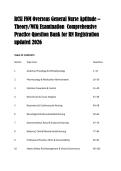
RCSI FNM Overseas General Nurse Aptitude –
Theory/MCQ Examination Comprehensive
Practice Question Bank for RN Registration
updated 2026
TABLE OF CONTENTS
Section Topic Area Questions
1 Anatomy, Physiology & Pathophysiology 1–15
2 Pharmacology & Medication Administration 16–30
3 Infection Prevention & Control 31–40
4 Wound Care & Tissue Integrity 41–48
5 Respiratory & Cardiovascular Nursing 49–58
6 Neurological & Musculoskeletal Nursing 59–66
7 Gastrointestinal, Renal & Endocrine Nursing 67–76
8 Maternal, Child & Mental Health Nursing 77–84
9 Professional Practice, Ethics & Accountability 85–95
10 Patient Safety, Risk Management & Clinical Governance 96–105
,Section Topic Area Questions
11 Communication, ISBAR & Documentation 106–113
12 Nursing Process, Critical Thinking & Clinical Decision-Making 114–122
13 Older Person Care, Dementia & Delirium 123–130
14 End-of-Life Care, Palliation & Grief 131–138
15 Health Promotion, Education & Reflective Practice 139–145
16 Emergency, Sepsis & Acute Care Management 146–150
SECTION 1: ANATOMY, PHYSIOLOGY & PATHOPHYSIOLOGY
• Q1. Cardiac output is defined as which of the following?
• A. The degree of stretch of the ventricular cardiac muscle fibres
• B. The resistance to ejection of blood from the ventricle
• C. The total amount of blood ejected by one of the ventricles in litres per minute
• D. The force generated by the contracting myocardium
Rationale: Cardiac output is the volume of blood pumped by each ventricle per minute,
calculated as stroke volume × heart rate.
• Q2. The closure or collapse of alveoli is referred to as which of the following?
• A. Atelectasis
• B. Haemothorax
• C. Pleural effusion
, • D. Pneumothorax
Rationale: Atelectasis is the collapse or closure of alveoli, resulting in reduced or absent gas
exchange. Haemothorax is blood in the pleural space; pleural effusion is fluid accumulation;
pneumothorax is air in the pleural space.
• Q3. Peptic ulcers are thought to be the result of which one of the following?
• A. Genetic defect
• B. Fatty diet
• C. Stress
• D. Helicobacter pylori infection
Rationale: H. pylori infection is a major causative factor in peptic ulcer disease, along with
NSAID use. Stress and diet are contributing factors rather than primary causes.
• Q4. Which of the following describes the correct sequence of the cardiac conduction system?
• A. SA node → Bundle of His → AV node → Purkinje fibres
• B. AV node → SA node → Purkinje fibres → Bundle of His
• C. SA node → AV node → Bundle of His → Purkinje fibres
• D. SA node → AV node → Bundle of His → Purkinje fibres
Rationale: The correct conduction pathway is: Sinoatrial (SA) node → Atrioventricular (AV) node
→ Bundle of His → Bundle branches → Purkinje fibres, which coordinate myocardial
contraction.
• Q5. A patient presents with jugular venous distension, peripheral oedema and hepatomegaly.
These findings are most consistent with:
• A. Left-sided heart failure
• B. Right-sided heart failure
• C. Pericarditis
• D. Aortic stenosis
, Rationale: Right-sided heart failure presents with signs of systemic venous congestion including
jugular venous distension, peripheral oedema, hepatomegaly and ascites due to impaired right
ventricular pumping.
• Q6. Which of the following laboratory findings is most indicative of acute kidney injury?
• A. Decreased serum creatinine
• B. Decreased blood urea nitrogen (BUN)
• C. Elevated serum creatinine and BUN
• D. Elevated serum albumin
Rationale: Acute kidney injury is characterised by a rapid rise in serum creatinine and BUN,
reflecting decreased glomerular filtration rate and impaired renal excretory function.
• Q7. In the inflammatory response, which of the following is the first cell type to arrive at the
site of injury?
• A. Lymphocytes
• B. Neutrophils
• C. Macrophages
• D. Eosinophils
Rationale: Neutrophils are the first leukocytes to migrate to the site of inflammation, typically
within 6–12 hours, initiating the acute inflammatory response through phagocytosis and release
of inflammatory mediators.
• Q8. The normal pH range of arterial blood is:
• A. 7.25–7.35
• B. 7.35–7.45
• C. 7.45–7.55
• D. 7.15–7.25
Theory/MCQ Examination Comprehensive
Practice Question Bank for RN Registration
updated 2026
TABLE OF CONTENTS
Section Topic Area Questions
1 Anatomy, Physiology & Pathophysiology 1–15
2 Pharmacology & Medication Administration 16–30
3 Infection Prevention & Control 31–40
4 Wound Care & Tissue Integrity 41–48
5 Respiratory & Cardiovascular Nursing 49–58
6 Neurological & Musculoskeletal Nursing 59–66
7 Gastrointestinal, Renal & Endocrine Nursing 67–76
8 Maternal, Child & Mental Health Nursing 77–84
9 Professional Practice, Ethics & Accountability 85–95
10 Patient Safety, Risk Management & Clinical Governance 96–105
,Section Topic Area Questions
11 Communication, ISBAR & Documentation 106–113
12 Nursing Process, Critical Thinking & Clinical Decision-Making 114–122
13 Older Person Care, Dementia & Delirium 123–130
14 End-of-Life Care, Palliation & Grief 131–138
15 Health Promotion, Education & Reflective Practice 139–145
16 Emergency, Sepsis & Acute Care Management 146–150
SECTION 1: ANATOMY, PHYSIOLOGY & PATHOPHYSIOLOGY
• Q1. Cardiac output is defined as which of the following?
• A. The degree of stretch of the ventricular cardiac muscle fibres
• B. The resistance to ejection of blood from the ventricle
• C. The total amount of blood ejected by one of the ventricles in litres per minute
• D. The force generated by the contracting myocardium
Rationale: Cardiac output is the volume of blood pumped by each ventricle per minute,
calculated as stroke volume × heart rate.
• Q2. The closure or collapse of alveoli is referred to as which of the following?
• A. Atelectasis
• B. Haemothorax
• C. Pleural effusion
, • D. Pneumothorax
Rationale: Atelectasis is the collapse or closure of alveoli, resulting in reduced or absent gas
exchange. Haemothorax is blood in the pleural space; pleural effusion is fluid accumulation;
pneumothorax is air in the pleural space.
• Q3. Peptic ulcers are thought to be the result of which one of the following?
• A. Genetic defect
• B. Fatty diet
• C. Stress
• D. Helicobacter pylori infection
Rationale: H. pylori infection is a major causative factor in peptic ulcer disease, along with
NSAID use. Stress and diet are contributing factors rather than primary causes.
• Q4. Which of the following describes the correct sequence of the cardiac conduction system?
• A. SA node → Bundle of His → AV node → Purkinje fibres
• B. AV node → SA node → Purkinje fibres → Bundle of His
• C. SA node → AV node → Bundle of His → Purkinje fibres
• D. SA node → AV node → Bundle of His → Purkinje fibres
Rationale: The correct conduction pathway is: Sinoatrial (SA) node → Atrioventricular (AV) node
→ Bundle of His → Bundle branches → Purkinje fibres, which coordinate myocardial
contraction.
• Q5. A patient presents with jugular venous distension, peripheral oedema and hepatomegaly.
These findings are most consistent with:
• A. Left-sided heart failure
• B. Right-sided heart failure
• C. Pericarditis
• D. Aortic stenosis
, Rationale: Right-sided heart failure presents with signs of systemic venous congestion including
jugular venous distension, peripheral oedema, hepatomegaly and ascites due to impaired right
ventricular pumping.
• Q6. Which of the following laboratory findings is most indicative of acute kidney injury?
• A. Decreased serum creatinine
• B. Decreased blood urea nitrogen (BUN)
• C. Elevated serum creatinine and BUN
• D. Elevated serum albumin
Rationale: Acute kidney injury is characterised by a rapid rise in serum creatinine and BUN,
reflecting decreased glomerular filtration rate and impaired renal excretory function.
• Q7. In the inflammatory response, which of the following is the first cell type to arrive at the
site of injury?
• A. Lymphocytes
• B. Neutrophils
• C. Macrophages
• D. Eosinophils
Rationale: Neutrophils are the first leukocytes to migrate to the site of inflammation, typically
within 6–12 hours, initiating the acute inflammatory response through phagocytosis and release
of inflammatory mediators.
• Q8. The normal pH range of arterial blood is:
• A. 7.25–7.35
• B. 7.35–7.45
• C. 7.45–7.55
• D. 7.15–7.25


