

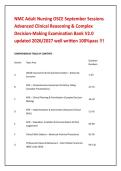
NMC Adult Nursing OSCE September Sessions
Advanced Clinical Reasoning & Complex
Decision-Making Examination Bank V2.0
updated 2026/2027 well written 100%pass !!!
COMPREHENSIVE TABLE OF CONTENTS
Question
Section Topic Area
Numbers
ABCDE Assessment & Clinical Deterioration – Advanced
A 1–20
Scenarios
APIE – Comprehensive Assessment & History Taking
B 21–35
(Complex Presentations)
APIE – Clinical Planning & Prioritisation (Complex Decision-
C 36–50
Making)
APIE – Implementation & Intervention (Advanced Clinical
D 51–65
Skills)
APIE – Evaluation, Escalation & Documentation (Critical
E 66–80
Judgement)
F Clinical Skills Stations – Advanced Technical Procedures 81–95
Professional Values & Behaviours – Silent Station Scenarios
G 96–110
(NMC Code 2018)
, Question
Section Topic Area
Numbers
H Evidence-Based Practice – Silent Station Critical Appraisal 111–125
Medication Management & Numerical Competency –
I 126–140
Advanced Calculations
Complex Multi-Morbidity & End-of-Life Scenarios –
J 141–150
Integrated Care
SECTION A: ABCDE ASSESSMENT & CLINICAL DETERIORATION – ADVANCED SCENARIOS
(Questions 1–20)
1. • A 78-year-old patient with known severe aortic stenosis is admitted with syncope and chest
pain. On assessment, they are pale, diaphoretic, with a heart rate of 110 bpm (irregularly
irregular), blood pressure 82/48 mmHg, and SpO₂ 91% on room air. Their GCS is 14 (E4 V4 M6).
What is the MOST appropriate immediate sequence of actions?
• A) Administer high-flow oxygen, obtain a 12-lead ECG, and request a chest X-ray
• B) Perform a full ABCDE assessment, administer high-flow oxygen, gain IV access, and
prepare for urgent echocardiography while escalating to the cardiac team
• C) Place the patient in the left lateral position and administer sublingual GTN
• D) Administer a fluid bolus of 500 mL 0.9% sodium chloride and reassess
:: B) Perform a full ABCDE assessment, administer high-flow oxygen, gain IV access, and prepare
for urgent echocardiography while escalating to the cardiac team
Rationale: This patient is in cardiogenic shock secondary to severe aortic stenosis. The ABCDE
approach must be followed systematically. High-flow oxygen should be administered (target
SpO₂ 94–98% as no COPD risk). IV access is essential for potential inotropic support. GTN is
contraindicated in aortic stenosis as it reduces preload and can precipitate cardiovascular
collapse. Fluid boluses should be given cautiously in aortic stenosis as the heart cannot tolerate
volume overload. Urgent echocardiography and cardiology involvement are required.
,2. • A 45-year-old patient with a history of asthma is brought to the emergency department.
They are unable to complete sentences, have a respiratory rate of 32/min, heart rate 120 bpm,
SpO₂ 88% on 15 L/min oxygen via non-rebreather mask, and peak expiratory flow rate is 30% of
predicted. On auscultation, there are diminished breath sounds with minimal wheeze. What is
the MOST appropriate immediate intervention?
• A) Administer nebulised salbutamol 5 mg and ipratropium 500 mcg, and prepare for
non-invasive ventilation
• B) Administer nebulised salbutamol 2.5 mg and observe
• C) Administer intravenous hydrocortisone 200 mg and wait for response
• D) Prepare for immediate intubation and mechanical ventilation
:: D) Prepare for immediate intubation and mechanical ventilation
Rationale: This patient has a life-threatening asthma exacerbation. The "silent chest" with
diminished breath sounds, SpO₂ <92% despite high-flow oxygen, PEFR <33% predicted, and
inability to complete sentences indicate impending respiratory arrest. Immediate intubation and
mechanical ventilation are required. While nebulised bronchodilators and steroids should be
administered, they should not delay definitive airway management in this critically ill patient.
3. • A 68-year-old patient with type 2 diabetes, hypertension, and known peripheral vascular
disease is admitted with a 3-day history of worsening right foot pain. The foot is cold, pale, and
pulseless on Doppler assessment. The patient is afebrile with a NEWS2 score of 2 (HR 92, RR 18,
SpO₂ 96%). What is your priority action?
• A) Apply a warm compress and elevate the foot
• B) Perform a full neurovascular assessment, document findings, and escalate
immediately to the vascular surgery team
• C) Administer analgesia and monitor
• D) Apply an anti-embolism stocking to the affected leg
:: B) Perform a full neurovascular assessment, document findings, and escalate immediately to
the vascular surgery team
Rationale: Acute limb ischaemia is a surgical emergency. The "6 Ps" (pain, pallor, pulselessness,
paraesthesia, paralysis, poikilothermia) indicate critical ischaemia requiring urgent vascular
, assessment. Time to revascularisation is critical (ideally <6 hours). Anti-embolism stockings are
contraindicated in acute limb ischaemia. Elevation worsens ischaemia by reducing arterial
perfusion pressure.
4. • A patient with a history of chronic obstructive pulmonary disease (COPD) and type 2
respiratory failure is receiving 28% oxygen via Venturi mask. Their SpO₂ is 94%, respiratory rate
is 24/min, and they are becoming increasingly drowsy. Arterial blood gas shows: pH 7.28, PaCO₂
9.2 kPa, PaO₂ 8.5 kPa, HCO₃⁻ 32 mmol/L. What is the MOST appropriate action?
• A) Increase oxygen to 35% to improve SpO₂
• B) Decrease oxygen to 24% and prepare for non-invasive ventilation (NIV)
• C) Administer nebulised salbutamol and continue current oxygen
• D) Administer intravenous doxapram
:: B) Decrease oxygen to 24% and prepare for non-invasive ventilation (NIV)
Rationale: This patient has acute-on-chronic type 2 respiratory failure with respiratory acidosis
(pH 7.28, PaCO₂ 9.2 kPa). The target SpO₂ for COPD patients is 88–92%. Current SpO₂ of 94%
indicates oxygen-induced hypercapnia. Reducing oxygen to 24% and preparing for NIV (BiPAP) is
the appropriate management. Doxapram is no longer recommended. NIV is the first-line
treatment for hypercapnic respiratory failure in COPD.
5. • You are assessing a patient who has just returned from the operating theatre following a
total hip replacement. They are drowsy but rousable, with a respiratory rate of 8/min, SpO₂ 89%
on 4 L/min oxygen via nasal cannulae, and heart rate 55 bpm. They have received morphine 10
mg IV intraoperatively. What is your priority action?
• A) Administer naloxone 400 mcg IV and call the anaesthetic team
• B) Increase oxygen to 8 L/min via non-rebreather mask
• C) Stimulate the patient to breathe and monitor
• D) Administer a fluid bolus
:: A) Administer naloxone 400 mcg IV and call the anaesthetic team
Rationale: Respiratory rate of 8/min with SpO₂ 89% on oxygen in a post-operative patient who
has received opioids indicates opioid-induced respiratory depression. Naloxone (an opioid
Advanced Clinical Reasoning & Complex
Decision-Making Examination Bank V2.0
updated 2026/2027 well written 100%pass !!!
COMPREHENSIVE TABLE OF CONTENTS
Question
Section Topic Area
Numbers
ABCDE Assessment & Clinical Deterioration – Advanced
A 1–20
Scenarios
APIE – Comprehensive Assessment & History Taking
B 21–35
(Complex Presentations)
APIE – Clinical Planning & Prioritisation (Complex Decision-
C 36–50
Making)
APIE – Implementation & Intervention (Advanced Clinical
D 51–65
Skills)
APIE – Evaluation, Escalation & Documentation (Critical
E 66–80
Judgement)
F Clinical Skills Stations – Advanced Technical Procedures 81–95
Professional Values & Behaviours – Silent Station Scenarios
G 96–110
(NMC Code 2018)
, Question
Section Topic Area
Numbers
H Evidence-Based Practice – Silent Station Critical Appraisal 111–125
Medication Management & Numerical Competency –
I 126–140
Advanced Calculations
Complex Multi-Morbidity & End-of-Life Scenarios –
J 141–150
Integrated Care
SECTION A: ABCDE ASSESSMENT & CLINICAL DETERIORATION – ADVANCED SCENARIOS
(Questions 1–20)
1. • A 78-year-old patient with known severe aortic stenosis is admitted with syncope and chest
pain. On assessment, they are pale, diaphoretic, with a heart rate of 110 bpm (irregularly
irregular), blood pressure 82/48 mmHg, and SpO₂ 91% on room air. Their GCS is 14 (E4 V4 M6).
What is the MOST appropriate immediate sequence of actions?
• A) Administer high-flow oxygen, obtain a 12-lead ECG, and request a chest X-ray
• B) Perform a full ABCDE assessment, administer high-flow oxygen, gain IV access, and
prepare for urgent echocardiography while escalating to the cardiac team
• C) Place the patient in the left lateral position and administer sublingual GTN
• D) Administer a fluid bolus of 500 mL 0.9% sodium chloride and reassess
:: B) Perform a full ABCDE assessment, administer high-flow oxygen, gain IV access, and prepare
for urgent echocardiography while escalating to the cardiac team
Rationale: This patient is in cardiogenic shock secondary to severe aortic stenosis. The ABCDE
approach must be followed systematically. High-flow oxygen should be administered (target
SpO₂ 94–98% as no COPD risk). IV access is essential for potential inotropic support. GTN is
contraindicated in aortic stenosis as it reduces preload and can precipitate cardiovascular
collapse. Fluid boluses should be given cautiously in aortic stenosis as the heart cannot tolerate
volume overload. Urgent echocardiography and cardiology involvement are required.
,2. • A 45-year-old patient with a history of asthma is brought to the emergency department.
They are unable to complete sentences, have a respiratory rate of 32/min, heart rate 120 bpm,
SpO₂ 88% on 15 L/min oxygen via non-rebreather mask, and peak expiratory flow rate is 30% of
predicted. On auscultation, there are diminished breath sounds with minimal wheeze. What is
the MOST appropriate immediate intervention?
• A) Administer nebulised salbutamol 5 mg and ipratropium 500 mcg, and prepare for
non-invasive ventilation
• B) Administer nebulised salbutamol 2.5 mg and observe
• C) Administer intravenous hydrocortisone 200 mg and wait for response
• D) Prepare for immediate intubation and mechanical ventilation
:: D) Prepare for immediate intubation and mechanical ventilation
Rationale: This patient has a life-threatening asthma exacerbation. The "silent chest" with
diminished breath sounds, SpO₂ <92% despite high-flow oxygen, PEFR <33% predicted, and
inability to complete sentences indicate impending respiratory arrest. Immediate intubation and
mechanical ventilation are required. While nebulised bronchodilators and steroids should be
administered, they should not delay definitive airway management in this critically ill patient.
3. • A 68-year-old patient with type 2 diabetes, hypertension, and known peripheral vascular
disease is admitted with a 3-day history of worsening right foot pain. The foot is cold, pale, and
pulseless on Doppler assessment. The patient is afebrile with a NEWS2 score of 2 (HR 92, RR 18,
SpO₂ 96%). What is your priority action?
• A) Apply a warm compress and elevate the foot
• B) Perform a full neurovascular assessment, document findings, and escalate
immediately to the vascular surgery team
• C) Administer analgesia and monitor
• D) Apply an anti-embolism stocking to the affected leg
:: B) Perform a full neurovascular assessment, document findings, and escalate immediately to
the vascular surgery team
Rationale: Acute limb ischaemia is a surgical emergency. The "6 Ps" (pain, pallor, pulselessness,
paraesthesia, paralysis, poikilothermia) indicate critical ischaemia requiring urgent vascular
, assessment. Time to revascularisation is critical (ideally <6 hours). Anti-embolism stockings are
contraindicated in acute limb ischaemia. Elevation worsens ischaemia by reducing arterial
perfusion pressure.
4. • A patient with a history of chronic obstructive pulmonary disease (COPD) and type 2
respiratory failure is receiving 28% oxygen via Venturi mask. Their SpO₂ is 94%, respiratory rate
is 24/min, and they are becoming increasingly drowsy. Arterial blood gas shows: pH 7.28, PaCO₂
9.2 kPa, PaO₂ 8.5 kPa, HCO₃⁻ 32 mmol/L. What is the MOST appropriate action?
• A) Increase oxygen to 35% to improve SpO₂
• B) Decrease oxygen to 24% and prepare for non-invasive ventilation (NIV)
• C) Administer nebulised salbutamol and continue current oxygen
• D) Administer intravenous doxapram
:: B) Decrease oxygen to 24% and prepare for non-invasive ventilation (NIV)
Rationale: This patient has acute-on-chronic type 2 respiratory failure with respiratory acidosis
(pH 7.28, PaCO₂ 9.2 kPa). The target SpO₂ for COPD patients is 88–92%. Current SpO₂ of 94%
indicates oxygen-induced hypercapnia. Reducing oxygen to 24% and preparing for NIV (BiPAP) is
the appropriate management. Doxapram is no longer recommended. NIV is the first-line
treatment for hypercapnic respiratory failure in COPD.
5. • You are assessing a patient who has just returned from the operating theatre following a
total hip replacement. They are drowsy but rousable, with a respiratory rate of 8/min, SpO₂ 89%
on 4 L/min oxygen via nasal cannulae, and heart rate 55 bpm. They have received morphine 10
mg IV intraoperatively. What is your priority action?
• A) Administer naloxone 400 mcg IV and call the anaesthetic team
• B) Increase oxygen to 8 L/min via non-rebreather mask
• C) Stimulate the patient to breathe and monitor
• D) Administer a fluid bolus
:: A) Administer naloxone 400 mcg IV and call the anaesthetic team
Rationale: Respiratory rate of 8/min with SpO₂ 89% on oxygen in a post-operative patient who
has received opioids indicates opioid-induced respiratory depression. Naloxone (an opioid


