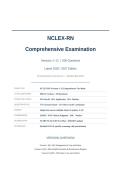
NCLEX-RN
Comprehensive Examination
Versions 1–12 | 600 Questions
Latest Edition
Actual Questions and Answers — Detailed Rationales
EXAM TITLE NCLEX-RN Versions 1–12 Comprehensive Test Bank
TOTAL QUESTIONS 600 (12 Versions × 50 Questions)
COGNITIVE LEVELS 20% Recall · 50% Application · 30% Analysis
QUESTION STYLE 75% Scenario-based · 25% Direct recall / calculation
FORMAT Single-best-answer multiple choice (4 options, A–D)
FRAMEWORKS ADPIE · NGN Clinical Judgment · ABC · Maslow
ALIGNED WITH NCSBN NCLEX-RN Test Plan · 2026/2027 updates
RATIONALES Detailed NCLEX-specific reasoning with prioritization
VERSION OVERVIEW
Version 1 (Q1–50): Management of Care and Safety
Version 2 (Q51–100): Health Promotion & Psychosocial Integrity
Version 3 (Q101–150): Basic Care and Comfort
,NCLEX-RN Comprehensive Exam | Versions 1-12 | 600 Questions 2026/2027 Edition
Version 4 (Q151–200): Pharmacological and Parenteral Therapies
Version 5 (Q201–250): Reduction of Risk Potential
Version 6 (Q251–300): Cardiovascular and Respiratory Systems
Version 7 (Q301–350): Neurological and Endocrine Systems
Version 8 (Q351–400): GI, Renal, and Musculoskeletal Systems
Version 9 (Q401–450): Integrated Pharmacology and Medication Safety
Version 10 (Q451–500): Comprehensive Integrated Scenarios — Adult Health
Version 11 (Q501–550): Next-Generation NCLEX Clinical Judgment
Version 12 (Q551–600): Comprehensive Final Review and Critical Thinking
Guaranteed Comprehension with Detailed Answer Rationales
Page 2
,NCLEX-RN Comprehensive Exam | Versions 1-12 | 600 Questions 2026/2027 Edition
VERSION 1 · Questions 1–50
Management of Care and Safety (Q1-50)
Client Rights, Advocacy, Delegation, Legal/Ethical Issues, and Safety/Infection Control
Q1: A client with a terminal illness tells the nurse, "I want to stop all treatment and go home to die." Which
action by the nurse demonstrates advocacy?
A. Notify the provider of the client's wishes and request a discharge order. [CORRECT]
B. Encourage the client to reconsider because treatment could prolong life.
C. Document the statement but continue prescribed treatments until the provider arrives.
D. Contact the hospital ethics committee before taking any action.
Correct Answer: A
Rationale: Advocacy requires the nurse to support the client's autonomous, informed decision and communicate it promptly
to the provider to initiate discharge planning and palliative care. Option B disregards client autonomy. Option C continues
unwanted treatment, violating informed consent. Option D delays action unnecessarily because no ethical dilemma exists
when a competent client refuses treatment.
Q2: A nurse on a medical unit is assigned four clients. Which client should the nurse assess FIRST?
A. A client 2 hours post-colonoscopy requesting clear liquids.
B. A client with chronic kidney disease whose potassium is 5.9 mEq/L.
C. A client with pneumonia whose pulse oximetry is 92% on room air.
D. A client with heart failure reporting dyspnea after walking to the bathroom. [CORRECT]
Correct Answer: D
Rationale: Using the ABC and acute-vs-chronic frameworks, the client with heart failure and new-onset dyspnea after
minimal exertion is unstable and requires immediate assessment for pulmonary edema. Option B is abnormal but expected
in CKD and not acutely life-threatening. Option C reflects expected hypoxemia with pneumonia and a stable trend. Option A
is a routine post-procedure need.
Q3: Which task is MOST appropriate for the RN to delegate to a licensed practical nurse (LPN)?
A. Initial admission assessment of a client transferred from the ICU.
B. Reinforcement of teaching for a stable client with a new colostomy. [CORRECT]
C. Development of a plan of care for a client with new-onset sepsis.
D. Evaluation of a client's response to IV nitroglycerin for chest pain.
Correct Answer: B
Rationale: LPNs may reinforce teaching for stable clients, an activity within their scope. Initial assessments, care planning
for unstable clients, and evaluation of complex IV medications require RN-level judgment (Options A, C, D). Delegation
follows the Five Rights: right task, right circumstance, right person, right communication, and right supervision.
Page 3
, NCLEX-RN Comprehensive Exam | Versions 1-12 | 600 Questions 2026/2027 Edition
Q4: A client refuses a blood transfusion due to religious beliefs. The provider insists the transfusion is
life-saving. What is the nurse's BEST action?
A. Administer the transfusion because the provider ordered it.
B. Notify the hospital legal department and withhold the transfusion.
C. Honor the client's refusal and document the refusal and provider notification. [CORRECT]
D. Ask the family to override the client's decision.
Correct Answer: C
Rationale: A competent adult has the legal and ethical right to refuse treatment, including life-saving measures. The nurse
must honor the refusal, document it thoroughly, notify the provider, and continue alternative supportive care. Administering
against refusal constitutes battery. Legal department notification may follow but does not override the client's autonomy.
Q5: Which finding indicates a breach of HIPAA?
A. Discussing a client's diagnosis with the oncoming nurse at shift change in a private report room.
B. Posting on social media about a "difficult patient" without using the client's name. [CORRECT]
C. Providing client information to a registered family member listed as authorized.
D. Faxing records to a specialist consulted on the case after obtaining verbal consent.
Correct Answer: B
Rationale: Any social media reference to a client, even without names, can identify the client through context and constitutes
a HIPAA violation. Option A is permitted through minimum-necessary information sharing for care. Option C is authorized
disclosure. Option D is permissible with consent for treatment purposes.
Q6: A nurse notices a colleague diverting controlled substances. Which action should the nurse take FIRST?
A. Confront the colleague privately and demand they stop.
B. Report the observation to the nurse manager and complete an incident report. [CORRECT]
C. Wait until there is definitive proof before taking action.
D. Discuss the suspicion with other staff members to confirm.
Correct Answer: B
Rationale: Substance diversion is a patient-safety and legal issue requiring immediate reporting through the chain of
command and documentation via incident report. Confronting the colleague (A) risks denial or destruction of evidence.
Delaying action (C) endangers clients. Discussing with other staff (D) violates confidentiality.
Q7: A client with a DNR order goes into cardiac arrest. The family at the bedside begs the nurse to "do
something." What is the appropriate nursing action?
A. Begin CPR because the family is requesting it.
B. Confirm the DNR order in the chart and provide comfort measures only. [CORRECT]
C. Call a code but inform the team not to intubate.
D. Ask the provider to revoke the DNR order immediately.
Correct Answer: B
Rationale: A valid DNR order must be honored regardless of family requests at the time of arrest. The nurse verifies the
order and provides compassionate end-of-life care. Initiating CPR (A) violates the order and client wishes. Calling a code
(C) creates confusion. The provider cannot revoke without the client or surrogate's consent.
Page 4