

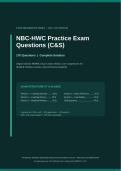
EXAM PREPARATION SERIES • EDITION
NBC-HWC Practice Exam
Questions (C&S)
170 Questions | Complete Solution
Aligned with the NBHWC Exam Content Outline, Core Competencies for
Health & Wellness Coaches, and Certification Standards.
EXAM STRUCTURE AT A GLANCE
Section 1 — Coaching Structure ......... 42 Q Section 4 — Ethics & Practice ......... 20 Q
Section 2 — Coaching Process .......... 50 Q Section 5 — Case Studies ................ 20 Q
Section 3 — Health & Wellness ......... 38 Q Total Questions .............................. 170 Q
Cognitive mix: 20% recall • 50% application • 30% analysis
Style: 70% scenario-based • 30% direct knowledge
NATIONAL BOARD CERTIFIED HEALTH & WELLNESS COACH | PRACTICE EXAMINATION
For educational use. Not affiliated with or endorsed by NBHWC or ICF.
,NBC-HWC Practice Exam (C&S) | 170 Questions | 2026/2027 Confidential Practice Material
NBC-HWC Practice Exam (C&S;) — Overview
This practice examination contains 170 multiple-choice questions covering the full breadth of the National Board
for Health & Wellness Coaching (NBHWC) Exam Content Outline and Core Competencies for the 2026/2027
testing cycle. The exam is organized into five sections that mirror the structure of the live NBC-HWC
examination: (1) Coaching Structure, (2) Coaching Process — Foundation, Assessment, Goal Setting and Action,
(3) Health & Wellness Knowledge including Biometrics and Risk Factors, (4) Ethics, Legal & Professional
Practice, and (5) Comprehensive Case Studies & Scenario-Based Questions.
Each question presents four options (A–D) with exactly one best correct answer. The correct option is marked
*[CORRECT]* and a concise rationale follows each question, citing the relevant NBHWC content domain and
the underlying coaching competency. The cognitive level distribution approximates the live exam: 20% recall,
50% application, and 30% analysis. Approximately 70% of items are scenario-based, requiring integration of
multiple competencies.
Section Topic Questions Cognitive Focus
1 Coaching Structure Q1 – Q42 (42) Recall + Application
2 Coaching Process Q43 – Q92 (50) Application + Analysis
3 Health & Wellness Knowledge (incl. Biometrics) Q93 – Q130 (38) Application
4 Ethics, Legal & Professional Practice Q131 – Q150 (20) Analysis + Recall
5 Comprehensive Case Studies Q151 – Q170 (20) Analysis (Scenario)
TOTAL 170 questions 20/50/30 mix
Special Inclusions
This practice exam deliberately over-samples three high-yield areas to mirror recent NBHWC blueprints: (a) 30
scenario-based coaching questions distributed across Sections 2 and 5 requiring application of core
competencies, the Transtheoretical Model (Stages of Change), and Motivational Interviewing techniques; (b) 20
biometric interpretation questions in Section 3 applying health risk knowledge (HbA1c, waist-to-hip ratio,
blood pressure, LDL cholesterol, BMI, and physical activity level) to coaching scenarios; and (c) 10 ethics and
scope-of-practice questions in Section 4 covering conflict of interest, confidentiality, boundaries, and HIPAA
compliance.
How to Use This Exam
Allow approximately 3.5 hours for a complete sitting, or work through one section at a time as a focused study
block. Read each stem carefully, paying close attention to whether the question asks for the best, first, most
appropriate, or least appropriate response — these qualifiers materially change the correct answer. After selecting
your response, review the rationale even when you answered correctly; the rationale explains why the chosen
option is right and why each distractor is wrong, which strengthens pattern recognition for the live exam.
Aligned with NBHWC Exam Content Outline & Core Competencies (2026/2027 Edition) Page 2
,NBC-HWC Practice Exam (C&S) | 170 Questions | 2026/2027 Confidential Practice Material
Section 1: Coaching Structure
Coach preparation, intake & agreement, climate & rapport, vision/values, client-as-
expert (42 questions)
This section assesses the foundational structure of coaching: how the coach prepares before sessions, establishes
the coaching agreement and rapport during intake, determines whether a client is an appropriate candidate, and
explores vision, values, and priorities while leaving the client in the expert role on what to work on.
Q1. Before meeting a new coaching client for the first intake session, which of the following represents the
MOST appropriate coach preparation?
A. Draft a tentative wellness plan with three SMART goals the coach believes the client should pursue, so the
session has direction.
B. Review any intake forms, health-history questionnaires, or self-assessments the client has submitted, while
remaining open to the client's own agenda. *[CORRECT]*
C. Contact the client's physician to obtain a clinical treatment plan that the coach will reinforce during coaching.
D. Decide which stage of change the client is most likely in so the coach can apply the matching intervention
immediately.
Correct Answer: B
Rationale: NBHWC Content Outline domain 'Coaching Structure' requires coaches to review materials in advance of
sessions while remaining mindful that the client's agenda—not the coach's—drives the work. Drafting goals (A), seeking
a clinical plan to reinforce (C), or pre-assigning a stage of change (D) all violate the client-as-expert principle and risk
coach-driven agendas.
Q2. Which action BEST exemplifies a coach eliminating distractions before a virtual coaching session?
A. Keeping a smartphone face-up on the desk so the coach can monitor urgent messages during the session.
B. Closing email and chat applications, silencing notifications, and arranging a private, well-lit space with
minimal background noise. *[CORRECT]*
C. Conducting the session from a coffee shop so the client sees the coach as relatable and informal.
D. Multitasking light administrative work while the client speaks, so the coach uses time efficiently.
Correct Answer: B
Rationale: NBHWC 'Coaching Structure' calls on the coach to eliminate internal and external distractions to sustain
attention. Closing applications and silencing devices (B) directly serves this competency; the other choices introduce
distractions that fragment attention and signal to the client that they do not have the coach's full presence.
Q3. What is the PRIMARY purpose of a coach reviewing a client's submitted intake materials before the
first session?
A. To identify the goal the coach will propose during the session.
B. To familiarize the coach with the client's context so questions can be more attuned, while leaving the
agenda-setting to the client. *[CORRECT]*
C. To determine whether the client meets medical criteria for coaching.
D. To screen for psychiatric diagnoses that would disqualify the client from any coaching relationship.
Correct Answer: B
Rationale: Intake materials inform—not replace—the coaching conversation. The coach reviews them to ask better,
more individualized questions, while the client retains authority over what to work on. Coach-driven goal setting (A) and
clinical screening for medical eligibility (C, D) exceed coaching scope of practice.
Aligned with NBHWC Exam Content Outline & Core Competencies (2026/2027 Edition) Page 3
, NBC-HWC Practice Exam (C&S) | 170 Questions | 2026/2027 Confidential Practice Material
Q4. A coach discovers, while reviewing intake materials, that a prospective client reported active suicidal
ideation two days ago. The MOST appropriate action is to:
A. Proceed with the intake session and address the suicidal ideation as a wellness goal once rapport is built.
B. Contact the client before the scheduled session, express concern, and refer immediately to crisis or
mental-health services, declining coaching engagement until the situation is stable. *[CORRECT]*
C. Begin coaching immediately but include a 'no self-harm' clause in the coaching agreement.
D. Notify the client's emergency contact without the client's knowledge and proceed with the session as planned.
Correct Answer: B
Rationale: Suicidal ideation is outside the scope of health & wellness coaching. The NBHWC Code of Ethics and
scope-of-practice standards require coaches to recognize red flags and refer to appropriate professionals before
establishing a coaching relationship. Proceeding (A), contracting around self-harm (C), or breaching confidentiality
without consent (D) are ethical violations.
Q5. During the very first minutes of an intake session, the coach should PRIMARILY:
A. Review the client's health history questionnaire line-by-line to verify accuracy.
B. Establish rapport, set the climate, and orient the client to what coaching is and is not. *[CORRECT]*
C. Administer a validated stage-of-change assessment to triage the client.
D. Present the coach's recommended first goal so the client has direction for the rest of the session.
Correct Answer: B
Rationale: NBHWC Core Competencies identify 'setting the climate' and 'establishing rapport' as the first-session
priorities; clients must understand the nature of coaching before meaningful work begins. Verification of forms (A),
assessment administration (C), and goal-setting (D) all come after the relationship and frame are established.
Q6. Which element MUST be included in a coaching agreement under the NBHWC Code of Ethics?
A. The coach's personal wellness goals as a model for the client.
B. A clear description of the nature and limits of confidentiality, scope of practice, and the roles and
responsibilities of both coach and client. *[CORRECT]*
C. A guarantee of specific health outcomes if the client follows the coach's recommendations.
D. A clause assigning the coach intellectual-property rights over the client's wellness plan.
Correct Answer: B
Rationale: The coaching agreement (informed consent) must transparently address confidentiality, scope, boundaries,
roles, and responsibilities. Guarantees of outcome (C) and IP claims over client plans (D) are unethical. Personal
wellness goals (A) are not part of the formal agreement.
Q7. A new client asks, 'So you'll be telling me what to eat and how to exercise, right?' The coach's MOST
appropriate response is to:
A. Agree, because clients expect expert guidance and outcomes suffer without it.
B. Clarify that coaching is a partnership in which the client remains the expert on their own life and selects
the focus, while the coach facilitates self-discovery and supports behavior change. *[CORRECT]*
C. Agree to give advice but only after the client has tried their own plan for 30 days.
D. Explain that the coach cannot give any health information at all, ever, under HIPAA.
Correct Answer: B
Rationale: Scope of practice under NBHWC positions the coach as a partner and facilitator, not a prescriber. Option B
reflects the client-as-expert and self-directed learning principles. Advice-giving (A, C) and the absolute prohibition on
information (D) both misrepresent the coaching role.
Aligned with NBHWC Exam Content Outline & Core Competencies (2026/2027 Edition) Page 4
NBC-HWC Practice Exam
Questions (C&S)
170 Questions | Complete Solution
Aligned with the NBHWC Exam Content Outline, Core Competencies for
Health & Wellness Coaches, and Certification Standards.
EXAM STRUCTURE AT A GLANCE
Section 1 — Coaching Structure ......... 42 Q Section 4 — Ethics & Practice ......... 20 Q
Section 2 — Coaching Process .......... 50 Q Section 5 — Case Studies ................ 20 Q
Section 3 — Health & Wellness ......... 38 Q Total Questions .............................. 170 Q
Cognitive mix: 20% recall • 50% application • 30% analysis
Style: 70% scenario-based • 30% direct knowledge
NATIONAL BOARD CERTIFIED HEALTH & WELLNESS COACH | PRACTICE EXAMINATION
For educational use. Not affiliated with or endorsed by NBHWC or ICF.
,NBC-HWC Practice Exam (C&S) | 170 Questions | 2026/2027 Confidential Practice Material
NBC-HWC Practice Exam (C&S;) — Overview
This practice examination contains 170 multiple-choice questions covering the full breadth of the National Board
for Health & Wellness Coaching (NBHWC) Exam Content Outline and Core Competencies for the 2026/2027
testing cycle. The exam is organized into five sections that mirror the structure of the live NBC-HWC
examination: (1) Coaching Structure, (2) Coaching Process — Foundation, Assessment, Goal Setting and Action,
(3) Health & Wellness Knowledge including Biometrics and Risk Factors, (4) Ethics, Legal & Professional
Practice, and (5) Comprehensive Case Studies & Scenario-Based Questions.
Each question presents four options (A–D) with exactly one best correct answer. The correct option is marked
*[CORRECT]* and a concise rationale follows each question, citing the relevant NBHWC content domain and
the underlying coaching competency. The cognitive level distribution approximates the live exam: 20% recall,
50% application, and 30% analysis. Approximately 70% of items are scenario-based, requiring integration of
multiple competencies.
Section Topic Questions Cognitive Focus
1 Coaching Structure Q1 – Q42 (42) Recall + Application
2 Coaching Process Q43 – Q92 (50) Application + Analysis
3 Health & Wellness Knowledge (incl. Biometrics) Q93 – Q130 (38) Application
4 Ethics, Legal & Professional Practice Q131 – Q150 (20) Analysis + Recall
5 Comprehensive Case Studies Q151 – Q170 (20) Analysis (Scenario)
TOTAL 170 questions 20/50/30 mix
Special Inclusions
This practice exam deliberately over-samples three high-yield areas to mirror recent NBHWC blueprints: (a) 30
scenario-based coaching questions distributed across Sections 2 and 5 requiring application of core
competencies, the Transtheoretical Model (Stages of Change), and Motivational Interviewing techniques; (b) 20
biometric interpretation questions in Section 3 applying health risk knowledge (HbA1c, waist-to-hip ratio,
blood pressure, LDL cholesterol, BMI, and physical activity level) to coaching scenarios; and (c) 10 ethics and
scope-of-practice questions in Section 4 covering conflict of interest, confidentiality, boundaries, and HIPAA
compliance.
How to Use This Exam
Allow approximately 3.5 hours for a complete sitting, or work through one section at a time as a focused study
block. Read each stem carefully, paying close attention to whether the question asks for the best, first, most
appropriate, or least appropriate response — these qualifiers materially change the correct answer. After selecting
your response, review the rationale even when you answered correctly; the rationale explains why the chosen
option is right and why each distractor is wrong, which strengthens pattern recognition for the live exam.
Aligned with NBHWC Exam Content Outline & Core Competencies (2026/2027 Edition) Page 2
,NBC-HWC Practice Exam (C&S) | 170 Questions | 2026/2027 Confidential Practice Material
Section 1: Coaching Structure
Coach preparation, intake & agreement, climate & rapport, vision/values, client-as-
expert (42 questions)
This section assesses the foundational structure of coaching: how the coach prepares before sessions, establishes
the coaching agreement and rapport during intake, determines whether a client is an appropriate candidate, and
explores vision, values, and priorities while leaving the client in the expert role on what to work on.
Q1. Before meeting a new coaching client for the first intake session, which of the following represents the
MOST appropriate coach preparation?
A. Draft a tentative wellness plan with three SMART goals the coach believes the client should pursue, so the
session has direction.
B. Review any intake forms, health-history questionnaires, or self-assessments the client has submitted, while
remaining open to the client's own agenda. *[CORRECT]*
C. Contact the client's physician to obtain a clinical treatment plan that the coach will reinforce during coaching.
D. Decide which stage of change the client is most likely in so the coach can apply the matching intervention
immediately.
Correct Answer: B
Rationale: NBHWC Content Outline domain 'Coaching Structure' requires coaches to review materials in advance of
sessions while remaining mindful that the client's agenda—not the coach's—drives the work. Drafting goals (A), seeking
a clinical plan to reinforce (C), or pre-assigning a stage of change (D) all violate the client-as-expert principle and risk
coach-driven agendas.
Q2. Which action BEST exemplifies a coach eliminating distractions before a virtual coaching session?
A. Keeping a smartphone face-up on the desk so the coach can monitor urgent messages during the session.
B. Closing email and chat applications, silencing notifications, and arranging a private, well-lit space with
minimal background noise. *[CORRECT]*
C. Conducting the session from a coffee shop so the client sees the coach as relatable and informal.
D. Multitasking light administrative work while the client speaks, so the coach uses time efficiently.
Correct Answer: B
Rationale: NBHWC 'Coaching Structure' calls on the coach to eliminate internal and external distractions to sustain
attention. Closing applications and silencing devices (B) directly serves this competency; the other choices introduce
distractions that fragment attention and signal to the client that they do not have the coach's full presence.
Q3. What is the PRIMARY purpose of a coach reviewing a client's submitted intake materials before the
first session?
A. To identify the goal the coach will propose during the session.
B. To familiarize the coach with the client's context so questions can be more attuned, while leaving the
agenda-setting to the client. *[CORRECT]*
C. To determine whether the client meets medical criteria for coaching.
D. To screen for psychiatric diagnoses that would disqualify the client from any coaching relationship.
Correct Answer: B
Rationale: Intake materials inform—not replace—the coaching conversation. The coach reviews them to ask better,
more individualized questions, while the client retains authority over what to work on. Coach-driven goal setting (A) and
clinical screening for medical eligibility (C, D) exceed coaching scope of practice.
Aligned with NBHWC Exam Content Outline & Core Competencies (2026/2027 Edition) Page 3
, NBC-HWC Practice Exam (C&S) | 170 Questions | 2026/2027 Confidential Practice Material
Q4. A coach discovers, while reviewing intake materials, that a prospective client reported active suicidal
ideation two days ago. The MOST appropriate action is to:
A. Proceed with the intake session and address the suicidal ideation as a wellness goal once rapport is built.
B. Contact the client before the scheduled session, express concern, and refer immediately to crisis or
mental-health services, declining coaching engagement until the situation is stable. *[CORRECT]*
C. Begin coaching immediately but include a 'no self-harm' clause in the coaching agreement.
D. Notify the client's emergency contact without the client's knowledge and proceed with the session as planned.
Correct Answer: B
Rationale: Suicidal ideation is outside the scope of health & wellness coaching. The NBHWC Code of Ethics and
scope-of-practice standards require coaches to recognize red flags and refer to appropriate professionals before
establishing a coaching relationship. Proceeding (A), contracting around self-harm (C), or breaching confidentiality
without consent (D) are ethical violations.
Q5. During the very first minutes of an intake session, the coach should PRIMARILY:
A. Review the client's health history questionnaire line-by-line to verify accuracy.
B. Establish rapport, set the climate, and orient the client to what coaching is and is not. *[CORRECT]*
C. Administer a validated stage-of-change assessment to triage the client.
D. Present the coach's recommended first goal so the client has direction for the rest of the session.
Correct Answer: B
Rationale: NBHWC Core Competencies identify 'setting the climate' and 'establishing rapport' as the first-session
priorities; clients must understand the nature of coaching before meaningful work begins. Verification of forms (A),
assessment administration (C), and goal-setting (D) all come after the relationship and frame are established.
Q6. Which element MUST be included in a coaching agreement under the NBHWC Code of Ethics?
A. The coach's personal wellness goals as a model for the client.
B. A clear description of the nature and limits of confidentiality, scope of practice, and the roles and
responsibilities of both coach and client. *[CORRECT]*
C. A guarantee of specific health outcomes if the client follows the coach's recommendations.
D. A clause assigning the coach intellectual-property rights over the client's wellness plan.
Correct Answer: B
Rationale: The coaching agreement (informed consent) must transparently address confidentiality, scope, boundaries,
roles, and responsibilities. Guarantees of outcome (C) and IP claims over client plans (D) are unethical. Personal
wellness goals (A) are not part of the formal agreement.
Q7. A new client asks, 'So you'll be telling me what to eat and how to exercise, right?' The coach's MOST
appropriate response is to:
A. Agree, because clients expect expert guidance and outcomes suffer without it.
B. Clarify that coaching is a partnership in which the client remains the expert on their own life and selects
the focus, while the coach facilitates self-discovery and supports behavior change. *[CORRECT]*
C. Agree to give advice but only after the client has tried their own plan for 30 days.
D. Explain that the coach cannot give any health information at all, ever, under HIPAA.
Correct Answer: B
Rationale: Scope of practice under NBHWC positions the coach as a partner and facilitator, not a prescriber. Option B
reflects the client-as-expert and self-directed learning principles. Advice-giving (A, C) and the absolute prohibition on
information (D) both misrepresent the coaching role.
Aligned with NBHWC Exam Content Outline & Core Competencies (2026/2027 Edition) Page 4


