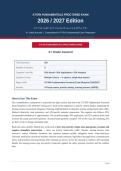
ATI RN FUNDAMENTALS PROCTORED EXAM
Edition
150 Questions with Detailed Answers & Rationales
EDITION
A+ Grade Assured | Comprehensive ATI RN Fundamentals Exam Preparation
150 Questions with Detailed Answers & Rationales
ATI RN FUNDAMENTALS PROCTORED EXAM
A+ Grade Assured
Total Questions 150
Number of Sections 8
Cognitive Level Mix 25% Recall • 50% Application • 25% Analysis
Question Format Multiple Choice — 4 options, single best answer
Aligned With ATI RN Fundamentals Proctored Exam Blueprint 2026/2027
Includes ATI-style stems, priority setting, nursing process (ADPIE)
How to Use This Exam
This comprehensive examination is structured into eight sections that mirror the ATI RN Fundamentals Proctored
Exam blueprint for the 2026/2027 testing cycle. Each section emphasizes a specific content domain, integrating the
nursing process (Assessment, Diagnosis, Planning, Implementation, Evaluation), priority-setting frameworks (ABC,
Maslow's Hierarchy, least restrictive), and ATI-specific rationale construction. The cognitive mix follows ATI's
recommended distribution of approximately 25% recall/knowledge, 50% application, and 25% analysis-level items
to mirror the actual proctored experience. Scenario-based questions comprise 75% of the exam; the remaining 25%
are direct recall or dosage-calculation items.
Read each stem carefully. Identify key words such as first, best, priority, initial, most appropriate, essential, and
requires immediate intervention — these cue priority frameworks (ABC, Maslow, nursing process, least
restrictive, safety). Eliminate distractors that represent common pitfalls: delegation errors, scope-of-practice
violations, medication calculation mistakes, infection-control confusion, legal/ethical misapplication, communication
errors, and procedure step misordering. After choosing an answer, review the rationale to reinforce ATI reasoning:
identify the nursing process step, the priority framework applied, the safety principle involved, and the evidence
base.
Page 1
,ATI RN Fundamentals Proctored Exam 2026/2027 — 150 Questions with Detailed Answers & Rationales A+ Grade Assured
Exam Content Map
Section Topic Question Range Count
1 Management of Care Q1 – Q30 30
2 Safety and Infection Control Q31 – Q50 20
3 Health Promotion and Maintenance Q51 – Q65 15
4 Psychosocial Integrity Q66 – Q80 15
5 Basic Care and Comfort Q81 – Q100 20
6 Pharmacological and Parenteral Therapies Q101 – Q120 20
7 Reduction of Risk Potential Q121 – Q135 15
8 Physiological Adaptation Q136 – Q150 15
TOTAL 150
ATI RN Fundamentals Proctored Exam Preparation Page 2
,ATI RN Fundamentals Proctored Exam 2026/2027 — 150 Questions with Detailed Answers & Rationales A+ Grade Assured
SECTION 1 — Safe, Effective Care Environment: Management of Care
Client Rights • Delegation • Legal/Ethical Issues • HIPAA • Advance Directives • Informed Consent • Advocacy (Q1–Q30)
Directions: Choose the single best answer for each question. Correct answer is marked [CORRECT], followed by
the rationale explaining ATI-specific reasoning, the nursing process step, priority framework, and safety principle.
Q1. A client scheduled for an emergency appendectomy asks the nurse to explain the surgery in detail before signing
the consent form. The surgeon is in the operating room and cannot be reached for 15 minutes. Which action should
the nurse take to fulfill the role of client advocate while respecting informed consent?
A. Explain the procedure, risks, and benefits in detail and have the client sign the consent
B. Withhold the consent form, document the client's request, and notify the surgeon as soon as possible
C. Have the client sign the consent with a note that the surgeon will explain after surgery
D. Contact the surgeon by phone to provide the explanation to the client, then witness the client's
signature [CORRECT]
Correct Answer: D
Rationale: Informed consent requires the provider (not the nurse) to disclose the diagnosis, proposed procedure,
risks, benefits, and alternatives. The nurse's role is to witness the signature and verify understanding, not to obtain
consent. Contacting the surgeon by phone preserves the client's autonomy (right to informed consent) and supports
advocacy, while still allowing timely emergency care. Options A and C inappropriately delegate consent to the nurse,
and option B delays needed treatment without offering a workable solution.
Q2. An RN on a medical-surgical unit is assigned a team consisting of one LPN and one UAP. Which of the
following tasks is most appropriate for the RN to assign to the LPN?
A. Ambulating a client two days postoperatively with a Foley catheter
B. Reinforcing discharge teaching about a new low-sodium diet to a client with heart failure
C. Administering oral medications to a stable client with a nasogastric tube [CORRECT]
D. Performing the initial admission assessment on a newly admitted client with pneumonia
Correct Answer: C
Rationale: The LPN scope includes administering oral medications and caring for stable clients with predictable
needs, fitting the Five Rights of Delegation (right task, right circumstance, right person, right direction, right
supervision). Initial admission assessments (D) require RN-level judgment per the nursing process (Assessment step is
non-delegable). Discharge teaching (B) requires RN evaluation of comprehension. Ambulating a post-op client with a
Foley (A) is safely within UAP scope with stable, predictable clients, freeing the LPN for medication administration.
Q3. A client with a terminal illness has a living will that requests no resuscitation, but the client's adult daughter
insists the healthcare team "do everything" to keep her parent alive. What is the nurse's most appropriate action?
A. Follow the daughter's wishes because she is the next of kin
B. Initiate resuscitation efforts if the client arrests while awaiting clarification
C. Honor the living will and notify the provider of the advance directive [CORRECT]
D. Ask the ethics committee to convene before any care decisions are made
Correct Answer: C
ATI RN Fundamentals Proctored Exam Preparation Page 3
, ATI RN Fundamentals Proctored Exam 2026/2027 — 150 Questions with Detailed Answers & Rationales A+ Grade Assured
Rationale: A living will is a form of advance directive that guides care when the client cannot communicate; it reflects
the client's autonomy and must be honored over family preferences. The nurse's role as advocate is to ensure the
documented wishes are followed and to notify the provider so the medical record and orders are consistent (
beneficence + autonomy). Initiating resuscitation against the directive (B) violates the client's rights. Ethics
committee consultation (D) may help with conflict resolution but does not override the legal directive.
Q4. A nurse observes a coworker document a medication as given when it was actually left in the client's drawer.
The nurse first verifies the client is safe, then completes an incident report. Which ethical principle is most directly
upheld by the nurse's documentation?
A. Autonomy
B. Veracity [CORRECT]
C. Justice
D. Beneficence
Correct Answer: B
Rationale: Veracity is the duty to tell the truth and document accurately; the incident report reflects truthful, factual
accounting of an error so the system can learn and prevent recurrence. Beneficence (D) underlies client safety but is
not the principle demonstrated by documentation. Autonomy (A) concerns self-determination; justice (C) concerns fair
distribution of resources. Documentation of errors also supports nonmaleficence by enabling corrective action and
protects the nurse professionally.
Q5. A client is admitted after a suicide attempt. The client states, "I don't want anyone to know why I'm here." Which
response by the nurse best balances HIPAA with safety obligations?
A. Promise not to disclose any information to anyone, including the treatment team
B. Explain that protected health information is shared only as needed for treatment, payment, and
operations, and that safety concerns must be communicated to the care team [CORRECT]
C. Tell the client that HIPAA does not apply in psychiatric settings
D. Agree to keep the reason for admission confidential from the provider
Correct Answer: B
Rationale: HIPAA permits disclosure of protected health information for treatment, payment, and healthcare
operations (TPO) without separate authorization, and safety threats can override confidentiality. Option B accurately
explains this balance and supports the therapeutic relationship while ensuring the treatment team can address risk.
Complete silence (A, D) endangers the client and violates the nurse's duty to warn/protect. Option C is incorrect
because HIPAA applies to all covered entities, including psychiatric units.
Q6. An older adult client with mild dementia is scheduled for a hip replacement. The client can verbalize the
procedure but cannot state the risks. Who is responsible for obtaining informed consent, and what is the nurse's role?
A. The nurse obtains consent and documents the client's understanding
B. The surgeon obtains consent; the nurse assesses understanding and notifies the surgeon if deficits are
present [CORRECT]
C. The family must provide consent because the client has dementia
D. Consent is not required because the procedure is medically necessary
Correct Answer: B
Rationale: Informed consent is obtained by the provider performing the procedure. The nurse's role is to witness the
signature and assess the client's capacity to understand; if capacity is questionable, the provider must be notified and
ATI RN Fundamentals Proctored Exam Preparation Page 4
Edition
150 Questions with Detailed Answers & Rationales
EDITION
A+ Grade Assured | Comprehensive ATI RN Fundamentals Exam Preparation
150 Questions with Detailed Answers & Rationales
ATI RN FUNDAMENTALS PROCTORED EXAM
A+ Grade Assured
Total Questions 150
Number of Sections 8
Cognitive Level Mix 25% Recall • 50% Application • 25% Analysis
Question Format Multiple Choice — 4 options, single best answer
Aligned With ATI RN Fundamentals Proctored Exam Blueprint 2026/2027
Includes ATI-style stems, priority setting, nursing process (ADPIE)
How to Use This Exam
This comprehensive examination is structured into eight sections that mirror the ATI RN Fundamentals Proctored
Exam blueprint for the 2026/2027 testing cycle. Each section emphasizes a specific content domain, integrating the
nursing process (Assessment, Diagnosis, Planning, Implementation, Evaluation), priority-setting frameworks (ABC,
Maslow's Hierarchy, least restrictive), and ATI-specific rationale construction. The cognitive mix follows ATI's
recommended distribution of approximately 25% recall/knowledge, 50% application, and 25% analysis-level items
to mirror the actual proctored experience. Scenario-based questions comprise 75% of the exam; the remaining 25%
are direct recall or dosage-calculation items.
Read each stem carefully. Identify key words such as first, best, priority, initial, most appropriate, essential, and
requires immediate intervention — these cue priority frameworks (ABC, Maslow, nursing process, least
restrictive, safety). Eliminate distractors that represent common pitfalls: delegation errors, scope-of-practice
violations, medication calculation mistakes, infection-control confusion, legal/ethical misapplication, communication
errors, and procedure step misordering. After choosing an answer, review the rationale to reinforce ATI reasoning:
identify the nursing process step, the priority framework applied, the safety principle involved, and the evidence
base.
Page 1
,ATI RN Fundamentals Proctored Exam 2026/2027 — 150 Questions with Detailed Answers & Rationales A+ Grade Assured
Exam Content Map
Section Topic Question Range Count
1 Management of Care Q1 – Q30 30
2 Safety and Infection Control Q31 – Q50 20
3 Health Promotion and Maintenance Q51 – Q65 15
4 Psychosocial Integrity Q66 – Q80 15
5 Basic Care and Comfort Q81 – Q100 20
6 Pharmacological and Parenteral Therapies Q101 – Q120 20
7 Reduction of Risk Potential Q121 – Q135 15
8 Physiological Adaptation Q136 – Q150 15
TOTAL 150
ATI RN Fundamentals Proctored Exam Preparation Page 2
,ATI RN Fundamentals Proctored Exam 2026/2027 — 150 Questions with Detailed Answers & Rationales A+ Grade Assured
SECTION 1 — Safe, Effective Care Environment: Management of Care
Client Rights • Delegation • Legal/Ethical Issues • HIPAA • Advance Directives • Informed Consent • Advocacy (Q1–Q30)
Directions: Choose the single best answer for each question. Correct answer is marked [CORRECT], followed by
the rationale explaining ATI-specific reasoning, the nursing process step, priority framework, and safety principle.
Q1. A client scheduled for an emergency appendectomy asks the nurse to explain the surgery in detail before signing
the consent form. The surgeon is in the operating room and cannot be reached for 15 minutes. Which action should
the nurse take to fulfill the role of client advocate while respecting informed consent?
A. Explain the procedure, risks, and benefits in detail and have the client sign the consent
B. Withhold the consent form, document the client's request, and notify the surgeon as soon as possible
C. Have the client sign the consent with a note that the surgeon will explain after surgery
D. Contact the surgeon by phone to provide the explanation to the client, then witness the client's
signature [CORRECT]
Correct Answer: D
Rationale: Informed consent requires the provider (not the nurse) to disclose the diagnosis, proposed procedure,
risks, benefits, and alternatives. The nurse's role is to witness the signature and verify understanding, not to obtain
consent. Contacting the surgeon by phone preserves the client's autonomy (right to informed consent) and supports
advocacy, while still allowing timely emergency care. Options A and C inappropriately delegate consent to the nurse,
and option B delays needed treatment without offering a workable solution.
Q2. An RN on a medical-surgical unit is assigned a team consisting of one LPN and one UAP. Which of the
following tasks is most appropriate for the RN to assign to the LPN?
A. Ambulating a client two days postoperatively with a Foley catheter
B. Reinforcing discharge teaching about a new low-sodium diet to a client with heart failure
C. Administering oral medications to a stable client with a nasogastric tube [CORRECT]
D. Performing the initial admission assessment on a newly admitted client with pneumonia
Correct Answer: C
Rationale: The LPN scope includes administering oral medications and caring for stable clients with predictable
needs, fitting the Five Rights of Delegation (right task, right circumstance, right person, right direction, right
supervision). Initial admission assessments (D) require RN-level judgment per the nursing process (Assessment step is
non-delegable). Discharge teaching (B) requires RN evaluation of comprehension. Ambulating a post-op client with a
Foley (A) is safely within UAP scope with stable, predictable clients, freeing the LPN for medication administration.
Q3. A client with a terminal illness has a living will that requests no resuscitation, but the client's adult daughter
insists the healthcare team "do everything" to keep her parent alive. What is the nurse's most appropriate action?
A. Follow the daughter's wishes because she is the next of kin
B. Initiate resuscitation efforts if the client arrests while awaiting clarification
C. Honor the living will and notify the provider of the advance directive [CORRECT]
D. Ask the ethics committee to convene before any care decisions are made
Correct Answer: C
ATI RN Fundamentals Proctored Exam Preparation Page 3
, ATI RN Fundamentals Proctored Exam 2026/2027 — 150 Questions with Detailed Answers & Rationales A+ Grade Assured
Rationale: A living will is a form of advance directive that guides care when the client cannot communicate; it reflects
the client's autonomy and must be honored over family preferences. The nurse's role as advocate is to ensure the
documented wishes are followed and to notify the provider so the medical record and orders are consistent (
beneficence + autonomy). Initiating resuscitation against the directive (B) violates the client's rights. Ethics
committee consultation (D) may help with conflict resolution but does not override the legal directive.
Q4. A nurse observes a coworker document a medication as given when it was actually left in the client's drawer.
The nurse first verifies the client is safe, then completes an incident report. Which ethical principle is most directly
upheld by the nurse's documentation?
A. Autonomy
B. Veracity [CORRECT]
C. Justice
D. Beneficence
Correct Answer: B
Rationale: Veracity is the duty to tell the truth and document accurately; the incident report reflects truthful, factual
accounting of an error so the system can learn and prevent recurrence. Beneficence (D) underlies client safety but is
not the principle demonstrated by documentation. Autonomy (A) concerns self-determination; justice (C) concerns fair
distribution of resources. Documentation of errors also supports nonmaleficence by enabling corrective action and
protects the nurse professionally.
Q5. A client is admitted after a suicide attempt. The client states, "I don't want anyone to know why I'm here." Which
response by the nurse best balances HIPAA with safety obligations?
A. Promise not to disclose any information to anyone, including the treatment team
B. Explain that protected health information is shared only as needed for treatment, payment, and
operations, and that safety concerns must be communicated to the care team [CORRECT]
C. Tell the client that HIPAA does not apply in psychiatric settings
D. Agree to keep the reason for admission confidential from the provider
Correct Answer: B
Rationale: HIPAA permits disclosure of protected health information for treatment, payment, and healthcare
operations (TPO) without separate authorization, and safety threats can override confidentiality. Option B accurately
explains this balance and supports the therapeutic relationship while ensuring the treatment team can address risk.
Complete silence (A, D) endangers the client and violates the nurse's duty to warn/protect. Option C is incorrect
because HIPAA applies to all covered entities, including psychiatric units.
Q6. An older adult client with mild dementia is scheduled for a hip replacement. The client can verbalize the
procedure but cannot state the risks. Who is responsible for obtaining informed consent, and what is the nurse's role?
A. The nurse obtains consent and documents the client's understanding
B. The surgeon obtains consent; the nurse assesses understanding and notifies the surgeon if deficits are
present [CORRECT]
C. The family must provide consent because the client has dementia
D. Consent is not required because the procedure is medically necessary
Correct Answer: B
Rationale: Informed consent is obtained by the provider performing the procedure. The nurse's role is to witness the
signature and assess the client's capacity to understand; if capacity is questionable, the provider must be notified and
ATI RN Fundamentals Proctored Exam Preparation Page 4