1
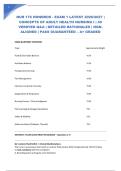
NUR 176 HONDROS - EXAM 1 LATEST 2026/2027 |
CONCEPTS OF ADULT HEALTH NURSING I | 40
VERIFIED Q&A | DETAILED RATIONALES | NGN-
ALIGNED | PASS GUARANTEED – A+ GRADED
EXAM BLUEPRINT OVERVIEW
Topic Approximate Weight
Fluid & Electrolyte Balance ~15%
Acid-Base Balance ~15%
Perioperative Nursing ~15%
Pain Management ~10%
Infection Control & Immunity ~10%
Oxygenation & Respiratory ~10%
Nursing Process / Clinical Judgment ~10%
Pharmacology & Dosage Calculations ~5%
Safety & Mobility ~5%
Endocrine Basics (Diabetes, Thyroid) ~5%
SECTION 1: FLUID & ELECTROLYTE BALANCE – Questions 1–6
Q1: Isotonic Fluid Deficit – Clinical Manifestations
The nurse is assessing a client with an isotonic fluid volume deficit (hypovolemia). Which finding
is most consistent with this condition?
A. Bounding pulse and jugular vein distention
, 2
B. Orthostatic hypotension and flat neck veins
C. Crackles in lung bases and peripheral edema
D. Weight gain and decreased hematocrit
Correct Answer: B
Rationale: Isotonic fluid deficit causes decreased vascular volume, leading to orthostatic
hypotension, tachycardia, flat neck veins, poor skin turgor, and increased hematocrit. Bounding
pulse, JVD, crackles, and edema are signs of fluid overload. [100% CORRECT]
Q2: Hyponatremia – Priority Assessment
A client with hyponatremia (serum Na⁺ 128 mEq/L) is at risk for which life-threatening complication?
A. Hyperkalemia
B. Cerebral edema and seizures
C. Pulmonary embolism
D. Cardiac tamponade
Correct Answer: B
Rationale: Hyponatremia causes water to shift into brain cells, leading to cerebral edema, confusion,
headaches, and seizures. Rapid correction is needed but must be done cautiously to avoid osmotic
demyelination syndrome. [100% CORRECT]
Q3: Hyperkalemia – ECG Changes
A client with chronic kidney disease has a serum potassium of 6.8 mEq/L. Which ECG change is the
nurse most likely to observe?
A. Prolonged PR interval and flat T waves
B. Tall, peaked T waves and widened QRS
C. U waves and ST depression
D. Prolonged QT interval
Correct Answer: B
Rationale: Hyperkalemia causes tall, peaked (tented) T waves, widened QRS, and eventually a sine-
wave pattern leading to cardiac arrest. Flat T waves and U waves are seen in hypokalemia. [100%
CORRECT]
Q4: Hypocalcemia – Positive Sign
The nurse assesses a client with hypocalcemia. Which finding indicates a positive Trousseau's sign?
A. Facial twitching when the facial nerve is tapped
B. Dorsiflexion of the foot when the calf is squeezed
C. Carpal spasm when the blood pressure cuff is inflated
D. Numbness and tingling around the mouth
Correct Answer: C
Rationale: Trousseau's sign (carpal spasm) is elicited by inflating a blood pressure cuff above systolic
pressure for 3 minutes. It indicates hypocalcemia. Facial twitching (Chvostek's sign) is another sign,
but that is facial nerve tapping. [100% CORRECT]
NUR 176 HONDROS - EXAM 1 LATEST 2026/2027 |
CONCEPTS OF ADULT HEALTH NURSING I | 40
VERIFIED Q&A | DETAILED RATIONALES | NGN-
ALIGNED | PASS GUARANTEED – A+ GRADED
EXAM BLUEPRINT OVERVIEW
Topic Approximate Weight
Fluid & Electrolyte Balance ~15%
Acid-Base Balance ~15%
Perioperative Nursing ~15%
Pain Management ~10%
Infection Control & Immunity ~10%
Oxygenation & Respiratory ~10%
Nursing Process / Clinical Judgment ~10%
Pharmacology & Dosage Calculations ~5%
Safety & Mobility ~5%
Endocrine Basics (Diabetes, Thyroid) ~5%
SECTION 1: FLUID & ELECTROLYTE BALANCE – Questions 1–6
Q1: Isotonic Fluid Deficit – Clinical Manifestations
The nurse is assessing a client with an isotonic fluid volume deficit (hypovolemia). Which finding
is most consistent with this condition?
A. Bounding pulse and jugular vein distention
, 2
B. Orthostatic hypotension and flat neck veins
C. Crackles in lung bases and peripheral edema
D. Weight gain and decreased hematocrit
Correct Answer: B
Rationale: Isotonic fluid deficit causes decreased vascular volume, leading to orthostatic
hypotension, tachycardia, flat neck veins, poor skin turgor, and increased hematocrit. Bounding
pulse, JVD, crackles, and edema are signs of fluid overload. [100% CORRECT]
Q2: Hyponatremia – Priority Assessment
A client with hyponatremia (serum Na⁺ 128 mEq/L) is at risk for which life-threatening complication?
A. Hyperkalemia
B. Cerebral edema and seizures
C. Pulmonary embolism
D. Cardiac tamponade
Correct Answer: B
Rationale: Hyponatremia causes water to shift into brain cells, leading to cerebral edema, confusion,
headaches, and seizures. Rapid correction is needed but must be done cautiously to avoid osmotic
demyelination syndrome. [100% CORRECT]
Q3: Hyperkalemia – ECG Changes
A client with chronic kidney disease has a serum potassium of 6.8 mEq/L. Which ECG change is the
nurse most likely to observe?
A. Prolonged PR interval and flat T waves
B. Tall, peaked T waves and widened QRS
C. U waves and ST depression
D. Prolonged QT interval
Correct Answer: B
Rationale: Hyperkalemia causes tall, peaked (tented) T waves, widened QRS, and eventually a sine-
wave pattern leading to cardiac arrest. Flat T waves and U waves are seen in hypokalemia. [100%
CORRECT]
Q4: Hypocalcemia – Positive Sign
The nurse assesses a client with hypocalcemia. Which finding indicates a positive Trousseau's sign?
A. Facial twitching when the facial nerve is tapped
B. Dorsiflexion of the foot when the calf is squeezed
C. Carpal spasm when the blood pressure cuff is inflated
D. Numbness and tingling around the mouth
Correct Answer: C
Rationale: Trousseau's sign (carpal spasm) is elicited by inflating a blood pressure cuff above systolic
pressure for 3 minutes. It indicates hypocalcemia. Facial twitching (Chvostek's sign) is another sign,
but that is facial nerve tapping. [100% CORRECT]