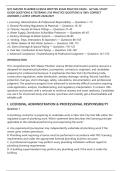
NYC MASTER PLUMBER LICENSE WRITTEN EXAM PRACTICE EXAM - ACTUAL STUDY
GUIDE QUESTIONS & TESTBANK | 150 PRACTICE QUESTIONS & 100% CORRECT
ANSWERS | LATEST UPDATE 2026/2027
i. Licensing, Administration & Professional Responsibility — Questions 1–15
ii. General Plumbing Regulations & Materials — Questions 16–30
iii. Fixtures, Faucets & Fixture Fittings — Questions 31–45
iv. Water Supply, Distribution & Backflow Protection — Questions 46–65
v. Sanitary Drainage & Waste Systems — Questions 66–85
vi. Venting, Traps, Interceptors & Separators — Questions 86–105
vii. Water Heaters & Hot-Water Systems — Questions 106–115
viii. Storm Drainage & Special Piping — Questions 116–125
ix. Fuel Gas, Combustion & Gas Piping — Questions 126–140
x. Advanced Compliance, Troubleshooting & Professional Judgment — Questions 141–150
INTRODUCTION
This comprehensive NYC Master Plumber License Written Examination practice resource is
designed for experienced plumbers, journeymen, contractors, engineers, and candidates
preparing for professional licensure. It emphasizes the New York City Plumbing Code,
construction regulations, water distribution, sanitary drainage, venting, fixtures, backflow
protection, fuel gas, storm drainage, safety, calculations, documentation, and professional
judgment. The questions progress from advanced to extremely difficult scenarios requiring
code application, analysis, troubleshooting, and regulatory interpretation. It contains 100+
questions and answers with a rationale to reinforce mastery and exam readiness. Candidates
can use it for structured study and review. (purchase and instantly get a downloadable and
editable pdf)
I. LICENSING, ADMINISTRATION & PROFESSIONAL RESPONSIBILITY
Question 1
A plumbing contractor is preparing to undertake work in New York City that falls within the
regulated scope of plumbing work. Which statement best describes the licensing principle
applicable to the individual performing and supervising the work?
A. Any experienced journeyman may independently undertake all plumbing work if the
owner gives written permission.
B. Plumbing work requiring a license must be performed in accordance with NYC licensing
requirements and under the appropriate licensed plumbing business structure.
C. A professional engineer may perform every plumbing installation without regard to
plumbing licensing requirements.
D. A building superintendent may perform any plumbing work if the work is inside the
building.
, Correct Answer: B
Explanation: NYC regulates plumbing work through licensing, permitting, supervision, and
business requirements; experience alone does not replace required authorization.
Question 2
A master plumber discovers that an employee has repeatedly installed piping contrary to
approved plans. The work has not yet been concealed. What is the most professionally
appropriate response?
A. Allow completion because correction after inspection is easier.
B. Conceal the work and document the deviation afterward.
C. Stop the affected work, evaluate the deviation, correct it as necessary, and ensure the
installation conforms to approved requirements.
D. Have the owner accept the installation in writing.
Correct Answer: C
Explanation: A licensed professional must exercise responsible supervision and correct
noncompliant work rather than rely on owner acceptance or concealment.
Question 3
A plumbing design includes a condition not directly addressed by a prescriptive provision of
the NYC Plumbing Code. Which approach is most defensible?
A. Automatically use the least expensive method.
B. Ignore the code because no exact provision exists.
C. Apply applicable general requirements, referenced standards, manufacturer
requirements, and accepted engineering principles while obtaining required approvals
where necessary.
D. Use any installation permitted in another state.
Correct Answer: C
Explanation: Unaddressed conditions require a disciplined application of applicable code
provisions, referenced standards, engineering judgment, and required authority approval.
Question 4
A contractor proposes a material that is not specifically named in a prescriptive plumbing
provision but is listed by an accepted testing agency for the intended application. What
should determine acceptability?
A. The contractor's previous experience alone.
B. Whether the material is cheaper than the specified material.
,C. Applicable code provisions concerning approved/listed materials, intended use,
installation requirements, and required approvals.
D. Whether the owner has used it elsewhere.
Correct Answer: C
Explanation: Material acceptability depends on code authorization, listing or approval
where required, compatibility, intended use, and installation requirements.
Question 5
During inspection, a plumbing inspector identifies an installation that technically functions
but conflicts with the approved construction documents. What is the most appropriate
professional response?
A. Demonstrate that the system works and leave it unchanged.
B. Determine whether an approved revision is required and bring the installation into
compliance.
C. Ask the owner to waive the discrepancy.
D. Remove the plumbing permit from the project.
Correct Answer: B
Explanation: Functionality does not eliminate compliance obligations. Deviations must be
addressed through correction or approved modification.
Question 6
A master plumber is asked to certify work personally known to have been installed by an
unqualified worker without adequate supervision. What is the appropriate action?
A. Certify it because the work appears satisfactory.
B. Certify it if the owner accepts responsibility.
C. Refuse to falsely certify and require proper evaluation and correction before certification.
D. Certify only the visible portions.
Correct Answer: C
Explanation: Professional certification carries responsibility for accuracy and compliance
and cannot legitimately be based on knowingly false information.
Question 7
A project requires plumbing plans showing pipe sizes, fixture locations, equipment, and
system relationships. Which principle is most important?
A. Plans need only show visible piping.
B. Construction documents must contain sufficient information for review, construction, and
, inspection.
C. Only the owner needs a copy.
D. Dimensions may always be omitted.
Correct Answer: B
Explanation: Construction documents must communicate enough information to establish
code compliance and permit proper construction and inspection.
Question 8
A field condition requires relocating a drain stack several feet from its approved location.
What should the plumber do first?
A. Make the change without documentation because drain stacks are interchangeable.
B. Determine the effect on code compliance and obtain the required approval or revised
documentation before proceeding.
C. Reduce the stack size to compensate.
D. Replace the stack with a vent.
Correct Answer: B
Explanation: Significant field changes must be evaluated for hydraulic, structural, venting,
and approval consequences.
Question 9
A plumbing contractor is asked to perform work outside the scope authorized by the
project's permit. Which action is best?
A. Perform it because the work is related to plumbing.
B. Perform it if the owner signs a waiver.
C. Verify the permit and authorization requirements and obtain required amendments
before proceeding.
D. Perform the work at night to avoid inspection conflicts.
Correct Answer: C
Explanation: Permit scope and authorized work must correspond to the actual installation.
Question 10
Which condition most clearly demonstrates inadequate professional supervision?
A. A journeyman performs work under required supervision.
B. A master plumber reviews completed work and documentation.
C. Workers independently modify critical piping without review or authorization.
D. A supervisor conducts periodic inspections.
GUIDE QUESTIONS & TESTBANK | 150 PRACTICE QUESTIONS & 100% CORRECT
ANSWERS | LATEST UPDATE 2026/2027
i. Licensing, Administration & Professional Responsibility — Questions 1–15
ii. General Plumbing Regulations & Materials — Questions 16–30
iii. Fixtures, Faucets & Fixture Fittings — Questions 31–45
iv. Water Supply, Distribution & Backflow Protection — Questions 46–65
v. Sanitary Drainage & Waste Systems — Questions 66–85
vi. Venting, Traps, Interceptors & Separators — Questions 86–105
vii. Water Heaters & Hot-Water Systems — Questions 106–115
viii. Storm Drainage & Special Piping — Questions 116–125
ix. Fuel Gas, Combustion & Gas Piping — Questions 126–140
x. Advanced Compliance, Troubleshooting & Professional Judgment — Questions 141–150
INTRODUCTION
This comprehensive NYC Master Plumber License Written Examination practice resource is
designed for experienced plumbers, journeymen, contractors, engineers, and candidates
preparing for professional licensure. It emphasizes the New York City Plumbing Code,
construction regulations, water distribution, sanitary drainage, venting, fixtures, backflow
protection, fuel gas, storm drainage, safety, calculations, documentation, and professional
judgment. The questions progress from advanced to extremely difficult scenarios requiring
code application, analysis, troubleshooting, and regulatory interpretation. It contains 100+
questions and answers with a rationale to reinforce mastery and exam readiness. Candidates
can use it for structured study and review. (purchase and instantly get a downloadable and
editable pdf)
I. LICENSING, ADMINISTRATION & PROFESSIONAL RESPONSIBILITY
Question 1
A plumbing contractor is preparing to undertake work in New York City that falls within the
regulated scope of plumbing work. Which statement best describes the licensing principle
applicable to the individual performing and supervising the work?
A. Any experienced journeyman may independently undertake all plumbing work if the
owner gives written permission.
B. Plumbing work requiring a license must be performed in accordance with NYC licensing
requirements and under the appropriate licensed plumbing business structure.
C. A professional engineer may perform every plumbing installation without regard to
plumbing licensing requirements.
D. A building superintendent may perform any plumbing work if the work is inside the
building.
, Correct Answer: B
Explanation: NYC regulates plumbing work through licensing, permitting, supervision, and
business requirements; experience alone does not replace required authorization.
Question 2
A master plumber discovers that an employee has repeatedly installed piping contrary to
approved plans. The work has not yet been concealed. What is the most professionally
appropriate response?
A. Allow completion because correction after inspection is easier.
B. Conceal the work and document the deviation afterward.
C. Stop the affected work, evaluate the deviation, correct it as necessary, and ensure the
installation conforms to approved requirements.
D. Have the owner accept the installation in writing.
Correct Answer: C
Explanation: A licensed professional must exercise responsible supervision and correct
noncompliant work rather than rely on owner acceptance or concealment.
Question 3
A plumbing design includes a condition not directly addressed by a prescriptive provision of
the NYC Plumbing Code. Which approach is most defensible?
A. Automatically use the least expensive method.
B. Ignore the code because no exact provision exists.
C. Apply applicable general requirements, referenced standards, manufacturer
requirements, and accepted engineering principles while obtaining required approvals
where necessary.
D. Use any installation permitted in another state.
Correct Answer: C
Explanation: Unaddressed conditions require a disciplined application of applicable code
provisions, referenced standards, engineering judgment, and required authority approval.
Question 4
A contractor proposes a material that is not specifically named in a prescriptive plumbing
provision but is listed by an accepted testing agency for the intended application. What
should determine acceptability?
A. The contractor's previous experience alone.
B. Whether the material is cheaper than the specified material.
,C. Applicable code provisions concerning approved/listed materials, intended use,
installation requirements, and required approvals.
D. Whether the owner has used it elsewhere.
Correct Answer: C
Explanation: Material acceptability depends on code authorization, listing or approval
where required, compatibility, intended use, and installation requirements.
Question 5
During inspection, a plumbing inspector identifies an installation that technically functions
but conflicts with the approved construction documents. What is the most appropriate
professional response?
A. Demonstrate that the system works and leave it unchanged.
B. Determine whether an approved revision is required and bring the installation into
compliance.
C. Ask the owner to waive the discrepancy.
D. Remove the plumbing permit from the project.
Correct Answer: B
Explanation: Functionality does not eliminate compliance obligations. Deviations must be
addressed through correction or approved modification.
Question 6
A master plumber is asked to certify work personally known to have been installed by an
unqualified worker without adequate supervision. What is the appropriate action?
A. Certify it because the work appears satisfactory.
B. Certify it if the owner accepts responsibility.
C. Refuse to falsely certify and require proper evaluation and correction before certification.
D. Certify only the visible portions.
Correct Answer: C
Explanation: Professional certification carries responsibility for accuracy and compliance
and cannot legitimately be based on knowingly false information.
Question 7
A project requires plumbing plans showing pipe sizes, fixture locations, equipment, and
system relationships. Which principle is most important?
A. Plans need only show visible piping.
B. Construction documents must contain sufficient information for review, construction, and
, inspection.
C. Only the owner needs a copy.
D. Dimensions may always be omitted.
Correct Answer: B
Explanation: Construction documents must communicate enough information to establish
code compliance and permit proper construction and inspection.
Question 8
A field condition requires relocating a drain stack several feet from its approved location.
What should the plumber do first?
A. Make the change without documentation because drain stacks are interchangeable.
B. Determine the effect on code compliance and obtain the required approval or revised
documentation before proceeding.
C. Reduce the stack size to compensate.
D. Replace the stack with a vent.
Correct Answer: B
Explanation: Significant field changes must be evaluated for hydraulic, structural, venting,
and approval consequences.
Question 9
A plumbing contractor is asked to perform work outside the scope authorized by the
project's permit. Which action is best?
A. Perform it because the work is related to plumbing.
B. Perform it if the owner signs a waiver.
C. Verify the permit and authorization requirements and obtain required amendments
before proceeding.
D. Perform the work at night to avoid inspection conflicts.
Correct Answer: C
Explanation: Permit scope and authorized work must correspond to the actual installation.
Question 10
Which condition most clearly demonstrates inadequate professional supervision?
A. A journeyman performs work under required supervision.
B. A master plumber reviews completed work and documentation.
C. Workers independently modify critical piping without review or authorization.
D. A supervisor conducts periodic inspections.