
STATE OF HAWAII | DEPARTMENT OF THE ATTORNEY GENERAL
STATE OF HAWAII
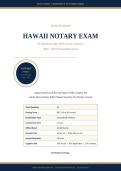
HAWAII NOTARY EXAM
50 Questions with 100% Correct Answers
Examination Cycle
NOTARY
PUBLIC
STATE OF HAWAII
Aligned with Hawaii Revised Statutes (HRS) Chapter 456
and the Hawaii Notary Public Manual issued by the Attorney General
Total Questions 50
Passing Score 80% (40 of 50 correct)
Examination Type Closed-Book, Written
Commission Term 4 Years
Official Bond $1,000 Surety
Standard Fee $5 per act | RON: $25 per act
Journal Retention 10 Years
Cognitive Mix 30% Recall | 50% Application | 20% Analysis
Six-Section Coverage:
Aligned with HRS Chapter 456 | Hawaii Notary Public Manual | 2026-2027 Cycle
,Hawaii Notary Exam | 50 Questions with 100% Correct Answers 2026/2027 HRS Chapter 456 | Attorney General Manual
1. Eligibility, Application, and Commission (8)
2. Notarial Powers, Duties, and Prohibited Acts (10)
3. Notarial Certificates: Acknowledgments, Jurats, Oaths/Affirmations (10)
4. Notary Seal, Signature, and Record Book (Journal) (10)
5. Bond, Fees, and Legal Liabilities (6)
6. Ethical Standards and Professional Conduct (6)
Closed-Book Examination | Passing Score: 80% (40/50) Page 2
, Hawaii Notary Exam | 50 Questions with 100% Correct Answers 2026/2027 HRS Chapter 456 | Attorney General Manual
Examination Overview
This examination is designed to assess a candidate’s readiness to serve as a Notary Public in the State of
Hawaii under HRS Chapter 456 and the Notary Public Manual issued by the Department of the Attorney
General. The examination contains exactly fifty (50) multiple-choice questions distributed across six content
areas. Each question presents four answer choices (A–D) with exactly one correct response.
A passing score of 80 percent (40 of 50 correct) is required. The examination is closed-book and written.
Questions are weighted across three cognitive levels: approximately 30 percent recall of statutory rules, 50
percent application to real-world scenarios, and 20 percent analysis of ethical and procedural dilemmas. Ten
questions are scenario-based ethical judgment items; ten questions test procedural and
certificate-identification skills; and five questions target key numerical and statutory identifiers (bond
amount, fee structure, passing score, term length, and journal retention).
Each question is followed by the correct answer and a 2–4 sentence rationale citing HRS Chapter 456 or the
Hawaii Notary Public Manual. Read each stem carefully, screen every signer for identity, willingness, and
competence, and apply the conflict-of-interest rules before selecting an answer.
Section 1: Eligibility, Application, and Commission
Q1: Malia, age 17, is a lifelong resident of Honolulu and a U.S. citizen by birth. She has worked as a
paralegal assistant for two years and wants to apply for a Hawaii notary commission to assist her
employer's clients. How should the Attorney General's office handle her application?
A. Approve her application because she meets the residency and citizenship requirements.
B. Approve her application only if her employer signs a financial guarantee.
C. Deny her application because she has not reached the minimum age of 18 years. [CORRECT]
D. Approve her application with a provisional commission until she turns 18.
Correct Answer: C
Rationale: Under HRS Section 456-8 and the Hawaii Notary Public Manual, every applicant must be at least 18 years
old, a Hawaii resident, and a U.S. citizen, national, or qualified permanent resident alien. Malia satisfies residency
and citizenship but fails the age requirement, so the Attorney General must deny her application. No provisional or
employer-guaranteed commission exists under Hawaii law.
Closed-Book Examination | Passing Score: 80% (40/50) Page 3
STATE OF HAWAII
HAWAII NOTARY EXAM
50 Questions with 100% Correct Answers
Examination Cycle
NOTARY
PUBLIC
STATE OF HAWAII
Aligned with Hawaii Revised Statutes (HRS) Chapter 456
and the Hawaii Notary Public Manual issued by the Attorney General
Total Questions 50
Passing Score 80% (40 of 50 correct)
Examination Type Closed-Book, Written
Commission Term 4 Years
Official Bond $1,000 Surety
Standard Fee $5 per act | RON: $25 per act
Journal Retention 10 Years
Cognitive Mix 30% Recall | 50% Application | 20% Analysis
Six-Section Coverage:
Aligned with HRS Chapter 456 | Hawaii Notary Public Manual | 2026-2027 Cycle
,Hawaii Notary Exam | 50 Questions with 100% Correct Answers 2026/2027 HRS Chapter 456 | Attorney General Manual
1. Eligibility, Application, and Commission (8)
2. Notarial Powers, Duties, and Prohibited Acts (10)
3. Notarial Certificates: Acknowledgments, Jurats, Oaths/Affirmations (10)
4. Notary Seal, Signature, and Record Book (Journal) (10)
5. Bond, Fees, and Legal Liabilities (6)
6. Ethical Standards and Professional Conduct (6)
Closed-Book Examination | Passing Score: 80% (40/50) Page 2
, Hawaii Notary Exam | 50 Questions with 100% Correct Answers 2026/2027 HRS Chapter 456 | Attorney General Manual
Examination Overview
This examination is designed to assess a candidate’s readiness to serve as a Notary Public in the State of
Hawaii under HRS Chapter 456 and the Notary Public Manual issued by the Department of the Attorney
General. The examination contains exactly fifty (50) multiple-choice questions distributed across six content
areas. Each question presents four answer choices (A–D) with exactly one correct response.
A passing score of 80 percent (40 of 50 correct) is required. The examination is closed-book and written.
Questions are weighted across three cognitive levels: approximately 30 percent recall of statutory rules, 50
percent application to real-world scenarios, and 20 percent analysis of ethical and procedural dilemmas. Ten
questions are scenario-based ethical judgment items; ten questions test procedural and
certificate-identification skills; and five questions target key numerical and statutory identifiers (bond
amount, fee structure, passing score, term length, and journal retention).
Each question is followed by the correct answer and a 2–4 sentence rationale citing HRS Chapter 456 or the
Hawaii Notary Public Manual. Read each stem carefully, screen every signer for identity, willingness, and
competence, and apply the conflict-of-interest rules before selecting an answer.
Section 1: Eligibility, Application, and Commission
Q1: Malia, age 17, is a lifelong resident of Honolulu and a U.S. citizen by birth. She has worked as a
paralegal assistant for two years and wants to apply for a Hawaii notary commission to assist her
employer's clients. How should the Attorney General's office handle her application?
A. Approve her application because she meets the residency and citizenship requirements.
B. Approve her application only if her employer signs a financial guarantee.
C. Deny her application because she has not reached the minimum age of 18 years. [CORRECT]
D. Approve her application with a provisional commission until she turns 18.
Correct Answer: C
Rationale: Under HRS Section 456-8 and the Hawaii Notary Public Manual, every applicant must be at least 18 years
old, a Hawaii resident, and a U.S. citizen, national, or qualified permanent resident alien. Malia satisfies residency
and citizenship but fails the age requirement, so the Attorney General must deny her application. No provisional or
employer-guaranteed commission exists under Hawaii law.
Closed-Book Examination | Passing Score: 80% (40/50) Page 3


