
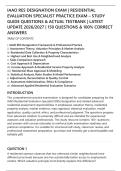
IAAO RES DESIGNATION EXAM | RESIDENTIAL
EVALUATION SPECIALIST PRACTICE EXAM – STUDY
GUIDE QUESTIONS & ACTUAL TESTBANK | LATEST
UPDATE 2026/2027 | 150 QUESTIONS & 100% CORRECT
ANSWERS
TABLE OF CONTENTS
i. IAAO RES Designation Framework & Professional Practice
ii. Assessment Theory, Valuation Principles & Market Analysis
iii. Residential Data Collection & Property Characteristics
iv. Highest and Best Use & Neighborhood Analysis
v. Sales Comparison Approach
vi. Cost Approach & Depreciation
vii. Income Approach & Residential Income Property Analysis
viii. Residential Mass Appraisal & Modeling
ix. Statistical Analysis, Ratio Studies & Model Performance
x. Adjustments, Reconciliation & Quality Control
xi. Assessment Administration, Ethics & Compliance
xii. Advanced Applied Residential Evaluation Scenarios
INTRODUCTION
This comprehensive practice examination is designed for candidates preparing for the
IAAO Residential Evaluation Specialist (RES) designation and related advanced
residential assessment responsibilities. It emphasizes valuation theory, residential
property analysis, market evidence, mass appraisal, statistical evaluation, model
application, quality control, ethics, and professional judgment. The questions progress
from advanced-medium to extremely difficult and are intended for experienced
assessors and valuation professionals. This study resource contains 150+ questions
and answers with concise rationales to reinforce both examination readiness and
practical competence. It is suitable for structured self-study, classroom review, and
professional assessment preparation. (purchase and instantly get a downloadable and
editable pdf)
QUESTION 1
A residential assessor observes that two otherwise similar neighborhoods have
different price levels because one has substantially better access to employment
centers. Which valuation principle most directly explains this difference?
,A. Substitution
B. Contribution
C. Anticipation
D. Supply and demand
Correct Answer: D
Explanation: Differences in accessibility can materially alter market demand and
therefore the equilibrium price level within otherwise comparable residential
markets.
QUESTION 2
An assessor selects comparable sales primarily because they were recently exposed to
the market and involved typical, arm's-length transactions. What valuation objective is
being strengthened?
A. Reliability of market evidence
B. Depreciation estimation
C. Cost reconciliation
D. Income capitalization
Correct Answer: A
Explanation: Recent, arm's-length transactions generally provide stronger evidence
of prevailing market behavior.
QUESTION 3
A property contains a feature that buyers value, but the feature's cost exceeds the
amount it adds to the property's market value. Which principle is most applicable?
A. Conformity
B. Contribution
C. Change
D. Competition
Correct Answer: B
Explanation: Contribution concerns the amount a particular component adds to the
value of the whole property, which may differ substantially from its cost.
QUESTION 4
,A neighborhood experiences rapidly increasing demand after a major transportation
improvement. An assessor continues using historical price relationships without
testing whether the market structure changed. What is the greatest concern?
A. Excess depreciation
B. Model misspecification
C. Excess land value
D. Incorrect ownership classification
Correct Answer: B
Explanation: A structural market change can invalidate previously stable
relationships and produce model misspecification if not incorporated.
QUESTION 5
Which condition most strongly supports the conclusion that a residential sale is an
arm's-length transaction?
A. The seller is highly motivated
B. The buyer and seller are unrelated and reasonably exposed the property to the
market
C. The property sold below its assessed value
D. The transaction occurred between neighbors
Correct Answer: B
Explanation: Arm's-length transactions generally involve independent parties acting
knowledgeably and without unusual pressure.
QUESTION 6
An assessor is asked to estimate market value as of January 1 but receives several
highly relevant sales occurring afterward. How should those sales generally be
treated?
A. Automatically excluded
B. Used without adjustment
C. Considered if they provide evidence of market conditions at the valuation date
D. Used only if they occurred within 30 days
Correct Answer: C
Explanation: Later sales may provide retrospective evidence when analyzed
, appropriately for intervening market changes.
QUESTION 7
A buyer pays more for a residence because it is located near a highly desirable school
district. Which principle best explains the capitalization of this locational advantage
into property value?
A. Anticipation
B. Regression
C. Contribution
D. Balance
Correct Answer: C
Explanation: A locational attribute contributes value to the property when market
participants recognize and pay for that advantage.
QUESTION 8
A neighborhood's residential values increase because household incomes and
demand increase while housing supply remains relatively constrained. Which market
mechanism is primarily involved?
A. Increased depreciation
B. Supply and demand interaction
C. Functional obsolescence
D. Assessment uniformity
Correct Answer: B
Explanation: Prices tend to rise when demand strengthens relative to available
supply, assuming other conditions remain comparable.
QUESTION 9
An assessor discovers that a comparable sale included seller financing at below-
market terms. What is the most appropriate response?
A. Automatically reject the sale
B. Ignore the financing
C. Analyze and adjust for the financing terms when they affected the transaction price
D. Replace the sale with a cost estimate
EVALUATION SPECIALIST PRACTICE EXAM – STUDY
GUIDE QUESTIONS & ACTUAL TESTBANK | LATEST
UPDATE 2026/2027 | 150 QUESTIONS & 100% CORRECT
ANSWERS
TABLE OF CONTENTS
i. IAAO RES Designation Framework & Professional Practice
ii. Assessment Theory, Valuation Principles & Market Analysis
iii. Residential Data Collection & Property Characteristics
iv. Highest and Best Use & Neighborhood Analysis
v. Sales Comparison Approach
vi. Cost Approach & Depreciation
vii. Income Approach & Residential Income Property Analysis
viii. Residential Mass Appraisal & Modeling
ix. Statistical Analysis, Ratio Studies & Model Performance
x. Adjustments, Reconciliation & Quality Control
xi. Assessment Administration, Ethics & Compliance
xii. Advanced Applied Residential Evaluation Scenarios
INTRODUCTION
This comprehensive practice examination is designed for candidates preparing for the
IAAO Residential Evaluation Specialist (RES) designation and related advanced
residential assessment responsibilities. It emphasizes valuation theory, residential
property analysis, market evidence, mass appraisal, statistical evaluation, model
application, quality control, ethics, and professional judgment. The questions progress
from advanced-medium to extremely difficult and are intended for experienced
assessors and valuation professionals. This study resource contains 150+ questions
and answers with concise rationales to reinforce both examination readiness and
practical competence. It is suitable for structured self-study, classroom review, and
professional assessment preparation. (purchase and instantly get a downloadable and
editable pdf)
QUESTION 1
A residential assessor observes that two otherwise similar neighborhoods have
different price levels because one has substantially better access to employment
centers. Which valuation principle most directly explains this difference?
,A. Substitution
B. Contribution
C. Anticipation
D. Supply and demand
Correct Answer: D
Explanation: Differences in accessibility can materially alter market demand and
therefore the equilibrium price level within otherwise comparable residential
markets.
QUESTION 2
An assessor selects comparable sales primarily because they were recently exposed to
the market and involved typical, arm's-length transactions. What valuation objective is
being strengthened?
A. Reliability of market evidence
B. Depreciation estimation
C. Cost reconciliation
D. Income capitalization
Correct Answer: A
Explanation: Recent, arm's-length transactions generally provide stronger evidence
of prevailing market behavior.
QUESTION 3
A property contains a feature that buyers value, but the feature's cost exceeds the
amount it adds to the property's market value. Which principle is most applicable?
A. Conformity
B. Contribution
C. Change
D. Competition
Correct Answer: B
Explanation: Contribution concerns the amount a particular component adds to the
value of the whole property, which may differ substantially from its cost.
QUESTION 4
,A neighborhood experiences rapidly increasing demand after a major transportation
improvement. An assessor continues using historical price relationships without
testing whether the market structure changed. What is the greatest concern?
A. Excess depreciation
B. Model misspecification
C. Excess land value
D. Incorrect ownership classification
Correct Answer: B
Explanation: A structural market change can invalidate previously stable
relationships and produce model misspecification if not incorporated.
QUESTION 5
Which condition most strongly supports the conclusion that a residential sale is an
arm's-length transaction?
A. The seller is highly motivated
B. The buyer and seller are unrelated and reasonably exposed the property to the
market
C. The property sold below its assessed value
D. The transaction occurred between neighbors
Correct Answer: B
Explanation: Arm's-length transactions generally involve independent parties acting
knowledgeably and without unusual pressure.
QUESTION 6
An assessor is asked to estimate market value as of January 1 but receives several
highly relevant sales occurring afterward. How should those sales generally be
treated?
A. Automatically excluded
B. Used without adjustment
C. Considered if they provide evidence of market conditions at the valuation date
D. Used only if they occurred within 30 days
Correct Answer: C
Explanation: Later sales may provide retrospective evidence when analyzed
, appropriately for intervening market changes.
QUESTION 7
A buyer pays more for a residence because it is located near a highly desirable school
district. Which principle best explains the capitalization of this locational advantage
into property value?
A. Anticipation
B. Regression
C. Contribution
D. Balance
Correct Answer: C
Explanation: A locational attribute contributes value to the property when market
participants recognize and pay for that advantage.
QUESTION 8
A neighborhood's residential values increase because household incomes and
demand increase while housing supply remains relatively constrained. Which market
mechanism is primarily involved?
A. Increased depreciation
B. Supply and demand interaction
C. Functional obsolescence
D. Assessment uniformity
Correct Answer: B
Explanation: Prices tend to rise when demand strengthens relative to available
supply, assuming other conditions remain comparable.
QUESTION 9
An assessor discovers that a comparable sale included seller financing at below-
market terms. What is the most appropriate response?
A. Automatically reject the sale
B. Ignore the financing
C. Analyze and adjust for the financing terms when they affected the transaction price
D. Replace the sale with a cost estimate


