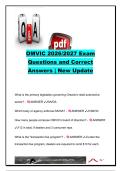
The OMVIC Exam 2026/2027 study guide is an 18-page exam-preparation resource containing 90+ questions and correct answers covering the rules, regulations, consumer-protection requirements, and professional responsibilities presented for Ontario motor vehicle dealers and salespeople. Major topics include the Motor Vehicle Dealers Act (MVDA), OMVIC registration and enforcement, dealer records, trust accounts, purchase and lease contracts, mandatory vehicle disclosures, rescission rights, advertising, extended warranties, inspections, curbsiders, the Motor Vehicle Dealers Compensation Fund, Consumer Protection Act (CPA), repair requirements, vehicle liens, Sale of Goods Act, Code of Ethics Regulations, CAMVAP, consignment transactions, dealer plates, vehicle branding, and Safety Standards Certificates.
The opening material focuses on OMVIC and the Motor Vehicle Dealers Act, identifying the MVDA as the primary legislation governing Ontario's retail automotive sector and OMVIC as the body enforcing it. The guide reviews OMVIC's board composition, the transaction fee program, information OMVIC makes available to the public, its authority regarding false or misleading advertising, registration requirements, and appeals to the Licence Appeal Tribunal (LAT). It also covers dealer classes and examples of individuals or businesses presented as exempt from registration.
A substantial section addresses dealer registration, business locations, records, and trust accounts. Students review requirements for displaying a dealer registration certificate, restrictions on selling vehicles from unregistered locations, the six-year record-retention period stated in the guide, employee records, notification following destroyed or stolen records, and conditions for remote record storage. Trust-account questions address when deposits must be held in trust and OMVIC's authority to issue freeze orders.
The guide gives significant attention to vehicle purchase contracts and mandatory disclosures. Topics include the required sales-final statement near the purchaser's signature, odometer disclosures when a dealer must locate a new vehicle, Safety Standards Certificates, and the contractual requirements associated with vehicles sold “as is.” Students also review advisory statements involving OMVIC, the Motor Vehicle Dealers Compensation Fund, and the Canadian Motor Vehicle Arbitration Plan (CAMVAP), as well as a customer's rights when a deposit or trade-in is provided without a signed contract.
One of the most exam-relevant sections concerns vehicle history and condition disclosures. The source requires students to recognize previous uses such as taxi, limousine, police, emergency-services, and daily-rental use, along with collision damage exceeding the threshold stated in the guide, fire or flood damage, structural damage or alterations, and replacement of two or more adjacent body panels excluding bumper covers. Other disclosure examples include prior registration outside Ontario, non-functioning anti-lock brakes, missing airbags, air-conditioning systems requiring repair, and cancelled manufacturer warranties. The document emphasizes that disclosures should be timely, written, clear, comprehensible, and prominent.
The material then examines rescission and consumer cancellation rights. It identifies circumstances in which failures to disclose information such as vehicle make, model, model year, branding, specified previous uses, and mileage can trigger remedies. The source discusses the 90-day MVDA rescission period and notes that consumers may have additional rights under the Consumer Protection Act. It also covers odometer disclosure tolerances and explains that a dealer's lack of knowledge about a vehicle's true history does not necessarily eliminate the customer's remedy under the rules presented in the document.
The advertising and warranty section reviews all-in price requirements, mandatory disclosure of certain previous vehicle uses in advertisements, and OMVIC's authority to require correction or retraction of false, misleading, or deceptive advertising. Extended-warranty questions address financial backing through an insurer or an irrevocable letter of credit, requirements for uninsured dealer warranties, and deadlines for forwarding payments and contractual documentation to warranty companies.
Another major area covers OMVIC inspections and curbsiders. According to the guide, OMVIC inspectors do not have to provide advance notice and may access dealer records, vehicles, and relevant computer systems. A curbsider is defined as an unlicensed dealer posing as a private seller. The document associates curbsider vehicles with risks such as accident damage, odometer tampering, theft, and liens, while also explaining how unregistered sellers can avoid taxes and normal dealership overhead.
The Motor Vehicle Dealers Compensation Fund and Consumer Protection Act receive extensive coverage. Students review eligibility for the compensation fund, dealer contributions, reimbursement responsibilities, and distinctions between consumers and commercial purchasers. CPA material includes consumer rights, sales and leases, repair services, prohibited waiver of statutory protections, penalties, repossession rules, and unfair practices, including unconscionable and false, misleading, or deceptive representations. The guide also defines a material fact as information capable of influencing a customer's decision to purchase or lease a vehicle or the amount they would be prepared to pay.
The document provides focused preparation on motor vehicle repairs under the Consumer Protection Act. It covers repair estimates, the limit stated in the source on how far final costs may exceed an estimate, warranties on new or reconditioned replacement parts, offering replaced parts back to consumers, and required signage concerning labour charges, estimates, and removed parts. These questions help candidates distinguish vehicle-sales requirements from repair-related consumer protections.
Vehicle financing and ownership issues are explored through liens and the Sale of Goods Act. Students learn why dealers should perform lien checks on trade-ins, whether multiple liens can exist on one vehicle, requirements when a dealer agrees to pay an existing lien, and release documentation. The Sale of Goods Act material discusses merchantable quality, fitness for intended purpose, quiet possession, stolen vehicles, deposits, and “as is” sales as presented in the study guide.
Professional conduct is addressed through the Code of Ethics Regulations, which the document presents as legally enforceable rather than merely voluntary best practices. Dealers and salespeople are expected to conduct business with integrity, fairness, and honesty, and failure to comply can result in disciplinary proceedings or consequences affecting registration. The guide also notes that decisions or orders of the OMVIC discipline committee may be subject to appeal.
The final sections cover CAMVAP, consignment sales, dealer plates, vehicle branding, Safety Standards Certificates, and Used Vehicle Information Packages. CAMVAP is described as an arbitration program for qualifying disputes between consumers and vehicle manufacturers concerning alleged manufacturing defects or implementation of new-vehicle warranties. Consignment questions cover the relationship between the vehicle owner and dealer, contractual compensation, and trust-account requirements. The final pages also review the issuing authority for dealer plates, wholesale auctions, Ontario environmental-program administration, vehicle branding, situations requiring a Safety Standards Certificate, its stated validity period, and requirements for Used Vehicle Information Packages in private sales.
Relevant Students
This document is particularly relevant to OMVIC exam candidates, Ontario automotive salesperson applicants, motor vehicle dealer applicants, dealership sales representatives, automotive sales professionals, dealership managers, used-car dealership employees, vehicle leasing professionals, automotive finance staff, and learners preparing for Ontario motor vehicle dealer or salesperson registration requirements. It is especially useful for candidates reviewing regulatory obligations, consumer protection, vehicle disclosure, contracts, advertising, ethical conduct, and dealership compliance.
Referenced Legislation and Professional Sources
The document itself does not provide a formal textbook, journal citation, author, or bibliography. However, it explicitly bases its questions on Ontario automotive regulatory and consumer-protection topics and names the Motor Vehicle Dealers Act (MVDA), Consumer Protection Act (CPA), Sale of Goods Act, Code of Ethics Regulations, OMVIC, Licence Appeal Tribunal, Motor Vehicle Dealers Compensation Fund, CAMVAP, and Ministry of Transportation. These are the relevant legislative and professional references identified within the uploaded material; no unsupported textbook or journal attribution has been added.
Keywords
OMVIC Exam 2026, OMVIC Exam 2027, OMVIC exam questions and answers, OMVIC test questions, OMVIC study guide, Ontario motor vehicle dealer exam, Ontario automotive salesperson exam, MVDA exam, Motor Vehicle Dealers Act, OMVIC certification, OMVIC registration, Ontario car dealer license, Ontario car salesperson license, OMVIC practice questions, vehicle disclosure requirements Ontario, OMVIC vehicle disclosure, used vehicle disclosure, vehicle damage disclosure, odometer disclosure, OMVIC rescission, vehicle purchase contract Ontario, as is vehicle sale Ontario, OMVIC advertising rules, all in price advertising, OMVIC inspections, curbsiders Ontario, Motor Vehicle Dealers Compensation Fund, Consumer Protection Act Ontario, CPA automotive sales, unfair practices Ontario, motor vehicle repair rules, vehicle liens Ontario, Sale of Goods Act Ontario, merchantable quality vehicle, OMVIC Code of Ethics, CAMVAP, vehicle consignment Ontario, Safety Standards Certificate Ontario, Used Vehicle Information Package, Ontario dealer regulations, automotive dealer compliance, OMVIC exam preparation
Content preview
OMVIC 2026/2027 Exam
Questions and Correct
Answers | New Update
What is the primary legislation governing Ontario's retail automotive
sector? - ANSWER ✔✔MVDA
Which body or agency enforces MVDA? - ANSWER ✔✔OMVIC
How many people compose OMVIC's board of directors? - ANSWER
✔✔12 in total, 9 dealers and 3 consumer reps
What is the "transaction fee program"? - ANSWER ✔✔under the
transaction fee program, dealers are required to remit $10 for each
,vehicle sold or leased to OMVIC. These funds are remitted annually with
the dealers registration renewal fee.
T or F: the fee can be passed on to the consumer - ANSWER
✔✔True
What is OMVIC required to make available to the public? - ANSWER
✔✔A dealers name, address and phone number; a salespersons name;
any proposal to refuse to renew, suspend or revoke the registration of a
dealer or salesperson
Should OMVIC determine a dealers advertising to be false or misleading
what powers do they have to stop or correct it? - ANSWER ✔✔Order
to the dealer to cease publication and or issue a retraction or correction
If an order is used to stop or correct false advertising, for how long may
the dealer need to seek OMVIC pre approval for future advertising? -
ANSWER ✔✔up to 2 years
What is the minimum age requirement to become a dealer? -
ANSWER ✔✔18
If a person has been refused registration, what are 2 conditions that
have to be met before the person can reapply? - ANSWER ✔✔2
years have passed; new evidence to demonstrate circumstances
, If OMVIC issues a proposal to refuse registration, to whom can the
applicant appeal? - ANSWER ✔✔LAT (license appeal tribunal ),
Independent judicial body called LAT, within 15 days of receiving the
proposal
List the 4 classes of dealers - ANSWER ✔✔General dealer, Broker,
Exporter, Wholesaler, Lease finance dealer
List 3 examples of individuals or businesses that are exempt from
registration - ANSWER ✔✔Wholesale auction, wrecker, lawyer
Where is the certificate of the dealer registration kept? - ANSWER
✔✔Where the public can see it
T or F: Dealers may sell vehicles from any location so long as they have
registered a head office with OMVIC - ANSWER ✔✔False
T or F: the MVDA specifies the records a dealer must maintain- these
records must be held for at least 6 years. - ANSWER ✔✔True
Which records of employees must be maintained? - ANSWER
✔✔Employee names, proof of payments, and employee salaries
If a dealer's records are destroyed or stolen, the dealer must notify? -
ANSWER ✔✔OMVIC, in writing, within 5 days
COPYRIGHT©NINJANERD 2026/2027. YEAR PUBLISHED 2026. COMPANY REGISTRATION NUMBER: 619652435. TERMS OF USE. PRIVACY
STATEMENT. ALL RIGHTS RESERVED
3