
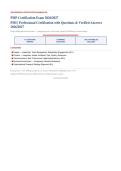
PROFESSIONAL CERTIFICATION EXAMINATION
PMP Certification Exam 2026/2027
PMI | Professional Certification with Questions & Verified Answers
2026/2027
Project Management Professional — Complete Practice Assessment Aligned to PMI Exam Content Outline
A+ QUESTIONS 3 DOMAINS 100% RATIONALES
VERIFIED 5 SECTIONS INCLUDED
CATEGORIES
■ People — Leadership, Team Management, Stakeholder Engagement (42%)
■ Process — Integration, Scope, Schedule, Cost, Quality, Resources,
■ Communications, Risk, Procurement, Agile/Hybrid Delivery (50%)
■ Business Environment — Compliance, Benefits Realization,
■ Organizational Change & Strategy Alignment (8%)
Passing Score: ~61% (PMI psychometric cut score) | 180 Questions | Multiple Choice A–D
Aligned to PMI Exam Content Outline domains. Original practice content.
STUVIAACTUALEXAM
,SECTION 1: People — Leadership, Team Management & Stakeholder Engagement
Q1.
A project manager notices that two senior team members repeatedly interrupt each other during daily stand-ups and that other
team members have stopped contributing ideas. The project is using a hybrid approach and the product owner is becoming
frustrated with declining velocity. The project manager's most effective first action is to
A. Reassign both team members to different work streams immediately.
B. Facilitate a private conversation with both individuals to surface the root cause and agree on ground rules for collaboration.
C. Escalate the conflict to the sponsor and request formal disciplinary action.
D. Cancel stand-ups until the interpersonal issues resolve themselves.
Correct Answer: B
Rationale: Conflict that is affecting team performance requires prompt, respectful intervention. A private facilitated discussion allows the
parties to address the issue constructively while protecting psychological safety for the rest of the team.
Q2.
A project manager is leading a newly formed virtual team spread across four time zones. During the first two weeks, several
team members miss meetings and deliverables are late. The project manager has already confirmed that technology tools are
functioning. The most appropriate next step is to
A. Issue a formal written warning to every team member who missed a meeting.
B. Co-create team working agreements that address availability, communication norms, and response expectations, then model and
reinforce them.
C. Move the entire project to a single geographic location.
D. Reduce the scope so that less coordination is required.
Correct Answer: B
Rationale: Virtual teams need explicit working agreements to compensate for the lack of informal office cues. Co-creating norms increases
buy-in and clarifies expectations across time zones.
Q3.
A key stakeholder repeatedly requests changes that expand the product backlog after the sprint has started. The development
team is becoming demoralized. The project manager should
A. Accept every change to keep the stakeholder happy.
B. Remove the stakeholder from all communications.
C. Cancel the current sprint and restart with the new requirements.
D. Protect the sprint goal by reinforcing the change-control process for the current iteration and scheduling a backlog refinement
session for future work.
Correct Answer: D
Rationale: In agile and hybrid environments the sprint goal is protected once committed. New requests are captured and prioritized for
subsequent iterations, preserving team focus and predictability.
Q4.
During a retrospective a team member states that they feel their ideas are never valued by the more experienced members.
The project manager observes that the quieter members rarely speak. The most effective leadership response is to
A. Tell the quieter members to speak up more forcefully.
B. Assign all decision-making to the senior members only.
C. Introduce structured facilitation techniques such as round-robin or silent brainstorming so that every voice is heard, and coach the
dominant members on inclusive behaviour.
D. Ignore the comment because retrospectives are not for personal issues.
Correct Answer: C
Rationale: Servant leaders create psychological safety and equal participation. Structured techniques and coaching on inclusive behaviour
address the systemic pattern rather than blaming individuals.
PMP Certification Exam 2026/2027 | Page 2
,Q5.
A project manager inherits a team that has low trust after a previous project failure. Several members openly question the
project manager's competence. The highest-leverage action to rebuild trust is to
A. Remind the team of the project manager's formal authority and demand compliance.
B. Demonstrate competence through transparent decision-making, follow-through on commitments, and consistent support of the
team, while inviting feedback.
C. Replace the most vocal critics immediately.
D. Avoid all difficult conversations for the first three months.
Correct Answer: B
Rationale: Trust is rebuilt through consistent, visible behaviour—competence, integrity, and benevolence—rather than through positional
authority alone.
Q6.
A team member approaches the project manager privately and discloses that they are experiencing significant personal stress
that is affecting their performance. The project manager's most appropriate response is to
A. Listen empathetically, explore what support the organization can offer, and agree on a temporary workload adjustment if needed
while maintaining confidentiality.
B. Publicly announce the issue so the rest of the team can provide support.
C. Insist that personal issues must never affect work and require full productivity immediately.
D. Document the conversation in the risk register as a resource risk without further action.
Correct Answer: A
Rationale: Emotional intelligence and servant leadership require empathy, confidentiality, and practical support while still protecting project
outcomes.
Q7.
Two functional managers are competing for the same scarce specialist resource that is critical to the critical path. Both
managers escalate to the project manager. The most effective approach is to
A. Facilitate a collaborative discussion focused on project priorities, overall business value, and possible alternatives such as
sequencing or knowledge transfer.
B. Award the resource to the manager with the higher organizational rank.
C. Refuse to become involved and let the managers resolve it themselves.
D. Hire an external consultant without consulting either manager.
Correct Answer: A
Rationale: Resource conflicts are best resolved by focusing on project and organizational priorities rather than hierarchy. Facilitation that
surfaces options preserves relationships and optimizes value.
Q8.
A project manager observes that a high-performing team member has become withdrawn and is producing lower-quality work.
Other team members have started to avoid collaborating with this person. The project manager should first
A. Issue a formal performance improvement plan without discussion.
B. Reassign the person to a less visible role immediately.
C. Share the observation with the entire team to solicit peer pressure.
D. Hold a private, supportive conversation to understand what is happening and jointly identify support or adjustments.
Correct Answer: D
Rationale: A sudden drop in performance often has an underlying cause. A private, non-judgmental conversation is the professional first step
and models servant leadership.
PMP Certification Exam 2026/2027 | Page 3
, Q9.
During stakeholder analysis the project manager identifies a senior executive who has high power but currently low interest in
the project. The most appropriate engagement strategy is to
A. Ignore the executive because interest is low.
B. Keep the executive informed with concise, relevant updates and watch for opportunities to increase interest by linking the project
to the executive's strategic goals.
C. Invite the executive to every detailed technical meeting.
D. Escalate every minor issue to the executive to force attention.
Correct Answer: B
Rationale: High-power/low-interest stakeholders are managed by keeping them satisfied and informed, while looking for ways to raise
interest when their support becomes critical.
Q10.
A project is using a hybrid life cycle. The development team wants full autonomy over technical decisions, while the compliance
department insists on formal design reviews at every stage. The project manager's best approach is to
A. Side exclusively with the development team because agile values autonomy.
B. Implement every compliance control without discussion.
C. Remove compliance stakeholders from the project.
D. Facilitate a discussion that clarifies the minimum viable governance required for compliance while preserving as much team
autonomy as possible, and document the agreed working model.
Correct Answer: D
Rationale: Hybrid environments require deliberate negotiation of governance boundaries so that regulatory needs are met without
unnecessarily constraining the team.
Q11.
A new team member from a different cultural background consistently arrives late to meetings and appears disengaged. Other
team members are starting to complain. The project manager should
A. Publicly reprimand the team member for lateness.
B. Have a private conversation to understand cultural norms and personal circumstances, clarify team expectations, and explore
mutually acceptable adjustments.
C. Exclude the team member from future meetings.
D. Assume the behaviour is intentional disrespect and document it formally.
Correct Answer: B
Rationale: Cultural intelligence and inclusion require curiosity before judgment. Clarifying expectations while remaining open to legitimate
differences builds a stronger team.
Q12.
The project sponsor asks the project manager to withhold negative status information from the steering committee until the next
major milestone is achieved. The project manager should
A. Comply fully because the sponsor is the ultimate authority.
B. Send the negative information only to selected committee members.
C. Explain the professional and ethical obligation to provide accurate, timely information and propose a transparent communication
approach that still frames risks constructively.
D. Resign from the project immediately.
Correct Answer: C
Rationale: Project managers have an ethical duty of honesty and transparency. Framing challenges constructively is appropriate; concealing
material information is not.
PMP Certification Exam 2026/2027 | Page 4
PMP Certification Exam 2026/2027
PMI | Professional Certification with Questions & Verified Answers
2026/2027
Project Management Professional — Complete Practice Assessment Aligned to PMI Exam Content Outline
A+ QUESTIONS 3 DOMAINS 100% RATIONALES
VERIFIED 5 SECTIONS INCLUDED
CATEGORIES
■ People — Leadership, Team Management, Stakeholder Engagement (42%)
■ Process — Integration, Scope, Schedule, Cost, Quality, Resources,
■ Communications, Risk, Procurement, Agile/Hybrid Delivery (50%)
■ Business Environment — Compliance, Benefits Realization,
■ Organizational Change & Strategy Alignment (8%)
Passing Score: ~61% (PMI psychometric cut score) | 180 Questions | Multiple Choice A–D
Aligned to PMI Exam Content Outline domains. Original practice content.
STUVIAACTUALEXAM
,SECTION 1: People — Leadership, Team Management & Stakeholder Engagement
Q1.
A project manager notices that two senior team members repeatedly interrupt each other during daily stand-ups and that other
team members have stopped contributing ideas. The project is using a hybrid approach and the product owner is becoming
frustrated with declining velocity. The project manager's most effective first action is to
A. Reassign both team members to different work streams immediately.
B. Facilitate a private conversation with both individuals to surface the root cause and agree on ground rules for collaboration.
C. Escalate the conflict to the sponsor and request formal disciplinary action.
D. Cancel stand-ups until the interpersonal issues resolve themselves.
Correct Answer: B
Rationale: Conflict that is affecting team performance requires prompt, respectful intervention. A private facilitated discussion allows the
parties to address the issue constructively while protecting psychological safety for the rest of the team.
Q2.
A project manager is leading a newly formed virtual team spread across four time zones. During the first two weeks, several
team members miss meetings and deliverables are late. The project manager has already confirmed that technology tools are
functioning. The most appropriate next step is to
A. Issue a formal written warning to every team member who missed a meeting.
B. Co-create team working agreements that address availability, communication norms, and response expectations, then model and
reinforce them.
C. Move the entire project to a single geographic location.
D. Reduce the scope so that less coordination is required.
Correct Answer: B
Rationale: Virtual teams need explicit working agreements to compensate for the lack of informal office cues. Co-creating norms increases
buy-in and clarifies expectations across time zones.
Q3.
A key stakeholder repeatedly requests changes that expand the product backlog after the sprint has started. The development
team is becoming demoralized. The project manager should
A. Accept every change to keep the stakeholder happy.
B. Remove the stakeholder from all communications.
C. Cancel the current sprint and restart with the new requirements.
D. Protect the sprint goal by reinforcing the change-control process for the current iteration and scheduling a backlog refinement
session for future work.
Correct Answer: D
Rationale: In agile and hybrid environments the sprint goal is protected once committed. New requests are captured and prioritized for
subsequent iterations, preserving team focus and predictability.
Q4.
During a retrospective a team member states that they feel their ideas are never valued by the more experienced members.
The project manager observes that the quieter members rarely speak. The most effective leadership response is to
A. Tell the quieter members to speak up more forcefully.
B. Assign all decision-making to the senior members only.
C. Introduce structured facilitation techniques such as round-robin or silent brainstorming so that every voice is heard, and coach the
dominant members on inclusive behaviour.
D. Ignore the comment because retrospectives are not for personal issues.
Correct Answer: C
Rationale: Servant leaders create psychological safety and equal participation. Structured techniques and coaching on inclusive behaviour
address the systemic pattern rather than blaming individuals.
PMP Certification Exam 2026/2027 | Page 2
,Q5.
A project manager inherits a team that has low trust after a previous project failure. Several members openly question the
project manager's competence. The highest-leverage action to rebuild trust is to
A. Remind the team of the project manager's formal authority and demand compliance.
B. Demonstrate competence through transparent decision-making, follow-through on commitments, and consistent support of the
team, while inviting feedback.
C. Replace the most vocal critics immediately.
D. Avoid all difficult conversations for the first three months.
Correct Answer: B
Rationale: Trust is rebuilt through consistent, visible behaviour—competence, integrity, and benevolence—rather than through positional
authority alone.
Q6.
A team member approaches the project manager privately and discloses that they are experiencing significant personal stress
that is affecting their performance. The project manager's most appropriate response is to
A. Listen empathetically, explore what support the organization can offer, and agree on a temporary workload adjustment if needed
while maintaining confidentiality.
B. Publicly announce the issue so the rest of the team can provide support.
C. Insist that personal issues must never affect work and require full productivity immediately.
D. Document the conversation in the risk register as a resource risk without further action.
Correct Answer: A
Rationale: Emotional intelligence and servant leadership require empathy, confidentiality, and practical support while still protecting project
outcomes.
Q7.
Two functional managers are competing for the same scarce specialist resource that is critical to the critical path. Both
managers escalate to the project manager. The most effective approach is to
A. Facilitate a collaborative discussion focused on project priorities, overall business value, and possible alternatives such as
sequencing or knowledge transfer.
B. Award the resource to the manager with the higher organizational rank.
C. Refuse to become involved and let the managers resolve it themselves.
D. Hire an external consultant without consulting either manager.
Correct Answer: A
Rationale: Resource conflicts are best resolved by focusing on project and organizational priorities rather than hierarchy. Facilitation that
surfaces options preserves relationships and optimizes value.
Q8.
A project manager observes that a high-performing team member has become withdrawn and is producing lower-quality work.
Other team members have started to avoid collaborating with this person. The project manager should first
A. Issue a formal performance improvement plan without discussion.
B. Reassign the person to a less visible role immediately.
C. Share the observation with the entire team to solicit peer pressure.
D. Hold a private, supportive conversation to understand what is happening and jointly identify support or adjustments.
Correct Answer: D
Rationale: A sudden drop in performance often has an underlying cause. A private, non-judgmental conversation is the professional first step
and models servant leadership.
PMP Certification Exam 2026/2027 | Page 3
, Q9.
During stakeholder analysis the project manager identifies a senior executive who has high power but currently low interest in
the project. The most appropriate engagement strategy is to
A. Ignore the executive because interest is low.
B. Keep the executive informed with concise, relevant updates and watch for opportunities to increase interest by linking the project
to the executive's strategic goals.
C. Invite the executive to every detailed technical meeting.
D. Escalate every minor issue to the executive to force attention.
Correct Answer: B
Rationale: High-power/low-interest stakeholders are managed by keeping them satisfied and informed, while looking for ways to raise
interest when their support becomes critical.
Q10.
A project is using a hybrid life cycle. The development team wants full autonomy over technical decisions, while the compliance
department insists on formal design reviews at every stage. The project manager's best approach is to
A. Side exclusively with the development team because agile values autonomy.
B. Implement every compliance control without discussion.
C. Remove compliance stakeholders from the project.
D. Facilitate a discussion that clarifies the minimum viable governance required for compliance while preserving as much team
autonomy as possible, and document the agreed working model.
Correct Answer: D
Rationale: Hybrid environments require deliberate negotiation of governance boundaries so that regulatory needs are met without
unnecessarily constraining the team.
Q11.
A new team member from a different cultural background consistently arrives late to meetings and appears disengaged. Other
team members are starting to complain. The project manager should
A. Publicly reprimand the team member for lateness.
B. Have a private conversation to understand cultural norms and personal circumstances, clarify team expectations, and explore
mutually acceptable adjustments.
C. Exclude the team member from future meetings.
D. Assume the behaviour is intentional disrespect and document it formally.
Correct Answer: B
Rationale: Cultural intelligence and inclusion require curiosity before judgment. Clarifying expectations while remaining open to legitimate
differences builds a stronger team.
Q12.
The project sponsor asks the project manager to withhold negative status information from the steering committee until the next
major milestone is achieved. The project manager should
A. Comply fully because the sponsor is the ultimate authority.
B. Send the negative information only to selected committee members.
C. Explain the professional and ethical obligation to provide accurate, timely information and propose a transparent communication
approach that still frames risks constructively.
D. Resign from the project immediately.
Correct Answer: C
Rationale: Project managers have an ethical duty of honesty and transparency. Framing challenges constructively is appropriate; concealing
material information is not.
PMP Certification Exam 2026/2027 | Page 4


