
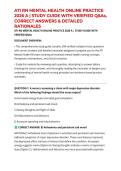
ATI RN MENTAL HEALTH ONLINE PRACTICE
2026 A | STUDY GUIDE WITH VERIFIED Q&As,
CORRECT ANSWERS & DETAILED
RATIONALES
ATI RN MENTAL HEALTH ONLINE PRACTICE 2026 A | STUDY GUIDE WITH
VERIFIED Q&As
DOCUMENT OVERVIEW:
• This comprehensive study guide contains 200 verified multiple-choice questions
with correct answers and detailed rationales designed to prepare you for the ATI
Mental Health RN exam covering all essential mental health nursing concepts,
therapeutic interventions, and clinical scenarios.
• Study this material by reviewing each question, attempting to answer before
checking the correct answer, and thoroughly reading the rationales to deepen your
understanding of mental health nursing principles and evidence-based practice
standards.
QUESTION 1: A nurse is assessing a client with major depressive disorder.
Which of the following findings should the nurse expect?
A) Increased energy levels and rapid goal completion
B) Anhedonia and persistent sad mood
C) Racing thoughts and flight of ideas
D) Hallucinations and delusions
E) Excessive spending and risky behaviors
CORRECT ANSWER: B) Anhedonia and persistent sad mood
RATIONALE: Anhedonia (loss of pleasure in activities) and persistent sad mood are
hallmark symptoms of major depressive disorder. These core features represent
the depressed affect and loss of interest that define the condition. Increased
energy suggests mania (Option A). Racing thoughts indicate a manic or hypomanic
state (Option C). Hallucinations and delusions are more associated with psychotic
,disorders or severe depression with psychotic features (Option D). Excessive
spending reflects manic behavior (Option E).
QUESTION 2: A nurse is planning care for a client experiencing a panic attack.
Which nursing intervention should be the priority?
A) Teach the client breathing techniques for future attacks
B) Provide a calm environment and remain with the client
C) Administer an intramuscular sedative immediately
D) Ask the client to explain the cause of their anxiety
E) Isolate the client to reduce external stimuli
CORRECT ANSWER: B) Provide a calm environment and remain with the
client
RATIONALE: During an active panic attack, the priority is to reduce anxiety through
presence and environmental modification. A calm environment and nursing
presence provide safety and reassurance. Teaching techniques (Option A) is
appropriate after the attack subsides. IM sedatives are not first-line interventions
(Option C). Asking for explanations during acute panic is ineffective and may
increase anxiety (Option D). Complete isolation may increase fear and sense of
abandonment (Option E).
QUESTION 3: A client with bipolar disorder is experiencing a manic episode.
Which medication should the nurse expect the provider to prescribe?
A) Fluoxetine (Prozac)
B) Lithium carbonate
C) Buspirone
D) Hydroxyzine
E) Bupropion
, CORRECT ANSWER: B) Lithium carbonate
RATIONALE: Lithium is the gold standard mood stabilizer for treating and
preventing manic episodes in bipolar disorder. It has decades of evidence
supporting its efficacy. Fluoxetine (Option A) is an SSRI used for depression but can
trigger mania. Buspirone (Option C) is used for anxiety. Hydroxyzine (Option D) is
an antihistamine for short-term anxiety relief. Bupropion (Option E) is an
antidepressant that may precipitate mania in bipolar clients.
QUESTION 4: A nurse is performing a suicide risk assessment on a client.
Which factor indicates the HIGHEST suicide risk?
A) Recent job loss and financial stress
B) Stated intent to harm self with a specific plan and access to means
C) Expression of hopelessness once during the shift
D) History of one previous suicide attempt three years ago
E) Age over 65 with chronic medical illness
CORRECT ANSWER: B) Stated intent to harm self with a specific plan and
access to means
RATIONALE: Intent, plan, and access to means are the strongest predictors of
imminent suicide risk. This combination indicates the highest risk level requiring
immediate intervention. While other factors (Options A, C, D, E) increase risk, none
compare to the combination of expressed intent, detailed plan, and actual access to
lethal means.
QUESTION 5: A client with generalized anxiety disorder asks the nurse about
non-pharmacological coping strategies. Which strategy should the nurse
recommend as MOST effective?
A) Avoiding situations that trigger anxiety
B) Progressive muscle relaxation and regular exercise
, C) Using caffeine to increase alertness
D) Sleeping more during the day
E) Limiting social interactions
CORRECT ANSWER: B) Progressive muscle relaxation and regular exercise
RATIONALE: Progressive muscle relaxation and regular aerobic exercise are
evidence-based techniques that reduce anxiety by decreasing physiological arousal
and promoting neurochemical balance. Avoidance (Option A) reinforces anxiety.
Caffeine (Option C) increases anxiety symptoms. Excessive daytime sleep (Option D)
disrupts sleep architecture. Social isolation (Option E) worsens anxiety and
depression.
QUESTION 6: A nurse is communicating with a client experiencing visual
hallucinations. Which approach is MOST therapeutic?
A) Argue that the hallucinations are not real
B) Pretend to see what the client sees to build rapport
C) Acknowledge the client's experience while offering reality orientation
D) Ignore the client's statements about hallucinations
E) Suggest that the client is imagining things
CORRECT ANSWER: C) Acknowledge the client's experience while offering
reality orientation
RATIONALE: This approach validates the client's subjective experience while gently
providing reality orientation without arguing. This maintains therapeutic rapport
while supporting reality testing. Arguing (Option A) is confrontational and damages
trust. Pretending to hallucinate (Option B) undermines reality orientation. Ignoring
(Option D) dismisses the client. Suggesting imagination (Option E) is invalidating
and confrontational.
2026 A | STUDY GUIDE WITH VERIFIED Q&As,
CORRECT ANSWERS & DETAILED
RATIONALES
ATI RN MENTAL HEALTH ONLINE PRACTICE 2026 A | STUDY GUIDE WITH
VERIFIED Q&As
DOCUMENT OVERVIEW:
• This comprehensive study guide contains 200 verified multiple-choice questions
with correct answers and detailed rationales designed to prepare you for the ATI
Mental Health RN exam covering all essential mental health nursing concepts,
therapeutic interventions, and clinical scenarios.
• Study this material by reviewing each question, attempting to answer before
checking the correct answer, and thoroughly reading the rationales to deepen your
understanding of mental health nursing principles and evidence-based practice
standards.
QUESTION 1: A nurse is assessing a client with major depressive disorder.
Which of the following findings should the nurse expect?
A) Increased energy levels and rapid goal completion
B) Anhedonia and persistent sad mood
C) Racing thoughts and flight of ideas
D) Hallucinations and delusions
E) Excessive spending and risky behaviors
CORRECT ANSWER: B) Anhedonia and persistent sad mood
RATIONALE: Anhedonia (loss of pleasure in activities) and persistent sad mood are
hallmark symptoms of major depressive disorder. These core features represent
the depressed affect and loss of interest that define the condition. Increased
energy suggests mania (Option A). Racing thoughts indicate a manic or hypomanic
state (Option C). Hallucinations and delusions are more associated with psychotic
,disorders or severe depression with psychotic features (Option D). Excessive
spending reflects manic behavior (Option E).
QUESTION 2: A nurse is planning care for a client experiencing a panic attack.
Which nursing intervention should be the priority?
A) Teach the client breathing techniques for future attacks
B) Provide a calm environment and remain with the client
C) Administer an intramuscular sedative immediately
D) Ask the client to explain the cause of their anxiety
E) Isolate the client to reduce external stimuli
CORRECT ANSWER: B) Provide a calm environment and remain with the
client
RATIONALE: During an active panic attack, the priority is to reduce anxiety through
presence and environmental modification. A calm environment and nursing
presence provide safety and reassurance. Teaching techniques (Option A) is
appropriate after the attack subsides. IM sedatives are not first-line interventions
(Option C). Asking for explanations during acute panic is ineffective and may
increase anxiety (Option D). Complete isolation may increase fear and sense of
abandonment (Option E).
QUESTION 3: A client with bipolar disorder is experiencing a manic episode.
Which medication should the nurse expect the provider to prescribe?
A) Fluoxetine (Prozac)
B) Lithium carbonate
C) Buspirone
D) Hydroxyzine
E) Bupropion
, CORRECT ANSWER: B) Lithium carbonate
RATIONALE: Lithium is the gold standard mood stabilizer for treating and
preventing manic episodes in bipolar disorder. It has decades of evidence
supporting its efficacy. Fluoxetine (Option A) is an SSRI used for depression but can
trigger mania. Buspirone (Option C) is used for anxiety. Hydroxyzine (Option D) is
an antihistamine for short-term anxiety relief. Bupropion (Option E) is an
antidepressant that may precipitate mania in bipolar clients.
QUESTION 4: A nurse is performing a suicide risk assessment on a client.
Which factor indicates the HIGHEST suicide risk?
A) Recent job loss and financial stress
B) Stated intent to harm self with a specific plan and access to means
C) Expression of hopelessness once during the shift
D) History of one previous suicide attempt three years ago
E) Age over 65 with chronic medical illness
CORRECT ANSWER: B) Stated intent to harm self with a specific plan and
access to means
RATIONALE: Intent, plan, and access to means are the strongest predictors of
imminent suicide risk. This combination indicates the highest risk level requiring
immediate intervention. While other factors (Options A, C, D, E) increase risk, none
compare to the combination of expressed intent, detailed plan, and actual access to
lethal means.
QUESTION 5: A client with generalized anxiety disorder asks the nurse about
non-pharmacological coping strategies. Which strategy should the nurse
recommend as MOST effective?
A) Avoiding situations that trigger anxiety
B) Progressive muscle relaxation and regular exercise
, C) Using caffeine to increase alertness
D) Sleeping more during the day
E) Limiting social interactions
CORRECT ANSWER: B) Progressive muscle relaxation and regular exercise
RATIONALE: Progressive muscle relaxation and regular aerobic exercise are
evidence-based techniques that reduce anxiety by decreasing physiological arousal
and promoting neurochemical balance. Avoidance (Option A) reinforces anxiety.
Caffeine (Option C) increases anxiety symptoms. Excessive daytime sleep (Option D)
disrupts sleep architecture. Social isolation (Option E) worsens anxiety and
depression.
QUESTION 6: A nurse is communicating with a client experiencing visual
hallucinations. Which approach is MOST therapeutic?
A) Argue that the hallucinations are not real
B) Pretend to see what the client sees to build rapport
C) Acknowledge the client's experience while offering reality orientation
D) Ignore the client's statements about hallucinations
E) Suggest that the client is imagining things
CORRECT ANSWER: C) Acknowledge the client's experience while offering
reality orientation
RATIONALE: This approach validates the client's subjective experience while gently
providing reality orientation without arguing. This maintains therapeutic rapport
while supporting reality testing. Arguing (Option A) is confrontational and damages
trust. Pretending to hallucinate (Option B) undermines reality orientation. Ignoring
(Option D) dismisses the client. Suggesting imagination (Option E) is invalidating
and confrontational.


