
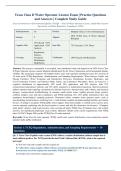
Texas Class D Water Operator License Exam | Practice Questions
and Answers | Complete Study Guide
Texas Commission on Environmental Quality (TCEQ) — Class D Water Operator License, Small Water System
Operations, and State Regulatory Compliance (2026)
Total Questions: 50 Format: Multiple Choice (A-D) with Rationales
2026 TCEQ Class D Water Operator
Sections: 5 Aligned:
Blueprint
30% Recall / 50%
Cognitive Mix: Application / 20% Item Mix: 75% Scenario / 25% Direct
Analysis
Regulations,
Sources,
Coverage: Treatment, Verification: 100% Keyed with Rationales
Distribution,
Math/Safety
Abstract. This practice examination is an original, non-confidential study aid aligned to the 2026 Texas Class
D Water Operator License content blueprint administered by the Texas Commission on Environmental Quality
(TCEQ). The instrument comprises 50 multiple-choice items with rationales distributed across five sections of
10 items each: TCEQ Regulations, Administration, and Sampling Requirements; Water Sources, Intake, and
Storage Facilities; Water Treatment and Disinfection Processes; Distribution Systems, Hydraulics, and
Cross-Connection Control; and Operator Math, Safety, and Laboratory Procedures. Items are keyed to a
cognitive distribution of approximately 30% recall, 50% application, and 20% analysis, with 75%
scenario-based operational vignettes and 25% direct regulatory or mathematical questions. Special inclusions
address operator math requiring calculations for chlorine feed rates, detention time, tank volume, and chemical
dosages; scenario-based troubleshooting of common small-system issues (sudden pressure drops, positive
coliform samples, taste and odor complaints); and TCEQ reporting, Tier 1/2/3 public notification rules, and
mandatory bacteriological sampling protocols. Distractors reflect common water operator errors, such as
miscalculating chemical doses, confusing free vs. total chlorine residual, misunderstanding backflow prevention
devices, or failing to recognize TCEQ public notice triggers. Each item includes a verified correct answer and a
concise rationale explaining why the keyed option is correct and why the distractors are incorrect. “Complete
study guide” denotes a full-scope practice exam covering all major TCEQ Class D domain areas with worked
answers, not reproduced proprietary exam content. Operators should verify current requirements with TCEQ
rules (30 TAC Chapter 290) and the TCEQ Class D study materials.
Keywords: Texas Class D water operator; TCEQ; small water system; disinfection; cross-connection control;
operator math; public notification
Section 1: TCEQ Regulations, Administration, and Sampling Requirements — 10
Questions
Q1: A Texas Class D public water system (PWS) collects a routine distribution coliform sample that is
total coliform-positive. Per TCEQ and the Revised Total Coliform Rule (RTCR), what is the required
next step?
A. Wait one week and resample only the original site
B. Collect three repeat samples within 24 hours at locations specified by RTCR (one upstream, one
downstream, one at the original site) and notify TCEQ *[CORRECT]*
C. Disinfect the system before sampling again
, D. No action is needed unless the sample is E. coli positive
Correct Answer: B
Rationale: RTCR requires three repeat samples within 24 hours at specified locations and TCEQ notification;
waiting a week, disinfecting before sampling, or ignoring a total-coliform positive result are non-compliant.
Q2: Under TCEQ public notification rules, an acute violation (such as an E. coli MCL violation) requires
which tier of public notice?
A. Tier 2 notice within 30 days
B. Tier 3 notice within 1 year
C. Tier 1 public notice, requiring notice within 24 hours via radio, TV, hand delivery, or other rapid
method *[CORRECT]*
D. No public notice is required
Correct Answer: C
Rationale: Tier 1 is required for acute violations (E. coli MCL) within 24 hours; Tier 2 (30 days) and Tier 3 (1 year)
are for non-acute violations, and no notice is non-compliant.
Q3: Which violation typically requires a Tier 2 public notice under TCEQ rules?
A. E. coli MCL violation requiring 24-hour notice
B. Failure to publish the annual Consumer Confidence Report on time
C. Use of a treatment technique not requiring notice
D. A non-acute MCL violation (e.g., total coliform or a chemical MCL exceedance) requiring notice within
30 days *[CORRECT]*
Correct Answer: D
Rationale: Tier 2 applies to non-acute MCL and treatment technique violations within 30 days; E. coli is Tier 1,
CCR timing issues are Tier 3, and 'no notice' is incorrect.
Q4: A small Texas PWS serves 25-1,000 people year-round. How often must it collect routine
bacteriological (TCR) samples at minimum?
A. At least monthly, with frequency based on population per the TCEQ sampling situation plan
*[CORRECT]*
B. Once per year
C. Once per quarter only
D. Daily
Correct Answer: A
Rationale: Systems serving 25-1,000 people must sample at least monthly per TCEQ/RTCR; annual and
quarterly-only frequencies are too infrequent, and daily is not required.
Q5: TCEQ requires that Class D operators maintain certain records. How long must a PWS retain
bacteriological sample results and turbidity measurements?
A. 1 year for both
B. At least 5 years for bacteriological results and 10 years for turbidity records per TCEQ rules
*[CORRECT]*
C. 3 years for both
D. Permanent retention in the operator's home
Correct Answer: B
Rationale: TCEQ requires 5-year retention of bacteriological results and 10-year retention of turbidity records; 1 or 3
years are too short, and home storage is not an official record.
Q6: A Texas PWS exceeds the lead action level during tap sampling. The required TCEQ action
includes:
and Answers | Complete Study Guide
Texas Commission on Environmental Quality (TCEQ) — Class D Water Operator License, Small Water System
Operations, and State Regulatory Compliance (2026)
Total Questions: 50 Format: Multiple Choice (A-D) with Rationales
2026 TCEQ Class D Water Operator
Sections: 5 Aligned:
Blueprint
30% Recall / 50%
Cognitive Mix: Application / 20% Item Mix: 75% Scenario / 25% Direct
Analysis
Regulations,
Sources,
Coverage: Treatment, Verification: 100% Keyed with Rationales
Distribution,
Math/Safety
Abstract. This practice examination is an original, non-confidential study aid aligned to the 2026 Texas Class
D Water Operator License content blueprint administered by the Texas Commission on Environmental Quality
(TCEQ). The instrument comprises 50 multiple-choice items with rationales distributed across five sections of
10 items each: TCEQ Regulations, Administration, and Sampling Requirements; Water Sources, Intake, and
Storage Facilities; Water Treatment and Disinfection Processes; Distribution Systems, Hydraulics, and
Cross-Connection Control; and Operator Math, Safety, and Laboratory Procedures. Items are keyed to a
cognitive distribution of approximately 30% recall, 50% application, and 20% analysis, with 75%
scenario-based operational vignettes and 25% direct regulatory or mathematical questions. Special inclusions
address operator math requiring calculations for chlorine feed rates, detention time, tank volume, and chemical
dosages; scenario-based troubleshooting of common small-system issues (sudden pressure drops, positive
coliform samples, taste and odor complaints); and TCEQ reporting, Tier 1/2/3 public notification rules, and
mandatory bacteriological sampling protocols. Distractors reflect common water operator errors, such as
miscalculating chemical doses, confusing free vs. total chlorine residual, misunderstanding backflow prevention
devices, or failing to recognize TCEQ public notice triggers. Each item includes a verified correct answer and a
concise rationale explaining why the keyed option is correct and why the distractors are incorrect. “Complete
study guide” denotes a full-scope practice exam covering all major TCEQ Class D domain areas with worked
answers, not reproduced proprietary exam content. Operators should verify current requirements with TCEQ
rules (30 TAC Chapter 290) and the TCEQ Class D study materials.
Keywords: Texas Class D water operator; TCEQ; small water system; disinfection; cross-connection control;
operator math; public notification
Section 1: TCEQ Regulations, Administration, and Sampling Requirements — 10
Questions
Q1: A Texas Class D public water system (PWS) collects a routine distribution coliform sample that is
total coliform-positive. Per TCEQ and the Revised Total Coliform Rule (RTCR), what is the required
next step?
A. Wait one week and resample only the original site
B. Collect three repeat samples within 24 hours at locations specified by RTCR (one upstream, one
downstream, one at the original site) and notify TCEQ *[CORRECT]*
C. Disinfect the system before sampling again
, D. No action is needed unless the sample is E. coli positive
Correct Answer: B
Rationale: RTCR requires three repeat samples within 24 hours at specified locations and TCEQ notification;
waiting a week, disinfecting before sampling, or ignoring a total-coliform positive result are non-compliant.
Q2: Under TCEQ public notification rules, an acute violation (such as an E. coli MCL violation) requires
which tier of public notice?
A. Tier 2 notice within 30 days
B. Tier 3 notice within 1 year
C. Tier 1 public notice, requiring notice within 24 hours via radio, TV, hand delivery, or other rapid
method *[CORRECT]*
D. No public notice is required
Correct Answer: C
Rationale: Tier 1 is required for acute violations (E. coli MCL) within 24 hours; Tier 2 (30 days) and Tier 3 (1 year)
are for non-acute violations, and no notice is non-compliant.
Q3: Which violation typically requires a Tier 2 public notice under TCEQ rules?
A. E. coli MCL violation requiring 24-hour notice
B. Failure to publish the annual Consumer Confidence Report on time
C. Use of a treatment technique not requiring notice
D. A non-acute MCL violation (e.g., total coliform or a chemical MCL exceedance) requiring notice within
30 days *[CORRECT]*
Correct Answer: D
Rationale: Tier 2 applies to non-acute MCL and treatment technique violations within 30 days; E. coli is Tier 1,
CCR timing issues are Tier 3, and 'no notice' is incorrect.
Q4: A small Texas PWS serves 25-1,000 people year-round. How often must it collect routine
bacteriological (TCR) samples at minimum?
A. At least monthly, with frequency based on population per the TCEQ sampling situation plan
*[CORRECT]*
B. Once per year
C. Once per quarter only
D. Daily
Correct Answer: A
Rationale: Systems serving 25-1,000 people must sample at least monthly per TCEQ/RTCR; annual and
quarterly-only frequencies are too infrequent, and daily is not required.
Q5: TCEQ requires that Class D operators maintain certain records. How long must a PWS retain
bacteriological sample results and turbidity measurements?
A. 1 year for both
B. At least 5 years for bacteriological results and 10 years for turbidity records per TCEQ rules
*[CORRECT]*
C. 3 years for both
D. Permanent retention in the operator's home
Correct Answer: B
Rationale: TCEQ requires 5-year retention of bacteriological results and 10-year retention of turbidity records; 1 or 3
years are too short, and home storage is not an official record.
Q6: A Texas PWS exceeds the lead action level during tap sampling. The required TCEQ action
includes:


