
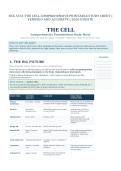
NSG 5531 THE CELL COMPREHENSIVE PRINTABLE STUDY SHEET |
VERIFIED AND ACCURATE | 2026 UPDATE
THE CELL
Comprehensive Foundational Study Sheet
Start here before the deep-dive guide • Printable • High-yield • Built-in annotation space
HOW TO USE THIS SHEET
This is the “make it click” pass: plain-language mechanisms, analogies, must-know distinctions, and clinical
application. Read it first, annotate the right margin, then move to your Unit 1 deep-dive material and practice
questions.
MY NOTES
1. THE BIG PICTURE
Why cell biology matters before organ-system pathophysiology
Every disease you will manage as an FNP can be traced back to cells not getting what
they need, cells being damaged, or the body responding to that injury.
Think of these chapters as the “alphabet.” Later organ-system diseases are the
sentences built from it.
EXAM ANCHOR — Anchor idea
If you can explain what happens to ATP, membranes, water movement, and cell death, you
can usually explain the first steps of many disease processes.
STRUCTURE FACTORY CORE JOB HIGH-YIELD
ANALOGY CONNECTION
Plasma Front gate / security Controls entry and exit; contains Many drugs act at membrane
membrane receptors that recognize signals receptors; membrane damage
is central to cell injury.
Nucleus Main office / Holds DNA and the instructions DNA damage can lead to
blueprint room for cell activity mutation and increased
cancer risk.
Mitochondria Power plant Produces ATP With ischemia, ATP
production fails early and
downstream functions
collapse.
Rough ER Protein assembly line Builds and folds proteins —
Smooth ER Detox / chemical Makes lipids; breaks down drugs Liver cells contain abundant
plant and toxins smooth ER, tying this
organelle to drug/toxin
processing.
Golgi apparatus Shipping department Packages proteins and lipids for —
delivery
Lysosomes Cleanup / recycling Digest old parts, debris, and If lysosomal contents escape,
crew invaders intracellular digestion can
worsen injury.
Cytoskeleton Support beams Maintains shape and supports —
intracellular movement
, MY NOTES
2. CELL STRUCTURE & FUNCTION
Think of the cell as a tiny factory
Core analogy: each organelle is a department with a specific job. Injury makes more
sense when you know which department is failing.
VERIFIED AND ACCURATE | 2026 UPDATE
THE CELL
Comprehensive Foundational Study Sheet
Start here before the deep-dive guide • Printable • High-yield • Built-in annotation space
HOW TO USE THIS SHEET
This is the “make it click” pass: plain-language mechanisms, analogies, must-know distinctions, and clinical
application. Read it first, annotate the right margin, then move to your Unit 1 deep-dive material and practice
questions.
MY NOTES
1. THE BIG PICTURE
Why cell biology matters before organ-system pathophysiology
Every disease you will manage as an FNP can be traced back to cells not getting what
they need, cells being damaged, or the body responding to that injury.
Think of these chapters as the “alphabet.” Later organ-system diseases are the
sentences built from it.
EXAM ANCHOR — Anchor idea
If you can explain what happens to ATP, membranes, water movement, and cell death, you
can usually explain the first steps of many disease processes.
STRUCTURE FACTORY CORE JOB HIGH-YIELD
ANALOGY CONNECTION
Plasma Front gate / security Controls entry and exit; contains Many drugs act at membrane
membrane receptors that recognize signals receptors; membrane damage
is central to cell injury.
Nucleus Main office / Holds DNA and the instructions DNA damage can lead to
blueprint room for cell activity mutation and increased
cancer risk.
Mitochondria Power plant Produces ATP With ischemia, ATP
production fails early and
downstream functions
collapse.
Rough ER Protein assembly line Builds and folds proteins —
Smooth ER Detox / chemical Makes lipids; breaks down drugs Liver cells contain abundant
plant and toxins smooth ER, tying this
organelle to drug/toxin
processing.
Golgi apparatus Shipping department Packages proteins and lipids for —
delivery
Lysosomes Cleanup / recycling Digest old parts, debris, and If lysosomal contents escape,
crew invaders intracellular digestion can
worsen injury.
Cytoskeleton Support beams Maintains shape and supports —
intracellular movement
, MY NOTES
2. CELL STRUCTURE & FUNCTION
Think of the cell as a tiny factory
Core analogy: each organelle is a department with a specific job. Injury makes more
sense when you know which department is failing.


