

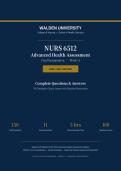
WALDEN UNIVERSITY
College of Nursing • School of Health Sciences
NURS 6512
Advanced Health Assessment
Final Examination • Week 11
EDITION
Complete Questions & Answers
150 Multiple-Choice Items with Detailed Rationales
150 11 3 hrs 100
Total Questions Clinical Sections Recommended Time Maximum Score
Aligned with Walden NURS 6512 Advanced Health Assessment Syllabus
NONPF Core Competencies • AACN Essentials • Advanced Physical Assessment Standards
OFFICIAL FINAL EXAMINATION • WEEK 11 • ACADEMIC YEAR 2026/2027
,Walden University • NURS 6512 • Advanced Health Assessment Final Exam — Week 11 (2026/2027)
Examination Overview
This comprehensive final examination is designed for graduate nursing students enrolled in
NURS 6512 Advanced Health Assessment at Walden University. The exam evaluates mastery
of advanced physical assessment techniques, clinical reasoning, and the integration of
subjective and objective data required for competent advanced practice nursing. Each item is
aligned with the Walden NURS 6512 course syllabus, NONPF APRN Core Competencies, and
the AACN Essentials for advanced nursing education.
The examination contains 150 multiple-choice questions distributed across eleven clinical
content areas spanning the full scope of advanced health assessment. Items are calibrated to
three cognitive levels in accordance with Bloom's taxonomy: approximately 15% recall, 50%
application, and 35% analysis. Roughly 80% of the items are scenario-based, requiring
interpretation of patient presentations, physical exam findings, and clinical
decision-making, while 20% assess direct foundational knowledge. Each question includes
one best answer (A–D) and a concise rationale grounded in advanced health assessment
standards.
Examination Structure
# Section Title Q Range Items
1 Comprehensive Health History & Interviewing Q1–Q20 20
2 General Survey, Vital Signs, & Pain Assessment Q21–Q32 12
3 Skin, Hair, Nails, & Lymphatic System Q33–Q42 10
4 HEENT (Head, Eyes, Ears, Nose, Throat) & Neck Q43–Q57 15
5 Thorax, Lungs, & Cardiovascular System Q58–Q77 20
6 Peripheral Vascular & Lymphatic System Q78–Q87 10
7 Abdomen, GI, & Renal Systems Q88–Q102 15
8 Musculoskeletal System Q103–Q112 10
9 Neurological System Q113–Q127 15
10 Mental Status, Psychosocial, & Special Populations Q128–Q137 10
11 Comprehensive Case Studies & Clinical Scenarios Q138–Q150 13
TOTAL Q1–Q150 150
NURS 6512 — Advanced Health Assessment Final Exam Page 2
,Walden University • NURS 6512 • Advanced Health Assessment Final Exam — Week 11 (2026/2027)
Cognitive Level Distribution
Cognitive Level Bloom's Tier Approx. % Item Count
Recall / Knowledge Remember 15% ~22 items
Application Apply 50% ~75 items
Analysis / Clinical Reasoning Analyze 35% ~53 items
Instructions to the Candidate
• Select the single best answer for each item. Multiple answers for a single item will be
scored as incorrect.
• Items are presented in sequential order (Q1 through Q150) across eleven clinical sections;
do not skip sections.
• Scenario-based items may include vital signs, physical findings, lab values, and clinical
background—read each stem carefully before answering.
• Rationales accompanying each answer reflect standards from Bates' Guide to Physical
Examination, Seidel's Guide to Physical Examination, and the NONPF APRN Core
Competencies.
• A passing composite score of 75% or higher is recommended for progression to the
clinical practicum.
NURS 6512 — Advanced Health Assessment Final Exam Page 3
, Walden University • NURS 6512 • Advanced Health Assessment Final Exam — Week 11 (2026/2027)
Section 1: Comprehensive Health History & Interviewing
Items: Q1–Q20 (20 questions) | Focus: Chief complaint, HPI (PQRST), PMH, FH, SH, ROS; cultural, spiritual, and
social determinants of health; therapeutic communication
Q1. A 54-year-old Vietnamese woman presents to the clinic for the first time with complaints
of fatigue and unintentional weight loss. When the NP begins the interview, the patient
avoids direct eye contact and answers questions briefly. Which interviewing approach best
demonstrates cultural humility while obtaining an accurate history?
A. Insist the patient maintain eye contact to build trust and rapport.
B. Document the patient as 'guarded' and proceed with closed-ended questions only.
C. Acknowledge her perspective, use open-ended questions, and allow silence as
needed. *[CORRECT]*
D. Have a family member answer questions on her behalf to expedite the visit.
Correct Answer: C
Rationale. Open-ended questions combined with active listening and respectful acknowledgment
of the patient's perspective are core components of therapeutic communication in the Walden
NURS 6512 curriculum. Avoiding eye contact may reflect cultural norms rather than evasiveness;
labeling the patient as 'guarded' or forcing eye contact compromises rapport. Family interpreters
may filter or alter information, so a trained medical interpreter is preferred when language barriers
exist.
Q2. An NP is obtaining a history from a 67-year-old man with chest pain. Using the PQRST
framework, which statement best captures the 'R' (region/radiation) component of the
history of present illness (HPI)?
A. "The pain began about two hours ago after dinner."
B. "The pain is a crushing pressure in the center of my chest that radiates to my left
arm and jaw." *[CORRECT]*
C. "The pain is an 8 out of 10 on the numeric scale."
D. "Nothing I do seems to make the pain better or worse."
Correct Answer: B
Rationale. In the PQRST mnemonic, 'R' represents region and radiation. Option B explicitly
identifies the anatomic location (central chest) and the radiating pattern (left arm and jaw), which
is the classic presentation of cardiac ischemia. Option A describes timing (T), option C describes
severity (S), and option D describes provocative/palliative factors (P).
Q3. A 42-year-old woman is asked about her past medical history (PMH). Which
documentation entry reflects a complete and accurate PMH according to advanced health
assessment standards?
A. "PMH: Hypertension, diabetes."
B. "PMH: Hypertension diagnosed 2018, managed with lisinopril 20 mg daily; type 2
diabetes diagnosed 2020, managed with metformin 1000 mg BID; last A1c 7.2%."
*[CORRECT]*
NURS 6512 — Advanced Health Assessment Final Exam Page 4
College of Nursing • School of Health Sciences
NURS 6512
Advanced Health Assessment
Final Examination • Week 11
EDITION
Complete Questions & Answers
150 Multiple-Choice Items with Detailed Rationales
150 11 3 hrs 100
Total Questions Clinical Sections Recommended Time Maximum Score
Aligned with Walden NURS 6512 Advanced Health Assessment Syllabus
NONPF Core Competencies • AACN Essentials • Advanced Physical Assessment Standards
OFFICIAL FINAL EXAMINATION • WEEK 11 • ACADEMIC YEAR 2026/2027
,Walden University • NURS 6512 • Advanced Health Assessment Final Exam — Week 11 (2026/2027)
Examination Overview
This comprehensive final examination is designed for graduate nursing students enrolled in
NURS 6512 Advanced Health Assessment at Walden University. The exam evaluates mastery
of advanced physical assessment techniques, clinical reasoning, and the integration of
subjective and objective data required for competent advanced practice nursing. Each item is
aligned with the Walden NURS 6512 course syllabus, NONPF APRN Core Competencies, and
the AACN Essentials for advanced nursing education.
The examination contains 150 multiple-choice questions distributed across eleven clinical
content areas spanning the full scope of advanced health assessment. Items are calibrated to
three cognitive levels in accordance with Bloom's taxonomy: approximately 15% recall, 50%
application, and 35% analysis. Roughly 80% of the items are scenario-based, requiring
interpretation of patient presentations, physical exam findings, and clinical
decision-making, while 20% assess direct foundational knowledge. Each question includes
one best answer (A–D) and a concise rationale grounded in advanced health assessment
standards.
Examination Structure
# Section Title Q Range Items
1 Comprehensive Health History & Interviewing Q1–Q20 20
2 General Survey, Vital Signs, & Pain Assessment Q21–Q32 12
3 Skin, Hair, Nails, & Lymphatic System Q33–Q42 10
4 HEENT (Head, Eyes, Ears, Nose, Throat) & Neck Q43–Q57 15
5 Thorax, Lungs, & Cardiovascular System Q58–Q77 20
6 Peripheral Vascular & Lymphatic System Q78–Q87 10
7 Abdomen, GI, & Renal Systems Q88–Q102 15
8 Musculoskeletal System Q103–Q112 10
9 Neurological System Q113–Q127 15
10 Mental Status, Psychosocial, & Special Populations Q128–Q137 10
11 Comprehensive Case Studies & Clinical Scenarios Q138–Q150 13
TOTAL Q1–Q150 150
NURS 6512 — Advanced Health Assessment Final Exam Page 2
,Walden University • NURS 6512 • Advanced Health Assessment Final Exam — Week 11 (2026/2027)
Cognitive Level Distribution
Cognitive Level Bloom's Tier Approx. % Item Count
Recall / Knowledge Remember 15% ~22 items
Application Apply 50% ~75 items
Analysis / Clinical Reasoning Analyze 35% ~53 items
Instructions to the Candidate
• Select the single best answer for each item. Multiple answers for a single item will be
scored as incorrect.
• Items are presented in sequential order (Q1 through Q150) across eleven clinical sections;
do not skip sections.
• Scenario-based items may include vital signs, physical findings, lab values, and clinical
background—read each stem carefully before answering.
• Rationales accompanying each answer reflect standards from Bates' Guide to Physical
Examination, Seidel's Guide to Physical Examination, and the NONPF APRN Core
Competencies.
• A passing composite score of 75% or higher is recommended for progression to the
clinical practicum.
NURS 6512 — Advanced Health Assessment Final Exam Page 3
, Walden University • NURS 6512 • Advanced Health Assessment Final Exam — Week 11 (2026/2027)
Section 1: Comprehensive Health History & Interviewing
Items: Q1–Q20 (20 questions) | Focus: Chief complaint, HPI (PQRST), PMH, FH, SH, ROS; cultural, spiritual, and
social determinants of health; therapeutic communication
Q1. A 54-year-old Vietnamese woman presents to the clinic for the first time with complaints
of fatigue and unintentional weight loss. When the NP begins the interview, the patient
avoids direct eye contact and answers questions briefly. Which interviewing approach best
demonstrates cultural humility while obtaining an accurate history?
A. Insist the patient maintain eye contact to build trust and rapport.
B. Document the patient as 'guarded' and proceed with closed-ended questions only.
C. Acknowledge her perspective, use open-ended questions, and allow silence as
needed. *[CORRECT]*
D. Have a family member answer questions on her behalf to expedite the visit.
Correct Answer: C
Rationale. Open-ended questions combined with active listening and respectful acknowledgment
of the patient's perspective are core components of therapeutic communication in the Walden
NURS 6512 curriculum. Avoiding eye contact may reflect cultural norms rather than evasiveness;
labeling the patient as 'guarded' or forcing eye contact compromises rapport. Family interpreters
may filter or alter information, so a trained medical interpreter is preferred when language barriers
exist.
Q2. An NP is obtaining a history from a 67-year-old man with chest pain. Using the PQRST
framework, which statement best captures the 'R' (region/radiation) component of the
history of present illness (HPI)?
A. "The pain began about two hours ago after dinner."
B. "The pain is a crushing pressure in the center of my chest that radiates to my left
arm and jaw." *[CORRECT]*
C. "The pain is an 8 out of 10 on the numeric scale."
D. "Nothing I do seems to make the pain better or worse."
Correct Answer: B
Rationale. In the PQRST mnemonic, 'R' represents region and radiation. Option B explicitly
identifies the anatomic location (central chest) and the radiating pattern (left arm and jaw), which
is the classic presentation of cardiac ischemia. Option A describes timing (T), option C describes
severity (S), and option D describes provocative/palliative factors (P).
Q3. A 42-year-old woman is asked about her past medical history (PMH). Which
documentation entry reflects a complete and accurate PMH according to advanced health
assessment standards?
A. "PMH: Hypertension, diabetes."
B. "PMH: Hypertension diagnosed 2018, managed with lisinopril 20 mg daily; type 2
diabetes diagnosed 2020, managed with metformin 1000 mg BID; last A1c 7.2%."
*[CORRECT]*
NURS 6512 — Advanced Health Assessment Final Exam Page 4


