UNIT 4 — MILESTONE
4
SCORE
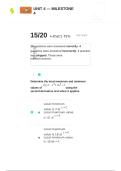
15/20
15/20 that's 75% RETAKE
15 questions were answered correctly. 4
questions were answered incorrectly. 1 question
was skipped. These were
marked incorrect.
1
Determine the local maximum and minimum
values of using the
second derivative test when it applies.
Local minimum
value is 3 at .
Local maximum value
is 111 at .
Local maximum
value is 18 at .
Local minimum value
is -18 at .
, Local minimum
value is 18 at .
Local maximum value
is -18 at .
Local maximum
value is 3 at .
Local minimum value
is 111 at .
RATIONALE
First, find the critical numbers. Critical numbers are
values in the domain of for which the
derivative is 0 or undefined.
The original function is a polynomial and
therefore has a domain of all real numbers.
Find the derivative:
The derivative is a polynomial and
therefore is never undefined.
Find the value(s) of x for which the derivative is 0:
The critical numbers of are and .
Now, take the second derivative and
substitute and .
,Find the second derivative:
Evaluate the second derivative at each
critical value, starting with :
The second derivative is positive at the critical
value . By the second derivative test,
is a local minimum. A local minimum
value is:
Do the same with the second critical value, :
The second derivative is negative at the critical
value . By the second derivative test,
is a local maximum. A local maximum
value is:
Therefore, a local minimum value is
and a local maximum value is .
CONCEPT
f'' and Extreme Values of f
Report an issue with this question
, Evaluate the following limit: .
RATIONALE
If we look at each factor separately, we see that
and as . Thus, this
limit has the form .
To rewrite, consider the fact that ,
which means , which
now has the form .
To evaluate, use L’Hopital’s rule. Since
and x are differentiable and the limit
has the form L'Hopital's rule is used.
Take the derivative of the
numerator and denominator:
4
SCORE
15/20
15/20 that's 75% RETAKE
15 questions were answered correctly. 4
questions were answered incorrectly. 1 question
was skipped. These were
marked incorrect.
1
Determine the local maximum and minimum
values of using the
second derivative test when it applies.
Local minimum
value is 3 at .
Local maximum value
is 111 at .
Local maximum
value is 18 at .
Local minimum value
is -18 at .
, Local minimum
value is 18 at .
Local maximum value
is -18 at .
Local maximum
value is 3 at .
Local minimum value
is 111 at .
RATIONALE
First, find the critical numbers. Critical numbers are
values in the domain of for which the
derivative is 0 or undefined.
The original function is a polynomial and
therefore has a domain of all real numbers.
Find the derivative:
The derivative is a polynomial and
therefore is never undefined.
Find the value(s) of x for which the derivative is 0:
The critical numbers of are and .
Now, take the second derivative and
substitute and .
,Find the second derivative:
Evaluate the second derivative at each
critical value, starting with :
The second derivative is positive at the critical
value . By the second derivative test,
is a local minimum. A local minimum
value is:
Do the same with the second critical value, :
The second derivative is negative at the critical
value . By the second derivative test,
is a local maximum. A local maximum
value is:
Therefore, a local minimum value is
and a local maximum value is .
CONCEPT
f'' and Extreme Values of f
Report an issue with this question
, Evaluate the following limit: .
RATIONALE
If we look at each factor separately, we see that
and as . Thus, this
limit has the form .
To rewrite, consider the fact that ,
which means , which
now has the form .
To evaluate, use L’Hopital’s rule. Since
and x are differentiable and the limit
has the form L'Hopital's rule is used.
Take the derivative of the
numerator and denominator: