
1
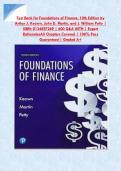
Test Bank for Foundations of Finance, 10th Edition by
Arthur J. Keown, John D. Martin, and J. William Petty |
ISBN: 0134897269 | 600 Q&A WITH | Expert
RationalesAll Chapters Covered | 100% Pass
Guaranteed | Graded A+
,2
[1] Financial management deals with the maintenance and creation of economic value or
wealth. Which of the following best describes the primary role of a financial manager in this
context?
A. To maximize the firm's accounting profits in the short term
B. To minimize the firm's tax liability through aggressive accounting
C. To make decisions that maximize the market value of the firm's existing stock
D. To ensure the firm maintains a high level of liquidity at all times
☑ Correct Answer: C
☑ Explanation: The primary role of a financial manager is to make decisions that maximize
shareholder wealth, which is reflected in the market price of the firm's existing common stock.
Option A is incorrect because profit maximization ignores risk and the timing of cash flows.
Option B is incorrect as minimizing taxes is not the primary objective. Option D is incorrect
because maintaining excessive liquidity can reduce returns and is a sub-optimization of the
broader goal.
[2] Each financial decision made by a corporate manager can be evaluated by its direct impact
on the corporation's stock price. Is this statement true or false?
,3
A. True
B. False
C. True, but only in the short run
D. True, but only if the firm is publicly traded
☑ Correct Answer: B
☑ Explanation: This statement is false. While stock price impact is an important
consideration, many factors such as market conditions, investor sentiment, and macroeconomic
trends also affect stock price. Managers should focus on decisions that maximize intrinsic value,
not just short-term price movements. The "ceteris paribus" assumption is necessary to evaluate
a manager's decision purely on its stock price effect.
[3] The fundamental goal of a business is to maximize the retained earnings available to the
corporation's shareholders. Is this statement true or false?
A. True
B. False
C. True, but only for corporations
D. True, but only for small businesses
, 4
☑ Correct Answer: B
☑ Explanation: This statement is false. The primary goal of a business is maximizing
shareholder wealth (stock price), not simply maximizing retained earnings. Retained earnings
are just one component of value creation and do not fully capture the firm's overall objective of
maximizing the present value of expected future cash flows.
[4] Shareholder wealth maximization means maximizing the price of the existing common stock.
Is this statement true or false?
A. True
B. False
C. True, but only in efficient markets
D. True, but only if dividends are paid
☑ Correct Answer: A
☑ Explanation: This statement is true. Stock price reflects the market's assessment of the
present value of expected future cash flows, making it a direct measure of shareholder wealth.
Maximizing shareholder wealth is the fundamental goal of financial management.
Test Bank for Foundations of Finance, 10th Edition by
Arthur J. Keown, John D. Martin, and J. William Petty |
ISBN: 0134897269 | 600 Q&A WITH | Expert
RationalesAll Chapters Covered | 100% Pass
Guaranteed | Graded A+
,2
[1] Financial management deals with the maintenance and creation of economic value or
wealth. Which of the following best describes the primary role of a financial manager in this
context?
A. To maximize the firm's accounting profits in the short term
B. To minimize the firm's tax liability through aggressive accounting
C. To make decisions that maximize the market value of the firm's existing stock
D. To ensure the firm maintains a high level of liquidity at all times
☑ Correct Answer: C
☑ Explanation: The primary role of a financial manager is to make decisions that maximize
shareholder wealth, which is reflected in the market price of the firm's existing common stock.
Option A is incorrect because profit maximization ignores risk and the timing of cash flows.
Option B is incorrect as minimizing taxes is not the primary objective. Option D is incorrect
because maintaining excessive liquidity can reduce returns and is a sub-optimization of the
broader goal.
[2] Each financial decision made by a corporate manager can be evaluated by its direct impact
on the corporation's stock price. Is this statement true or false?
,3
A. True
B. False
C. True, but only in the short run
D. True, but only if the firm is publicly traded
☑ Correct Answer: B
☑ Explanation: This statement is false. While stock price impact is an important
consideration, many factors such as market conditions, investor sentiment, and macroeconomic
trends also affect stock price. Managers should focus on decisions that maximize intrinsic value,
not just short-term price movements. The "ceteris paribus" assumption is necessary to evaluate
a manager's decision purely on its stock price effect.
[3] The fundamental goal of a business is to maximize the retained earnings available to the
corporation's shareholders. Is this statement true or false?
A. True
B. False
C. True, but only for corporations
D. True, but only for small businesses
, 4
☑ Correct Answer: B
☑ Explanation: This statement is false. The primary goal of a business is maximizing
shareholder wealth (stock price), not simply maximizing retained earnings. Retained earnings
are just one component of value creation and do not fully capture the firm's overall objective of
maximizing the present value of expected future cash flows.
[4] Shareholder wealth maximization means maximizing the price of the existing common stock.
Is this statement true or false?
A. True
B. False
C. True, but only in efficient markets
D. True, but only if dividends are paid
☑ Correct Answer: A
☑ Explanation: This statement is true. Stock price reflects the market's assessment of the
present value of expected future cash flows, making it a direct measure of shareholder wealth.
Maximizing shareholder wealth is the fundamental goal of financial management.


