
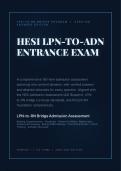
LPN-TO-RN BRIDGE PROGRAM | VERIFIED
ANSWERS EDITION
HESI LPN-TO-ADN
ENTRANCE EXAM
A comprehensive 150-item admission assessment
spanning nine content domains, with verified answers
and detailed rationales for every question. Aligned with
the HESI Admission Assessment (A2) Blueprint, LPN-
to-RN bridge curricular standards, and NCLEX-RN
foundation competencies.
LPN-to-RN Bridge Admission Assessment
Reading Comprehension · Vocabulary · Grammar & Writing · Mathematics ·
Anatomy & Physiology · Biology & Microbiology · Chemistry & Physics · Critical
Thinking · Transition Scenarios
VERSI ON 1 | 15 0 I TEMS | 2026-2027 ED I TI ON
,HESI LPN-TO-ADN ENTRANCE EXAM (2026/2027) 150 ITEMS | 9 SECTIONS
HESI LPN-TO-ADN ENTRANCE EXAM (2026/2027)
LPN-to-RN Bridge Program Admission Assessment | Practice Questions with Verified Answers
Total Items: 150 | Sections: 9 | Time Allotment: 180 Minutes | Cognitive Levels: 25% Recall / 50% Application / 25%
Analysis | Aligned with the HESI Admission Assessment (A2) Blueprint, LPN-to-RN Bridge Curricular Standards, and
NCLEX-RN Foundation Competencies
About this practice bank: All 150 items are original practice questions written to align with the HESI Admission Assessment (A2)
blueprint, LPN-to-RN bridge curricular standards, and NCLEX-RN foundation competencies. This is an independent study
resource - it is not affiliated with, endorsed by, and does not contain proprietary content from, HESI/Elsevier or any bridge
program. Each item carries a verified answer and a rationale that applies HESI test-taking methodology.
Section 1: Reading Comprehension
Passage: Alcohol-based hand rubs are the preferred method for routine hand hygiene in most clinical settings because
they take less time than handwashing and dry quickly. They are not effective, however, against spores of Clostridioides
difficile or when hands are visibly soiled. In those situations, staff must wash with soap and running water for at least
twenty seconds. Facilities that combine both methods correctly report lower overall infection rates.
Q1. Which statement best expresses the main idea of the passage?
A. Handwashing should replace alcohol-based rubs in all clinical settings.
B. Alcohol rubs are efficient for routine hygiene, but soap and water are required in specific situations.
[CORRECT]
C. Infection rates fall whenever alcohol-based rubs are available on every unit.
D. Clostridioides difficile is the most common cause of hospital-acquired infection.
Correct Answer: B
Rationale: The main idea must cover the whole passage: the preference for alcohol rubs plus the exceptions that
require soap and water, which choice B restates. Choices A and C overstate the passage's claims, and D introduces
information never discussed. HESI reading methodology: the main idea is broad enough to include all key details
without adding new claims.
HESI A2 Blueprint and LPN-to-RN Bridge Standards - 2026/2027 Edition 1
,HESI LPN-TO-ADN ENTRANCE EXAM (2026/2027) 150 ITEMS | 9 SECTIONS
Passage: Hypertension is often called the silent killer because it usually produces no symptoms until serious damage has
occurred. Many adults stop taking prescribed medication once they feel well, unaware that controlled blood pressure is
the result of treatment rather than the absence of disease. Home monitoring, clinic follow-up, and lifestyle changes such
as sodium reduction work together to keep readings in a safe range.
Q2. Which statement best expresses the main idea of the passage?
A. Blood pressure medication cures hypertension permanently.
B. Symptoms reliably warn patients when blood pressure is high.
C. Home monitoring is more accurate than clinic measurement.
D. Because hypertension is usually symptomless, ongoing treatment and monitoring are essential.
[CORRECT]
Correct Answer: D
Rationale: The passage centers on symptomless disease and the need for continued treatment and follow-up, which
D restates. A and B contradict the passage, and C raises a comparison the author never makes. HESI methodology:
eliminate distractors that contradict the text or import outside claims.
Passage: At discharge, the nurse instructs the client with heart failure to weigh herself every morning before breakfast,
using the same scale, after voiding. She is told to report a gain of more than three pounds in one day or five pounds in
one week, along with swelling in the ankles or increased shortness of breath.
Q3. Which conclusion is best supported by the discharge instructions?
A. Rapid weight gain is a useful early sign of fluid retention in heart failure. [CORRECT]
B. Daily weights should be taken at whatever time is most convenient.
C. Ankle swelling is an expected outcome of heart failure treatment.
D. Weight changes matter only after five pounds are gained in one week.
Correct Answer: A
Rationale: Because a failing heart retains fluid before other symptoms appear, the instruction to report rapid gains
implies that daily weight is an early detection tool, choice A. B and D contradict the stated method and thresholds,
and C contradicts the instruction to report swelling. HESI inference questions require answers that follow logically
from the text, never from outside opinion.
Passage: A single bottle of sweetened iced tea contains 2.5 servings of 8 ounces each, and each serving provides 90
calories and 22 grams of sugar. Consumers who drink the entire bottle actually receive 225 calories and 55 grams of
sugar, well above the amount most single beverages should contribute to a daily diet.
Q4. According to the passage, what is the most important reason to read the serving size on a nutrition label?
A. Bottled beverages are required to list sugar content.
B. Most drinks contain artificial sweeteners.
C. A container may hold several servings, so label figures must be multiplied accordingly. [CORRECT]
D. Nutrition labels list the totals for the entire container.
Correct Answer: C
Rationale: The passage's key detail is that one bottle holds 2.5 servings, so the consumer must multiply per-serving
values to know actual intake, choice C. A is true but not the lesson of the passage, B is never mentioned, and D is the
exact misconception the passage corrects. HESI detail questions reward answers that restate stated information.
HESI A2 Blueprint and LPN-to-RN Bridge Standards - 2026/2027 Edition 2
, HESI LPN-TO-ADN ENTRANCE EXAM (2026/2027) 150 ITEMS | 9 SECTIONS
Passage: Bright screens and late caffeine keep many adults from falling asleep at a reasonable hour. Setting a consistent
bedtime, dimming lights in the evening, and moving the last cup of coffee to early afternoon help the body maintain its
natural sleep rhythm, which supports memory, immunity, and emotional balance.
Q5. The author's primary purpose in writing this passage is to:
A. Prove that adults need exactly eight hours of sleep.
B. Criticize people who use electronic devices at night.
C. Explain practical habits that support healthy sleep. [CORRECT]
D. Compare prescription sleep aids with herbal remedies.
Correct Answer: C
Rationale: The author presents helpful habits and their benefits, which is an informative purpose, choice C. No
specific hours are stated (A), the tone is neutral rather than critical (B), and sleep aids are never discussed (D). HESI
author's-purpose questions match the tone and content: to inform, persuade, or entertain.
Passage: Most successful quitters do not succeed on their first attempt. Research shows that tobacco users typically
make several quit attempts before quitting permanently, and each attempt teaches something useful about personal
triggers. Health counselors are encouraged to treat relapse as a normal part of the process rather than a failure.
Q6. Which inference is best supported by this passage?
A. Relapse should be expected and treated as part of the learning process. [CORRECT]
B. Nicotine replacement products are the only effective treatment.
C. Quitting is easy for highly motivated patients.
D. Counselors should discontinue programs after a client relapses.
Correct Answer: A
Rationale: The passage normalizes multiple attempts, so the counselor should anticipate relapse and continue
supporting the client, choice A. B, C, and D all contradict the passage's message. HESI inference answers stay
consistent with the author's stance without exaggeration.
Passage: People with diabetes should inspect both feet every day for cuts, blisters, redness, or drainage, using a mirror if
the soles are hard to see. Feet should be washed and dried daily, shoes should never be worn on bare feet, and new shoes
should be broken in gradually. Any sore that does not heal within a few days should be shown to a healthcare provider.
Q7. According to the passage, which practice is recommended?
A. Soaking the feet in hot water every evening.
B. Checking the feet only when pain develops.
C. Walking barefoot indoors to toughen the skin.
D. Inspecting the feet daily and reporting sores that do not heal. [CORRECT]
Correct Answer: D
Rationale: D restates the passage's central recommendations. A, B, and C contradict the explicit instructions. HESI
detail questions are answered directly from the text; resist options that sound generally plausible but were not stated.
HESI A2 Blueprint and LPN-to-RN Bridge Standards - 2026/2027 Edition 3
ANSWERS EDITION
HESI LPN-TO-ADN
ENTRANCE EXAM
A comprehensive 150-item admission assessment
spanning nine content domains, with verified answers
and detailed rationales for every question. Aligned with
the HESI Admission Assessment (A2) Blueprint, LPN-
to-RN bridge curricular standards, and NCLEX-RN
foundation competencies.
LPN-to-RN Bridge Admission Assessment
Reading Comprehension · Vocabulary · Grammar & Writing · Mathematics ·
Anatomy & Physiology · Biology & Microbiology · Chemistry & Physics · Critical
Thinking · Transition Scenarios
VERSI ON 1 | 15 0 I TEMS | 2026-2027 ED I TI ON
,HESI LPN-TO-ADN ENTRANCE EXAM (2026/2027) 150 ITEMS | 9 SECTIONS
HESI LPN-TO-ADN ENTRANCE EXAM (2026/2027)
LPN-to-RN Bridge Program Admission Assessment | Practice Questions with Verified Answers
Total Items: 150 | Sections: 9 | Time Allotment: 180 Minutes | Cognitive Levels: 25% Recall / 50% Application / 25%
Analysis | Aligned with the HESI Admission Assessment (A2) Blueprint, LPN-to-RN Bridge Curricular Standards, and
NCLEX-RN Foundation Competencies
About this practice bank: All 150 items are original practice questions written to align with the HESI Admission Assessment (A2)
blueprint, LPN-to-RN bridge curricular standards, and NCLEX-RN foundation competencies. This is an independent study
resource - it is not affiliated with, endorsed by, and does not contain proprietary content from, HESI/Elsevier or any bridge
program. Each item carries a verified answer and a rationale that applies HESI test-taking methodology.
Section 1: Reading Comprehension
Passage: Alcohol-based hand rubs are the preferred method for routine hand hygiene in most clinical settings because
they take less time than handwashing and dry quickly. They are not effective, however, against spores of Clostridioides
difficile or when hands are visibly soiled. In those situations, staff must wash with soap and running water for at least
twenty seconds. Facilities that combine both methods correctly report lower overall infection rates.
Q1. Which statement best expresses the main idea of the passage?
A. Handwashing should replace alcohol-based rubs in all clinical settings.
B. Alcohol rubs are efficient for routine hygiene, but soap and water are required in specific situations.
[CORRECT]
C. Infection rates fall whenever alcohol-based rubs are available on every unit.
D. Clostridioides difficile is the most common cause of hospital-acquired infection.
Correct Answer: B
Rationale: The main idea must cover the whole passage: the preference for alcohol rubs plus the exceptions that
require soap and water, which choice B restates. Choices A and C overstate the passage's claims, and D introduces
information never discussed. HESI reading methodology: the main idea is broad enough to include all key details
without adding new claims.
HESI A2 Blueprint and LPN-to-RN Bridge Standards - 2026/2027 Edition 1
,HESI LPN-TO-ADN ENTRANCE EXAM (2026/2027) 150 ITEMS | 9 SECTIONS
Passage: Hypertension is often called the silent killer because it usually produces no symptoms until serious damage has
occurred. Many adults stop taking prescribed medication once they feel well, unaware that controlled blood pressure is
the result of treatment rather than the absence of disease. Home monitoring, clinic follow-up, and lifestyle changes such
as sodium reduction work together to keep readings in a safe range.
Q2. Which statement best expresses the main idea of the passage?
A. Blood pressure medication cures hypertension permanently.
B. Symptoms reliably warn patients when blood pressure is high.
C. Home monitoring is more accurate than clinic measurement.
D. Because hypertension is usually symptomless, ongoing treatment and monitoring are essential.
[CORRECT]
Correct Answer: D
Rationale: The passage centers on symptomless disease and the need for continued treatment and follow-up, which
D restates. A and B contradict the passage, and C raises a comparison the author never makes. HESI methodology:
eliminate distractors that contradict the text or import outside claims.
Passage: At discharge, the nurse instructs the client with heart failure to weigh herself every morning before breakfast,
using the same scale, after voiding. She is told to report a gain of more than three pounds in one day or five pounds in
one week, along with swelling in the ankles or increased shortness of breath.
Q3. Which conclusion is best supported by the discharge instructions?
A. Rapid weight gain is a useful early sign of fluid retention in heart failure. [CORRECT]
B. Daily weights should be taken at whatever time is most convenient.
C. Ankle swelling is an expected outcome of heart failure treatment.
D. Weight changes matter only after five pounds are gained in one week.
Correct Answer: A
Rationale: Because a failing heart retains fluid before other symptoms appear, the instruction to report rapid gains
implies that daily weight is an early detection tool, choice A. B and D contradict the stated method and thresholds,
and C contradicts the instruction to report swelling. HESI inference questions require answers that follow logically
from the text, never from outside opinion.
Passage: A single bottle of sweetened iced tea contains 2.5 servings of 8 ounces each, and each serving provides 90
calories and 22 grams of sugar. Consumers who drink the entire bottle actually receive 225 calories and 55 grams of
sugar, well above the amount most single beverages should contribute to a daily diet.
Q4. According to the passage, what is the most important reason to read the serving size on a nutrition label?
A. Bottled beverages are required to list sugar content.
B. Most drinks contain artificial sweeteners.
C. A container may hold several servings, so label figures must be multiplied accordingly. [CORRECT]
D. Nutrition labels list the totals for the entire container.
Correct Answer: C
Rationale: The passage's key detail is that one bottle holds 2.5 servings, so the consumer must multiply per-serving
values to know actual intake, choice C. A is true but not the lesson of the passage, B is never mentioned, and D is the
exact misconception the passage corrects. HESI detail questions reward answers that restate stated information.
HESI A2 Blueprint and LPN-to-RN Bridge Standards - 2026/2027 Edition 2
, HESI LPN-TO-ADN ENTRANCE EXAM (2026/2027) 150 ITEMS | 9 SECTIONS
Passage: Bright screens and late caffeine keep many adults from falling asleep at a reasonable hour. Setting a consistent
bedtime, dimming lights in the evening, and moving the last cup of coffee to early afternoon help the body maintain its
natural sleep rhythm, which supports memory, immunity, and emotional balance.
Q5. The author's primary purpose in writing this passage is to:
A. Prove that adults need exactly eight hours of sleep.
B. Criticize people who use electronic devices at night.
C. Explain practical habits that support healthy sleep. [CORRECT]
D. Compare prescription sleep aids with herbal remedies.
Correct Answer: C
Rationale: The author presents helpful habits and their benefits, which is an informative purpose, choice C. No
specific hours are stated (A), the tone is neutral rather than critical (B), and sleep aids are never discussed (D). HESI
author's-purpose questions match the tone and content: to inform, persuade, or entertain.
Passage: Most successful quitters do not succeed on their first attempt. Research shows that tobacco users typically
make several quit attempts before quitting permanently, and each attempt teaches something useful about personal
triggers. Health counselors are encouraged to treat relapse as a normal part of the process rather than a failure.
Q6. Which inference is best supported by this passage?
A. Relapse should be expected and treated as part of the learning process. [CORRECT]
B. Nicotine replacement products are the only effective treatment.
C. Quitting is easy for highly motivated patients.
D. Counselors should discontinue programs after a client relapses.
Correct Answer: A
Rationale: The passage normalizes multiple attempts, so the counselor should anticipate relapse and continue
supporting the client, choice A. B, C, and D all contradict the passage's message. HESI inference answers stay
consistent with the author's stance without exaggeration.
Passage: People with diabetes should inspect both feet every day for cuts, blisters, redness, or drainage, using a mirror if
the soles are hard to see. Feet should be washed and dried daily, shoes should never be worn on bare feet, and new shoes
should be broken in gradually. Any sore that does not heal within a few days should be shown to a healthcare provider.
Q7. According to the passage, which practice is recommended?
A. Soaking the feet in hot water every evening.
B. Checking the feet only when pain develops.
C. Walking barefoot indoors to toughen the skin.
D. Inspecting the feet daily and reporting sores that do not heal. [CORRECT]
Correct Answer: D
Rationale: D restates the passage's central recommendations. A, B, and C contradict the explicit instructions. HESI
detail questions are answered directly from the text; resist options that sound generally plausible but were not stated.
HESI A2 Blueprint and LPN-to-RN Bridge Standards - 2026/2027 Edition 3


