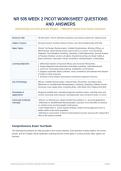
NR 505 WEEK 2 PICOT WORKSHEET QUESTIONS
AND ANSWERS
Epidemiology and Clinical Study Designs — 2026-2027 Update Exam Study Companion
Resource Title NR 505 Week 2 PICOT Worksheet Questions and Answers (2026-2027 Update Exam)
Subject / Course Nursing Research, Evidence-Based Practice, and Clinical Epidemiology (NR 505)
Major Topics Clinical Trial Design (Randomization, Stratified Randomization, Blinding, Efficacy vs.
Effectiveness), Observational Studies (Case-Control vs. Cohort, Cross-Sectional),
Diagnostic Test Evaluation (Sensitivity, Specificity, Cutoff Adjustments), Survival Analysis
& Prognosis (Relative survival, Life-tables, Dropout/Censoring), and Study Validity &
Biases (Selection, Information, Recall, Surveillance, Misclassification, Confounding).
Learning Objectives 1. Differentiate between clinical trial efficacy and real-world effectiveness.
2. Analyze diagnostic test performance (sensitivity, specificity, cutoff adjustments).
3. Control for confounding using matching, stratification, and restriction.
4. Diagnose systematic biases (selection, recall, surveillance) and estimate their direction
of impact on study measures.
5. Evaluate survival analysis assumptions and disease prognosis measures.
Key Terminology Efficacy, Stratified Randomization, Selection Bias, Recall Bias, Surveillance Bias,
Differential vs. Nondifferential Misclassification, Sensitivity, Specificity, Relative Survival,
Censoring, Case-Fatality Rate, Competing Risks, Odds Ratio (OR), Relative Risk (RR).
Procedures & Designing stratified trials, calculating diagnostic predictive values, matching cases and
Applications controls, assessing study dropouts, calculating odds ratios and person-years in cohorts.
Commonly Confused • Efficacy vs. Effectiveness: Ideal/controlled trial conditions vs. real-world applications.
Concepts • Differential vs. Nondifferential Misclassification: Exposure errors that differ by outcome
vs. random errors occurring equally in both groups.
• Case-Fatality Rate vs. Cause-Specific Mortality: Deaths among diagnosed cases vs.
deaths relative to the entire population.
• Matching in Case-Control: Controls confounding but prevents assessing the independent
effect of the matched variable.
Comprehensive Exam Test Bank
The following 60 questions are fully grounded in the course materials. Each question includes options, the correct
answer, and an in-depth clinical explanation outlining why the correct option is correct and why other options are
incorrect.
Nursing Research & Evidence-Based Practice (NR 505) Page 1
,NR 505 WEEK 2 PICOT WORKSHEET — 2026-2027 UPDATE EXAM STUDY COMPANION & TEST BANK
TOPIC: CLINICAL TRIAL METHODOLOGY & EFFICACY
QUESTION 1
Which of the following statements best describes efficacy?
A. It is an estimate of the benefit of treatment under ideal conditions, such as a randomized clinical trial,
estimating disease reduction in treated groups.
B. It is the practical benefit of a treatment under real-world clinical conditions, reflecting general population
outcomes.
C. It is the generalizability of a study's findings to a broader, uncontrolled clinical population.
D. It is the reduction of selection bias through frequency matching in a case-control design.
CORRECT ANSWER: A — It is an estimate of the benefit of treatment under ideal conditions, such as a
randomized clinical trial, estimating disease reduction in treated groups.
<b>Explanation:</b> Efficacy is an estimate of the benefit of a treatment under ideal conditions (such as in a
randomized clinical trial) and represents the reduction of disease in treated groups. Conversely, effectiveness describes
the benefit of treatment under real-world, clinical conditions in the general population.
TOPIC: CLINICAL TRIAL METHODOLOGY & EFFICACY
QUESTION 2
A study is conducted for a pharmaceutical agent that has shown promise for reducing heart disease
among women. In order to more fully test the agent, an additional study is done restricting the
participants to be randomized to those who have a history of hypertension. Which of the following
advantages cannot be claimed by the researchers?
A. Reducing the potential for selection bias in treatment allocation.
B. The generalizability of the study is increased.
C. Controlling for confounding by baseline history of hypertension.
D. Demonstrating efficacy in a specific high-risk clinical subgroup.
CORRECT ANSWER: B — The generalizability of the study is increased.
<b>Explanation:</b> Restricting participants in a study to a specific subpopulation (e.g., those with a history of
hypertension) reduces the generalizability (external validity) of the study because the findings may not apply to the
broader population of women without hypertension. However, it can increase internal validity by controlling for a
potential confounder.
Nursing Research & Evidence-Based Practice (NR 505) Page 2
, NR 505 WEEK 2 PICOT WORKSHEET — 2026-2027 UPDATE EXAM STUDY COMPANION & TEST BANK
TOPIC: CLINICAL TRIAL METHODOLOGY & EFFICACY
QUESTION 3
What is the main advantage of the randomization of the 168 study participants to one of the two drug
treatment groups?
A. It guarantees that both treatment groups will be of identical sample size.
B. It increases the generalizability (external validity) of the study's findings.
C. It reduces the potential for selection bias in the allocation of the treatment group.
D. It ensures that both investigators and subjects are fully blinded to treatment assignments.
CORRECT ANSWER: C — Reduces the potential for selection bias in the allocation of the treatment
group.
<b>Explanation:</b> The primary advantage of randomization in a clinical trial is that it reduces the potential for
selection bias in the allocation of participants to treatment groups. It helps ensure that both known and unknown
confounding variables are distributed equally between the groups at baseline.
TOPIC: CLINICAL TRIAL METHODOLOGY & EFFICACY
QUESTION 4
After entry into the study, patients were first classified into three groups: those who had a previous
acute myocardial infarction (AMI), those with a first AMI who were at high risk for other cardiovascular
diseases such as congestive heart failure, & those with a first AMI who were at low risk for other
cardiovascular diseases. Within each group, patients were randomized to treatment. Which term best
describes the study design?
A. Simple randomized clinical trial
B. Randomized clinical trial with stratified randomization
C. Matched case-control study with frequency matching
D. Prospective cohort study with matching
CORRECT ANSWER: B — Randomized clinical trial with stratified randomization
<b>Explanation:</b> In this study, patients are first categorized into subgroups (strata) based on their risk level or
clinical history (previous AMI, high risk, low risk) and then randomized within each stratum. This stratified randomization
ensures that key prognostic factors are balanced across the treatment arms.
Nursing Research & Evidence-Based Practice (NR 505) Page 3
AND ANSWERS
Epidemiology and Clinical Study Designs — 2026-2027 Update Exam Study Companion
Resource Title NR 505 Week 2 PICOT Worksheet Questions and Answers (2026-2027 Update Exam)
Subject / Course Nursing Research, Evidence-Based Practice, and Clinical Epidemiology (NR 505)
Major Topics Clinical Trial Design (Randomization, Stratified Randomization, Blinding, Efficacy vs.
Effectiveness), Observational Studies (Case-Control vs. Cohort, Cross-Sectional),
Diagnostic Test Evaluation (Sensitivity, Specificity, Cutoff Adjustments), Survival Analysis
& Prognosis (Relative survival, Life-tables, Dropout/Censoring), and Study Validity &
Biases (Selection, Information, Recall, Surveillance, Misclassification, Confounding).
Learning Objectives 1. Differentiate between clinical trial efficacy and real-world effectiveness.
2. Analyze diagnostic test performance (sensitivity, specificity, cutoff adjustments).
3. Control for confounding using matching, stratification, and restriction.
4. Diagnose systematic biases (selection, recall, surveillance) and estimate their direction
of impact on study measures.
5. Evaluate survival analysis assumptions and disease prognosis measures.
Key Terminology Efficacy, Stratified Randomization, Selection Bias, Recall Bias, Surveillance Bias,
Differential vs. Nondifferential Misclassification, Sensitivity, Specificity, Relative Survival,
Censoring, Case-Fatality Rate, Competing Risks, Odds Ratio (OR), Relative Risk (RR).
Procedures & Designing stratified trials, calculating diagnostic predictive values, matching cases and
Applications controls, assessing study dropouts, calculating odds ratios and person-years in cohorts.
Commonly Confused • Efficacy vs. Effectiveness: Ideal/controlled trial conditions vs. real-world applications.
Concepts • Differential vs. Nondifferential Misclassification: Exposure errors that differ by outcome
vs. random errors occurring equally in both groups.
• Case-Fatality Rate vs. Cause-Specific Mortality: Deaths among diagnosed cases vs.
deaths relative to the entire population.
• Matching in Case-Control: Controls confounding but prevents assessing the independent
effect of the matched variable.
Comprehensive Exam Test Bank
The following 60 questions are fully grounded in the course materials. Each question includes options, the correct
answer, and an in-depth clinical explanation outlining why the correct option is correct and why other options are
incorrect.
Nursing Research & Evidence-Based Practice (NR 505) Page 1
,NR 505 WEEK 2 PICOT WORKSHEET — 2026-2027 UPDATE EXAM STUDY COMPANION & TEST BANK
TOPIC: CLINICAL TRIAL METHODOLOGY & EFFICACY
QUESTION 1
Which of the following statements best describes efficacy?
A. It is an estimate of the benefit of treatment under ideal conditions, such as a randomized clinical trial,
estimating disease reduction in treated groups.
B. It is the practical benefit of a treatment under real-world clinical conditions, reflecting general population
outcomes.
C. It is the generalizability of a study's findings to a broader, uncontrolled clinical population.
D. It is the reduction of selection bias through frequency matching in a case-control design.
CORRECT ANSWER: A — It is an estimate of the benefit of treatment under ideal conditions, such as a
randomized clinical trial, estimating disease reduction in treated groups.
<b>Explanation:</b> Efficacy is an estimate of the benefit of a treatment under ideal conditions (such as in a
randomized clinical trial) and represents the reduction of disease in treated groups. Conversely, effectiveness describes
the benefit of treatment under real-world, clinical conditions in the general population.
TOPIC: CLINICAL TRIAL METHODOLOGY & EFFICACY
QUESTION 2
A study is conducted for a pharmaceutical agent that has shown promise for reducing heart disease
among women. In order to more fully test the agent, an additional study is done restricting the
participants to be randomized to those who have a history of hypertension. Which of the following
advantages cannot be claimed by the researchers?
A. Reducing the potential for selection bias in treatment allocation.
B. The generalizability of the study is increased.
C. Controlling for confounding by baseline history of hypertension.
D. Demonstrating efficacy in a specific high-risk clinical subgroup.
CORRECT ANSWER: B — The generalizability of the study is increased.
<b>Explanation:</b> Restricting participants in a study to a specific subpopulation (e.g., those with a history of
hypertension) reduces the generalizability (external validity) of the study because the findings may not apply to the
broader population of women without hypertension. However, it can increase internal validity by controlling for a
potential confounder.
Nursing Research & Evidence-Based Practice (NR 505) Page 2
, NR 505 WEEK 2 PICOT WORKSHEET — 2026-2027 UPDATE EXAM STUDY COMPANION & TEST BANK
TOPIC: CLINICAL TRIAL METHODOLOGY & EFFICACY
QUESTION 3
What is the main advantage of the randomization of the 168 study participants to one of the two drug
treatment groups?
A. It guarantees that both treatment groups will be of identical sample size.
B. It increases the generalizability (external validity) of the study's findings.
C. It reduces the potential for selection bias in the allocation of the treatment group.
D. It ensures that both investigators and subjects are fully blinded to treatment assignments.
CORRECT ANSWER: C — Reduces the potential for selection bias in the allocation of the treatment
group.
<b>Explanation:</b> The primary advantage of randomization in a clinical trial is that it reduces the potential for
selection bias in the allocation of participants to treatment groups. It helps ensure that both known and unknown
confounding variables are distributed equally between the groups at baseline.
TOPIC: CLINICAL TRIAL METHODOLOGY & EFFICACY
QUESTION 4
After entry into the study, patients were first classified into three groups: those who had a previous
acute myocardial infarction (AMI), those with a first AMI who were at high risk for other cardiovascular
diseases such as congestive heart failure, & those with a first AMI who were at low risk for other
cardiovascular diseases. Within each group, patients were randomized to treatment. Which term best
describes the study design?
A. Simple randomized clinical trial
B. Randomized clinical trial with stratified randomization
C. Matched case-control study with frequency matching
D. Prospective cohort study with matching
CORRECT ANSWER: B — Randomized clinical trial with stratified randomization
<b>Explanation:</b> In this study, patients are first categorized into subgroups (strata) based on their risk level or
clinical history (previous AMI, high risk, low risk) and then randomized within each stratum. This stratified randomization
ensures that key prognostic factors are balanced across the treatment arms.
Nursing Research & Evidence-Based Practice (NR 505) Page 3