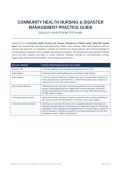
COMMUNITY HEALTH NURSING & DISASTER
MANAGEMENT PRACTICE GUIDE
2026-2027 UPDATE EXAM TEST BANK
Welcome to the Community Health Nursing and Disaster Management Practice Guide: 2026-2027 Update
Exam. This comprehensive test bank is fully grounded in official course materials, public health practices, and core
nursing exam blueprints. It is designed to evaluate and enhance the clinical judgment and technical knowledge of
nursing students preparing for license updates and professional practice. The questions are systematically distributed
across all major chapters and topics to ensure balanced, thorough coverage of community-based nursing,
epidemiology, maternal and child wellness, and emergency preparedness.
Resource Attribute Practice Guide Blueprint & Core Content
Resource Title Community Health Nursing and Disaster Management Practice Guide
Subject Matter Community Health, Public Health Nursing, and Disaster Triage Systems
Major Chapters 1. Intro to Community Health<br/>2. Epidemiology & Communicable Disease<br/>3.
Family, Maternal & Child Health<br/>4. Disaster Preparedness & Triage<br/>5.
traditional & Community Health Initiatives
Core Learning Objectives • Differentiate primary, secondary, and tertiary prevention levels<br/>• Execute triage
priority in multi-casualty events<br/>• Apply HIPAA, cultural competency, and ethical
principles (Autonomy)<br/>• Identify traditional and community health interventions (e.g.,
RA 9288, Lagundi, coining)
Terminology & Concepts Analytic epidemiology, prevalence, pandemic, dependency ratio, core group, fetal death
rate, SIDS prevention, RA 9288 (Newborn Screening), Level III water supplies.
Commonly Confused Concepts <b>Primary vs. Secondary Prevention:</b> Screening/Early detection (Secondary) vs.
Health promotion (Primary)<br/><b>Physical vs. Occupational Therapy:</b> Gross motor
rehabilitation vs. fine motor/dexterity rehabilitation<br/><b>Cultural Healing vs. Abuse:</b>
Cao Gio (Coining) vs. child abuse wounds<br/><b>Triage Categorization:</b> Red Tag
(Immediate survival) vs. Black Tag (Expectant)
Subject: Community & Public Health Nursing | 2026-2027 Update Exam Page 1 of 35
,COMMUNITY HEALTH NURSING & DISASTER MANAGEMENT PRACTICE GUIDE 2026-2027 UPDATE EXAM
COMPREHENSIVE PRACTICE EXAM (100 QUESTIONS)
Select the single best answer for each of the following questions. Each item includes a detailed,
evidence-based rationale.
Question 1: A nurse is planning a primary prevention strategy for reducing obesity in a community.
Which of the following strategies should the nurse use?
A. Provide blood pressure and weight screenings at a local health fair
B. Design home exercise programs for obese adults in the community
C. Educate children about nutrition and exercise at a daycare center
D. Refer clients to weight loss support groups and bariatric specialists
ANSWER : C — Educate children about nutrition and exercise at a daycare center
Explanation: Primary prevention focuses on health promotion and disease prevention before any illness or condition
occurs. Educating young children about healthy habits at a daycare center is a classic health promotion (primary
prevention) activity. Screenings represent secondary prevention (early detection), while exercise programs or support
groups for obese individuals are tertiary prevention (management/treatment).
Question 2: A community health nurse is developing health promotion activities for a community.
Which of the following is the highest priority action?
A. Establish a budget for planned activities and secure funding
B. Participate in community assessment to identify community health problems
C. Design promotional brochures for health education and distribute them
D. Partner with local clinics to coordinate healthcare delivery services
ANSWER : B — Participate in community assessment to identify community health problems
Explanation: Before any health promotion activities can be planned or implemented, the nurse must assess the
community's unique needs. Participating in a community assessment is the first step of the nursing process
(assessment) and is therefore the highest priority to identify community health problems.
Question 3: A home health nurse is scheduling client visits for the day. Which of the following clients
should the nurse plan to visit first?
A. A client who requires a routine dressing change for a surgical wound
B. An older adult client with a history of hypertension needing a blood pressure check
C. A 79-year-old client with an exacerbation of COPD
D. A client who needs assistance with organizing weekly medications
ANSWER : C — A 79-year-old client with an exacerbation of COPD
Explanation: The client with an exacerbation of Chronic Obstructive Pulmonary Disease (COPD) represents an
acute respiratory concern (Airway-Breathing-Circulation), which is the highest physiological priority. This client must
be visited first to assess respiratory status and intervene.
Subject: Community & Public Health Nursing | 2026-2027 Update Exam Page 2 of 35
,COMMUNITY HEALTH NURSING & DISASTER MANAGEMENT PRACTICE GUIDE 2026-2027 UPDATE EXAM
Question 4: A state public health nurse is asked to determine which county has the most people living
in it with a diagnosis of Alzheimer's disease. Which of the following measures or epidemiological fields
will determine this information?
A. Descriptive epidemiology
B. Analytic epidemiology
C. Experimental epidemiology
D. Clinical epidemiology
ANSWER : B — Analytic epidemiology
Explanation: According to the course material, analytic epidemiology is used to determine which area/county has the
most people living with this diagnosis, as it examines relationships and distributions. (Note: While descriptive
epidemiology deals with person, place, and time, the source explicitly indicates 'analytic epidemiology' for this
function).
Question 5: A community health nurse is reviewing laboratory results for his case load of clients.
Which of the following is the highest priority finding?
A. A blood glucose level of 180 mg/dL in a client with diabetes
B. A sputum specimen that is positive for tuberculosis
C. A total cholesterol level of 240 mg/dL in an adult client
D. A high platelet count in a client receiving chemotherapy
ANSWER : B — A sputum specimen that is positive for tuberculosis
Explanation: A sputum specimen positive for tuberculosis indicates an active, highly infectious communicable
disease that poses an immediate public health threat. This requires immediate isolation, notification, and initiation of
treatment, making it the highest priority.
Question 6: A nurse is triaging victims of a commuter train crash. Which of the following clients should
be transported to the Emergency Department first?
A. A client who is unresponsive with agonal respirations and a head injury
B. An ambulatory client whose nose is bleeding and who reports feeling dizzy
C. A client with a suspected fractured forearm and controlled bleeding
D. A client who has minor abrasions and is crying hysterically
ANSWER : B — An ambulatory client whose nose is bleeding and who reports feeling dizzy
Explanation: Under standard triage protocols (and matching the source), a client who is ambulatory but presenting
with epistaxis and dizziness represents a priority for transport/treatment due to potential head injury, hypertension, or
shock. (An unresponsive client with agonal respirations is classified as 'black tag' / expectant in disaster triage when
resources are constrained, making others with survival chances the priority).
Subject: Community & Public Health Nursing | 2026-2027 Update Exam Page 3 of 35
, COMMUNITY HEALTH NURSING & DISASTER MANAGEMENT PRACTICE GUIDE 2026-2027 UPDATE EXAM
Question 7: A community health nurse is caring for clients in a culturally diverse community. Which of
the following actions demonstrates accurate cultural knowledge about a specific cultural group?
A. Maintain direct, continuous eye contact with an Asian-American client
B. Avoid discussing family involvement with an African-American client
C. Include both hot and cold food items on a Hispanic client’s menu
D. Refuse to allow traditional healing practices for a Native American client
ANSWER : C — Include both hot and cold food items on a Hispanic client’s menu
Explanation: In traditional Hispanic culture, the 'hot and cold theory' of disease is a prevalent belief where illnesses,
foods, and medicines are classified as 'hot' or 'cold' to maintain balance. Incorporating both types of items on the
menu demonstrates respect and accurate cultural knowledge.
Question 8: A nurse is caring for a client who has questions about his treatment plan. Which of the
following should the nurse perform as a client advocate?
A. Provide education to the client about the diagnosis, inform the client about the provider’s responsibility to
provide information, assist the client in preparing questions for the provider, and affirm the client’s decision about
the treatment plan
B. Decide on the best option for the client to relieve anxiety
C. Encourage the client to follow the provider's plan without questioning it
D. Avoid discussing alternative treatments to prevent confusion
ANSWER : A — Provide education to the client about the diagnosis, inform the client about the provider’s
responsibility to provide information, assist the client in preparing questions for the provider, and affirm the
client’s decision about the treatment plan
Explanation: Client advocacy involves supporting client autonomy and informed decision-making. The nurse
advocates by educating the client, clarifying that the provider is responsible for delivering detailed medical
information, helping the client draft questions for the provider, and affirming the client's final, informed decisions.
Question 9: A nurse is working with a client who is homeless. Which of the following is the first step
that the nurse should take to advocate for this client?
A. Find long-term employment opportunities for the client
B. Refer the client to a public homeless shelter
C. Apply for federal housing assistance programs on behalf of the client
D. Conduct a comprehensive mental health screening
ANSWER : B — Refer the client to a public homeless shelter
Explanation: Meeting basic physiological and safety needs (food, water, shelter) is the highest priority when working
with homeless individuals. Referring the client to a public homeless shelter is the immediate first step to ensure safety
and shelter.
Subject: Community & Public Health Nursing | 2026-2027 Update Exam Page 4 of 35
MANAGEMENT PRACTICE GUIDE
2026-2027 UPDATE EXAM TEST BANK
Welcome to the Community Health Nursing and Disaster Management Practice Guide: 2026-2027 Update
Exam. This comprehensive test bank is fully grounded in official course materials, public health practices, and core
nursing exam blueprints. It is designed to evaluate and enhance the clinical judgment and technical knowledge of
nursing students preparing for license updates and professional practice. The questions are systematically distributed
across all major chapters and topics to ensure balanced, thorough coverage of community-based nursing,
epidemiology, maternal and child wellness, and emergency preparedness.
Resource Attribute Practice Guide Blueprint & Core Content
Resource Title Community Health Nursing and Disaster Management Practice Guide
Subject Matter Community Health, Public Health Nursing, and Disaster Triage Systems
Major Chapters 1. Intro to Community Health<br/>2. Epidemiology & Communicable Disease<br/>3.
Family, Maternal & Child Health<br/>4. Disaster Preparedness & Triage<br/>5.
traditional & Community Health Initiatives
Core Learning Objectives • Differentiate primary, secondary, and tertiary prevention levels<br/>• Execute triage
priority in multi-casualty events<br/>• Apply HIPAA, cultural competency, and ethical
principles (Autonomy)<br/>• Identify traditional and community health interventions (e.g.,
RA 9288, Lagundi, coining)
Terminology & Concepts Analytic epidemiology, prevalence, pandemic, dependency ratio, core group, fetal death
rate, SIDS prevention, RA 9288 (Newborn Screening), Level III water supplies.
Commonly Confused Concepts <b>Primary vs. Secondary Prevention:</b> Screening/Early detection (Secondary) vs.
Health promotion (Primary)<br/><b>Physical vs. Occupational Therapy:</b> Gross motor
rehabilitation vs. fine motor/dexterity rehabilitation<br/><b>Cultural Healing vs. Abuse:</b>
Cao Gio (Coining) vs. child abuse wounds<br/><b>Triage Categorization:</b> Red Tag
(Immediate survival) vs. Black Tag (Expectant)
Subject: Community & Public Health Nursing | 2026-2027 Update Exam Page 1 of 35
,COMMUNITY HEALTH NURSING & DISASTER MANAGEMENT PRACTICE GUIDE 2026-2027 UPDATE EXAM
COMPREHENSIVE PRACTICE EXAM (100 QUESTIONS)
Select the single best answer for each of the following questions. Each item includes a detailed,
evidence-based rationale.
Question 1: A nurse is planning a primary prevention strategy for reducing obesity in a community.
Which of the following strategies should the nurse use?
A. Provide blood pressure and weight screenings at a local health fair
B. Design home exercise programs for obese adults in the community
C. Educate children about nutrition and exercise at a daycare center
D. Refer clients to weight loss support groups and bariatric specialists
ANSWER : C — Educate children about nutrition and exercise at a daycare center
Explanation: Primary prevention focuses on health promotion and disease prevention before any illness or condition
occurs. Educating young children about healthy habits at a daycare center is a classic health promotion (primary
prevention) activity. Screenings represent secondary prevention (early detection), while exercise programs or support
groups for obese individuals are tertiary prevention (management/treatment).
Question 2: A community health nurse is developing health promotion activities for a community.
Which of the following is the highest priority action?
A. Establish a budget for planned activities and secure funding
B. Participate in community assessment to identify community health problems
C. Design promotional brochures for health education and distribute them
D. Partner with local clinics to coordinate healthcare delivery services
ANSWER : B — Participate in community assessment to identify community health problems
Explanation: Before any health promotion activities can be planned or implemented, the nurse must assess the
community's unique needs. Participating in a community assessment is the first step of the nursing process
(assessment) and is therefore the highest priority to identify community health problems.
Question 3: A home health nurse is scheduling client visits for the day. Which of the following clients
should the nurse plan to visit first?
A. A client who requires a routine dressing change for a surgical wound
B. An older adult client with a history of hypertension needing a blood pressure check
C. A 79-year-old client with an exacerbation of COPD
D. A client who needs assistance with organizing weekly medications
ANSWER : C — A 79-year-old client with an exacerbation of COPD
Explanation: The client with an exacerbation of Chronic Obstructive Pulmonary Disease (COPD) represents an
acute respiratory concern (Airway-Breathing-Circulation), which is the highest physiological priority. This client must
be visited first to assess respiratory status and intervene.
Subject: Community & Public Health Nursing | 2026-2027 Update Exam Page 2 of 35
,COMMUNITY HEALTH NURSING & DISASTER MANAGEMENT PRACTICE GUIDE 2026-2027 UPDATE EXAM
Question 4: A state public health nurse is asked to determine which county has the most people living
in it with a diagnosis of Alzheimer's disease. Which of the following measures or epidemiological fields
will determine this information?
A. Descriptive epidemiology
B. Analytic epidemiology
C. Experimental epidemiology
D. Clinical epidemiology
ANSWER : B — Analytic epidemiology
Explanation: According to the course material, analytic epidemiology is used to determine which area/county has the
most people living with this diagnosis, as it examines relationships and distributions. (Note: While descriptive
epidemiology deals with person, place, and time, the source explicitly indicates 'analytic epidemiology' for this
function).
Question 5: A community health nurse is reviewing laboratory results for his case load of clients.
Which of the following is the highest priority finding?
A. A blood glucose level of 180 mg/dL in a client with diabetes
B. A sputum specimen that is positive for tuberculosis
C. A total cholesterol level of 240 mg/dL in an adult client
D. A high platelet count in a client receiving chemotherapy
ANSWER : B — A sputum specimen that is positive for tuberculosis
Explanation: A sputum specimen positive for tuberculosis indicates an active, highly infectious communicable
disease that poses an immediate public health threat. This requires immediate isolation, notification, and initiation of
treatment, making it the highest priority.
Question 6: A nurse is triaging victims of a commuter train crash. Which of the following clients should
be transported to the Emergency Department first?
A. A client who is unresponsive with agonal respirations and a head injury
B. An ambulatory client whose nose is bleeding and who reports feeling dizzy
C. A client with a suspected fractured forearm and controlled bleeding
D. A client who has minor abrasions and is crying hysterically
ANSWER : B — An ambulatory client whose nose is bleeding and who reports feeling dizzy
Explanation: Under standard triage protocols (and matching the source), a client who is ambulatory but presenting
with epistaxis and dizziness represents a priority for transport/treatment due to potential head injury, hypertension, or
shock. (An unresponsive client with agonal respirations is classified as 'black tag' / expectant in disaster triage when
resources are constrained, making others with survival chances the priority).
Subject: Community & Public Health Nursing | 2026-2027 Update Exam Page 3 of 35
, COMMUNITY HEALTH NURSING & DISASTER MANAGEMENT PRACTICE GUIDE 2026-2027 UPDATE EXAM
Question 7: A community health nurse is caring for clients in a culturally diverse community. Which of
the following actions demonstrates accurate cultural knowledge about a specific cultural group?
A. Maintain direct, continuous eye contact with an Asian-American client
B. Avoid discussing family involvement with an African-American client
C. Include both hot and cold food items on a Hispanic client’s menu
D. Refuse to allow traditional healing practices for a Native American client
ANSWER : C — Include both hot and cold food items on a Hispanic client’s menu
Explanation: In traditional Hispanic culture, the 'hot and cold theory' of disease is a prevalent belief where illnesses,
foods, and medicines are classified as 'hot' or 'cold' to maintain balance. Incorporating both types of items on the
menu demonstrates respect and accurate cultural knowledge.
Question 8: A nurse is caring for a client who has questions about his treatment plan. Which of the
following should the nurse perform as a client advocate?
A. Provide education to the client about the diagnosis, inform the client about the provider’s responsibility to
provide information, assist the client in preparing questions for the provider, and affirm the client’s decision about
the treatment plan
B. Decide on the best option for the client to relieve anxiety
C. Encourage the client to follow the provider's plan without questioning it
D. Avoid discussing alternative treatments to prevent confusion
ANSWER : A — Provide education to the client about the diagnosis, inform the client about the provider’s
responsibility to provide information, assist the client in preparing questions for the provider, and affirm the
client’s decision about the treatment plan
Explanation: Client advocacy involves supporting client autonomy and informed decision-making. The nurse
advocates by educating the client, clarifying that the provider is responsible for delivering detailed medical
information, helping the client draft questions for the provider, and affirming the client's final, informed decisions.
Question 9: A nurse is working with a client who is homeless. Which of the following is the first step
that the nurse should take to advocate for this client?
A. Find long-term employment opportunities for the client
B. Refer the client to a public homeless shelter
C. Apply for federal housing assistance programs on behalf of the client
D. Conduct a comprehensive mental health screening
ANSWER : B — Refer the client to a public homeless shelter
Explanation: Meeting basic physiological and safety needs (food, water, shelter) is the highest priority when working
with homeless individuals. Referring the client to a public homeless shelter is the immediate first step to ensure safety
and shelter.
Subject: Community & Public Health Nursing | 2026-2027 Update Exam Page 4 of 35