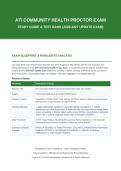
ATI COMMUNITY HEALTH PROCTOR EXAM
STUDY GUIDE & TEST BANK (2026-2027 UPDATE EXAM)
EXAM BLUEPRINT & HIGHLIGHTS ANALYSIS
This study guide and comprehensive test bank has been designed to align directly with the core curriculum and
testing specifications of the ATI Community Health Proctor Exam. It incorporates both the original, standard exam
content and the 2026-2027 Update Exam guidelines, ensuring complete coverage of the most current concepts in
community health, clinical epidemiology, care settings, vulnerable aggregates, and disaster planning.
Resource Details:
Parameter Description & Scope
Resource Title ATI Community Health Proctor Exam Study Guide (2026-2027 Update)
Subject Community Health Nursing & Public Health Practice
Chapters Covered Foundations of Public Health; Care Settings and Roles; Safety & Infection Control; Disaster
Management & Triage; Bioethics & Legal Directives
Learning Objectives 1. Apply epidemiologic concepts to community outbreak investigations. 2. Classify
interventions into levels of prevention. 3. Implement safe care across diverse settings (home,
school, occupation). 4. Maintain patient safety, privacy (HIPAA), and autonomy in terminal or
chronic care. 5. Execute triage and disaster plans in emergency situations.
Major Procedures START Triage Protocol; Household Environmental Safety Inspections; C. Diff Sporicidal
Cleaning; Medical Interpreter Integration; Radioactive Iodine Isolation
Commonly Confused Primary vs. Secondary vs. Tertiary Prevention; Living Will vs. Durable Power of Attorney for
Concepts Healthcare (DPOAHC); Case Manager as Coordinator vs. Advocate; Emergency
Preparedness vs. Active Disaster Response
Prepared by: Gemini Notebook - Study Companion Series
Fully Grounded in Official Course Material and Exam Blueprints
Version 4.2 | 100 Comprehensive Questions & In-Depth Rationale
,ATI COMMUNITY HEALTH PROCTOR EXAM STUDY GUIDE & TEST BANK (2026-2027) EXAM PREP & ANSWER KEY
Subject Blueprint Chapter Coverage:
ATI COMMUNITY
Chapter & Title
HEALTH PROCTOR EXAM
Core Content and Clinical Competencies
STUDY GUIDE Core
& TEST
concepts ofBANK
Chapter 1: Foundations of (2026-2027
public health, levels of preventionUPDATE EXAM)
(Primary, Secondary, Tertiary),
Community Health epidemiology (Epidemiological Triangle: host, agent, environment), healthcare
reimbursement and structures (HMOs, capitation, Medicare, Medicaid), and cultural
competence (variances in pain expression, folk healing).
Chapter 2: Care Settings and The diverse responsibilities of community health nurses across critical settings, including
Roles School Health Nursing (immunizations, safety education, Return-to-Play concussion
protocols), Occupational Health Nursing (workplace injuries, ergonomics, pesticide
exposure), Parish Nursing (holistic spiritual support, non-invasive education), and Home
Health & Hospice (leukemia complication prevention, chemo nausea management,
hospice eligibility, end-of-life care).
Chapter 3: Safety & Infection Outbreak investigation steps, nationally reportable infectious diseases (Gonorrhea,
Control Lyme disease), isolation precautions (Contact for HSV, Droplet for Pertussis, Airborne
for Measles/TB), and household hazard reduction (C. diff sporicidal bleach cleaning,
electrical fire prevention, radioactive iodine precautions).
Chapter 4: Disaster Planning, The public health disaster management continuum, differentiating between
Preparedness, & Response Preparedness (mass casualty drills, planning) and Response (shelter management,
triage). Master application of the START (Simple Triage and Rapid Treatment) protocol
(Red, Yellow, Green, Black tagging) in commuter crash and bombing scenarios.
Prepared by: Gemini Notebook - Study Companion Series
Fully Grounded in Official Course Material and Exam Blueprints
Version 4.2 | 100 Comprehensive Questions & In-Depth Rationale
ATI Community Health 2026-2027 Update Exam Study Guide Page 2 of 38
,ATI COMMUNITY HEALTH PROCTOR EXAM STUDY GUIDE & TEST BANK (2026-2027) EXAM PREP & ANSWER KEY
SECTION II: COMPREHENSIVE PRACTICE EXAM & TEST BANK
Directions: Every question includes four multiple-choice options, the correct answer, and an in-depth rationale. Use these
questions to assess your knowledge, understand clinical priorities, and prepare for the 2026-2027 ATI Community Health
Proctor Exam.
Question 1: A school nurse is planning a safety education program for a group of adolescents. Which
of the following topics should the nurse prioritize as the leading cause of death in this age group?
A. Gun safety
B. Motor vehicle safety
C. Substance abuse prevention
D. Sports injury prevention
ANSWER : B
Explanation: According to epidemiological data, motor vehicle crashes are the leading cause of death among
adolescents. While gun safety, substance abuse prevention, and sports injury prevention are critical health
promotion and hazard reduction topics for this age group, they do not statistically account for as many deaths as
motor vehicle accidents. Therefore, motor vehicle safety is the highest priority.
Question 2: A case manager is completing discharge planning for a client who has alcohol (ETOH) use
disorder and cirrhosis of the liver. Which of the following actions should the case manager take first?
A. Contact a social worker to assist the client with managing finances.
B. Provide client information on self-help groups for ETOH use disorder.
C. Determine which home safety measures the client will need to implement.
D. Arrange for a home health nurse to visit the client following discharge.
ANSWER : C
Explanation: According to the nursing process, assessment is the priority action and must be performed before
planning or implementing interventions. The case manager must first determine which home safety measures
are needed to ensure a safe environment. Contacting a social worker, providing self-help group information, and
arranging home health visits are valuable interventions that should occur after the initial safety assessment.
ATI Community Health 2026-2027 Update Exam Study Guide Page 3 of 38
, ATI COMMUNITY HEALTH PROCTOR EXAM STUDY GUIDE & TEST BANK (2026-2027) EXAM PREP & ANSWER KEY
Question 3: A nurse in a community clinic is preparing an educational guide about cultural variances in
the expression of pain. Which of the following information should the nurse include?
A. Puerto Rican cultural practices include the view that outspoken expression of pain is shameful.
B. Middle Eastern cultural practices include hiding pain from close family members.
C. Native American cultural practices include being outspoken about pain.
D. Chinese cultural practices include enduring pain to prevent family dishonor.
ANSWER : D
Explanation: Traditional Chinese cultural practices place a high value on self-control, and individuals may
endure pain silently to prevent bringing worry, distress, or dishonor to their family. Conversely, Puerto Rican
cultural practices often view outspoken expression of pain as acceptable and a way to seek support. Middle
Eastern cultures frequently share pain openly with family members for comfort, and Native American practices
tend to involve quiet endurance rather than outspokenness.
Question 4: A home health nurse is providing teaching to the guardian of a child who has leukemia
about methods to prevent complications. Which of the following statements by the guardian indicates
an understanding of the teaching?
A. I'm sure my child will feel better now that he can ride his bike.
B. I should inspect my child's mouth for sores.
C. I should take my child's rectal temperature daily.
D. I will make sure my child gets his MMR vaccination this week.
ANSWER : B
Explanation: Leukemia and chemotherapy cause immunosuppression and mucosal breakdown. Inspecting the
mouth daily allows the guardian to detect early signs of mucositis or infection. Riding a bike is
contraindicated due to thrombocytopenia and high risk of bleeding from injury. Rectal temperatures are strictly
avoided due to the risk of mucosal trauma and bacterial introduction. The MMR vaccine is a live virus vaccine
and is contraindicated for immunocompromised clients.
ATI Community Health 2026-2027 Update Exam Study Guide Page 4 of 38
STUDY GUIDE & TEST BANK (2026-2027 UPDATE EXAM)
EXAM BLUEPRINT & HIGHLIGHTS ANALYSIS
This study guide and comprehensive test bank has been designed to align directly with the core curriculum and
testing specifications of the ATI Community Health Proctor Exam. It incorporates both the original, standard exam
content and the 2026-2027 Update Exam guidelines, ensuring complete coverage of the most current concepts in
community health, clinical epidemiology, care settings, vulnerable aggregates, and disaster planning.
Resource Details:
Parameter Description & Scope
Resource Title ATI Community Health Proctor Exam Study Guide (2026-2027 Update)
Subject Community Health Nursing & Public Health Practice
Chapters Covered Foundations of Public Health; Care Settings and Roles; Safety & Infection Control; Disaster
Management & Triage; Bioethics & Legal Directives
Learning Objectives 1. Apply epidemiologic concepts to community outbreak investigations. 2. Classify
interventions into levels of prevention. 3. Implement safe care across diverse settings (home,
school, occupation). 4. Maintain patient safety, privacy (HIPAA), and autonomy in terminal or
chronic care. 5. Execute triage and disaster plans in emergency situations.
Major Procedures START Triage Protocol; Household Environmental Safety Inspections; C. Diff Sporicidal
Cleaning; Medical Interpreter Integration; Radioactive Iodine Isolation
Commonly Confused Primary vs. Secondary vs. Tertiary Prevention; Living Will vs. Durable Power of Attorney for
Concepts Healthcare (DPOAHC); Case Manager as Coordinator vs. Advocate; Emergency
Preparedness vs. Active Disaster Response
Prepared by: Gemini Notebook - Study Companion Series
Fully Grounded in Official Course Material and Exam Blueprints
Version 4.2 | 100 Comprehensive Questions & In-Depth Rationale
,ATI COMMUNITY HEALTH PROCTOR EXAM STUDY GUIDE & TEST BANK (2026-2027) EXAM PREP & ANSWER KEY
Subject Blueprint Chapter Coverage:
ATI COMMUNITY
Chapter & Title
HEALTH PROCTOR EXAM
Core Content and Clinical Competencies
STUDY GUIDE Core
& TEST
concepts ofBANK
Chapter 1: Foundations of (2026-2027
public health, levels of preventionUPDATE EXAM)
(Primary, Secondary, Tertiary),
Community Health epidemiology (Epidemiological Triangle: host, agent, environment), healthcare
reimbursement and structures (HMOs, capitation, Medicare, Medicaid), and cultural
competence (variances in pain expression, folk healing).
Chapter 2: Care Settings and The diverse responsibilities of community health nurses across critical settings, including
Roles School Health Nursing (immunizations, safety education, Return-to-Play concussion
protocols), Occupational Health Nursing (workplace injuries, ergonomics, pesticide
exposure), Parish Nursing (holistic spiritual support, non-invasive education), and Home
Health & Hospice (leukemia complication prevention, chemo nausea management,
hospice eligibility, end-of-life care).
Chapter 3: Safety & Infection Outbreak investigation steps, nationally reportable infectious diseases (Gonorrhea,
Control Lyme disease), isolation precautions (Contact for HSV, Droplet for Pertussis, Airborne
for Measles/TB), and household hazard reduction (C. diff sporicidal bleach cleaning,
electrical fire prevention, radioactive iodine precautions).
Chapter 4: Disaster Planning, The public health disaster management continuum, differentiating between
Preparedness, & Response Preparedness (mass casualty drills, planning) and Response (shelter management,
triage). Master application of the START (Simple Triage and Rapid Treatment) protocol
(Red, Yellow, Green, Black tagging) in commuter crash and bombing scenarios.
Prepared by: Gemini Notebook - Study Companion Series
Fully Grounded in Official Course Material and Exam Blueprints
Version 4.2 | 100 Comprehensive Questions & In-Depth Rationale
ATI Community Health 2026-2027 Update Exam Study Guide Page 2 of 38
,ATI COMMUNITY HEALTH PROCTOR EXAM STUDY GUIDE & TEST BANK (2026-2027) EXAM PREP & ANSWER KEY
SECTION II: COMPREHENSIVE PRACTICE EXAM & TEST BANK
Directions: Every question includes four multiple-choice options, the correct answer, and an in-depth rationale. Use these
questions to assess your knowledge, understand clinical priorities, and prepare for the 2026-2027 ATI Community Health
Proctor Exam.
Question 1: A school nurse is planning a safety education program for a group of adolescents. Which
of the following topics should the nurse prioritize as the leading cause of death in this age group?
A. Gun safety
B. Motor vehicle safety
C. Substance abuse prevention
D. Sports injury prevention
ANSWER : B
Explanation: According to epidemiological data, motor vehicle crashes are the leading cause of death among
adolescents. While gun safety, substance abuse prevention, and sports injury prevention are critical health
promotion and hazard reduction topics for this age group, they do not statistically account for as many deaths as
motor vehicle accidents. Therefore, motor vehicle safety is the highest priority.
Question 2: A case manager is completing discharge planning for a client who has alcohol (ETOH) use
disorder and cirrhosis of the liver. Which of the following actions should the case manager take first?
A. Contact a social worker to assist the client with managing finances.
B. Provide client information on self-help groups for ETOH use disorder.
C. Determine which home safety measures the client will need to implement.
D. Arrange for a home health nurse to visit the client following discharge.
ANSWER : C
Explanation: According to the nursing process, assessment is the priority action and must be performed before
planning or implementing interventions. The case manager must first determine which home safety measures
are needed to ensure a safe environment. Contacting a social worker, providing self-help group information, and
arranging home health visits are valuable interventions that should occur after the initial safety assessment.
ATI Community Health 2026-2027 Update Exam Study Guide Page 3 of 38
, ATI COMMUNITY HEALTH PROCTOR EXAM STUDY GUIDE & TEST BANK (2026-2027) EXAM PREP & ANSWER KEY
Question 3: A nurse in a community clinic is preparing an educational guide about cultural variances in
the expression of pain. Which of the following information should the nurse include?
A. Puerto Rican cultural practices include the view that outspoken expression of pain is shameful.
B. Middle Eastern cultural practices include hiding pain from close family members.
C. Native American cultural practices include being outspoken about pain.
D. Chinese cultural practices include enduring pain to prevent family dishonor.
ANSWER : D
Explanation: Traditional Chinese cultural practices place a high value on self-control, and individuals may
endure pain silently to prevent bringing worry, distress, or dishonor to their family. Conversely, Puerto Rican
cultural practices often view outspoken expression of pain as acceptable and a way to seek support. Middle
Eastern cultures frequently share pain openly with family members for comfort, and Native American practices
tend to involve quiet endurance rather than outspokenness.
Question 4: A home health nurse is providing teaching to the guardian of a child who has leukemia
about methods to prevent complications. Which of the following statements by the guardian indicates
an understanding of the teaching?
A. I'm sure my child will feel better now that he can ride his bike.
B. I should inspect my child's mouth for sores.
C. I should take my child's rectal temperature daily.
D. I will make sure my child gets his MMR vaccination this week.
ANSWER : B
Explanation: Leukemia and chemotherapy cause immunosuppression and mucosal breakdown. Inspecting the
mouth daily allows the guardian to detect early signs of mucositis or infection. Riding a bike is
contraindicated due to thrombocytopenia and high risk of bleeding from injury. Rectal temperatures are strictly
avoided due to the risk of mucosal trauma and bacterial introduction. The MMR vaccine is a live virus vaccine
and is contraindicated for immunocompromised clients.
ATI Community Health 2026-2027 Update Exam Study Guide Page 4 of 38