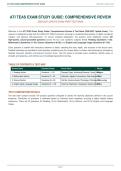
ATI TEAS EXAM COMPREHENSIVE STUDY GUIDE 2026-2027 Update Exam
ATI TEAS EXAM STUDY GUIDE: COMPREHENSIVE REVIEW
2026-2027 UPDATE EXAM PREP TEST BANK
Welcome to the ATI TEAS Exam Study Guide: Comprehensive Review & Test Bank (2026-2027 Update Exam). This
resource is designed to align with the official ATI TEAS curriculum, focusing on comprehensive practice, in-depth conceptual
mastery, and rigorous self-assessment. To ensure complete preparation, this practice exam distributes exactly 100
high-quality, source-grounded questions across the four core academic subjects tested: Reading (Questions 1–20),
Mathematics (Questions 21–45), Science (Questions 46–80), and English and Language Usage (Questions 81–100).
Every question is crafted with meticulous attention to detail, matching the style, depth, and structure of the actual exam.
Detailed rationales are provided for each question, explaining why the correct option is chosen and clarifying key concepts to
facilitate long-term retention and prevent common errors. Use this guide to simulate exam conditions, identify areas of
strength and weakness, and reinforce your knowledge base before test day.
TABLE OF CONTENTS & TEST MAP
Section Name Question Range Focus Areas Weight
1. Reading Section Questions 1 – 20 Passage Types, Authorship Elements, Comp. Strategies
20%
2. Mathematics Section Questions 21 – 45 Arithmetic, Algebra, Conversions, Data Analysis,25%
Stats
3. Science Section Questions 46 – 80 Cell Bio, Anatomy & Physiology, Pathology,35%
Immunology
4. English & Language Usage Questions 81 – 100 Grammar, Mechanics, Vocabulary, Sentence Structure
20%
TEST COMPOSITION DETAILS
This test bank contains exactly 100 practice questions designed to assess the learning objectives defined in the course
blueprints. Distribution of questions is calibrated based on historical exam weighting, ensuring a highly realistic testing
experience. There are 20 questions for Reading, 25 for Mathematics, 35 for Science, and 20 for English and Language
Usage.
Page 1
,ATI TEAS EXAM COMPREHENSIVE STUDY GUIDE & TEST BANK (2026-2027) Version 4.2 | 100 QA
SECTION 1: READING SECTION (QUESTIONS 1 – 20)
Question 1: What is the meaning of the word 'infamous' as used in the expository passage regarding King Henry VII?
A. Respected and widely admired
B. Notorious (well-known for some bad quality or deed)
C. Obscure and rarely discussed in historical texts
D. Virtuous and highly ethical
ANSWER ■: B — Notorious (well-known for some bad quality or deed)
Explanation: In the expository passage about King Henry VII, the word 'infamous' is defined as 'notorious' [1]. Infamous refers to
being well-known for some bad quality or deed, which aligns with 'notorious'. The other options represent opposite meanings or
unrelated concepts.
Question 2: What is the primary persuasive goal of the Social Media passage?
A. To encourage users to spend more hours online daily
B. To persuade people to fact-check information before posting or sharing random details
C. To promote new social media startups and platforms
D. To explain the technical algorithms used to distribute news articles
ANSWER ■: B — To persuade people to fact-check information before posting or sharing random details
Explanation: The Social Media passage discuss how news spreads rapidly online based on emotional reactions rather than truth [1].
Its central goal is to persuade readers to perform fact-checking before posting random, unverified information [1].
Question 3: The UFO passage, which describes aliens and an old man who got lost, belongs to which passage
genre?
A. Technical
B. Expository
C. Persuasive
D. Narrative
ANSWER ■: D — Narrative
Explanation: The UFO passage is classified as a narrative because it tells a story about aliens and an old man getting lost to
entertain the reader [1, 4]. Narrative writing is defined by telling a story and entertaining [4].
Question 4: The Greek Theater passage is classified as which type of text?
A. Narrative
B. Descriptive
C. Expository
D. Persuasive
ANSWER ■: C — Expository
Explanation: According to the review material, the Greek Theater passage is an expository text [2]. Expository texts are designed to
teach, inform, or explain a topic in a technical or academic manner [4].
Page 2
, ATI TEAS EXAM COMPREHENSIVE STUDY GUIDE & TEST BANK (2026-2027) Version 4.2 | 100 QA
Question 5: In the persuasive 'robbery' passage regarding dogs and humans being best friends, what is the correct
way to rename the passage?
A. Canine Companions and Their Loyal Instincts
B. Jewel Thief on the Lose
C. The History of Domesticated Animals
D. A Guide to Home Security and Guard Dogs
ANSWER ■: B — Jewel Thief on the Lose
Explanation: According to the review notes, when asked how you would rename the robbery/best friend passage, the correct
answer is 'Jewel Thief on the Lose' [2].
Question 6: What is the correct chronological order of the events in Frida Kahlo's life as presented in the expository
passage?
A. First, she married Diego; Next, she got hit by a train; Then, she drew pictures of herself
B. First, she got hit by a train; Next, she started drawing pictures of herself; Then, she married Diego
C. First, she drew pictures of herself; Next, she married Diego; Then, she got hit by a train
D. First, she got hit by a train; Next, she married Diego; Then, she drew pictures of herself
ANSWER ■: B — First, she got hit by a train; Next, she started drawing pictures of herself; Then, she married Diego
Explanation: The chronological sequence of Frida Kahlo's life in the passage is: First, she got hit by a train; Next, she started
drawing pictures of herself; Then, she married Diego [2].
Question 7: According to the Casino passage, why is it argued that going to a Casino is a better option than buying
lottery tickets?
A. Lottery tickets are more expensive than slot machines
B. Buying a lottery ticket gives you a lower chance of winning compared to playing at a Casino
C. Casinos donate all their proceeds to local communities
D. Lottery tickets require travel, whereas casinos are in every town
ANSWER ■: B — Buying a lottery ticket gives you a lower chance of winning compared to playing at a Casino
Explanation: The Casino passage argues that buying a lottery ticket gives you a lower chance of winning than going to a Casino and
playing [3]. It is a persuasive passage comparing the probability structures of both options [2, 3].
Question 8: When reading and executing the Chili Recipe expository passage, which critical preparation step is
emphasized?
A. Cook the meat for three hours prior to adding spices
B. Rinse the beans first
C. Serve the chili immediately without simmering
D. Add three tablespoons of sugar to neutralize the heat
ANSWER ■: B — Rinse the beans first
Explanation: The review notes highlight that a key correct answer for the Chili Recipe expository passage is to 'rinse the beans first'
[3].
Page 3
ATI TEAS EXAM STUDY GUIDE: COMPREHENSIVE REVIEW
2026-2027 UPDATE EXAM PREP TEST BANK
Welcome to the ATI TEAS Exam Study Guide: Comprehensive Review & Test Bank (2026-2027 Update Exam). This
resource is designed to align with the official ATI TEAS curriculum, focusing on comprehensive practice, in-depth conceptual
mastery, and rigorous self-assessment. To ensure complete preparation, this practice exam distributes exactly 100
high-quality, source-grounded questions across the four core academic subjects tested: Reading (Questions 1–20),
Mathematics (Questions 21–45), Science (Questions 46–80), and English and Language Usage (Questions 81–100).
Every question is crafted with meticulous attention to detail, matching the style, depth, and structure of the actual exam.
Detailed rationales are provided for each question, explaining why the correct option is chosen and clarifying key concepts to
facilitate long-term retention and prevent common errors. Use this guide to simulate exam conditions, identify areas of
strength and weakness, and reinforce your knowledge base before test day.
TABLE OF CONTENTS & TEST MAP
Section Name Question Range Focus Areas Weight
1. Reading Section Questions 1 – 20 Passage Types, Authorship Elements, Comp. Strategies
20%
2. Mathematics Section Questions 21 – 45 Arithmetic, Algebra, Conversions, Data Analysis,25%
Stats
3. Science Section Questions 46 – 80 Cell Bio, Anatomy & Physiology, Pathology,35%
Immunology
4. English & Language Usage Questions 81 – 100 Grammar, Mechanics, Vocabulary, Sentence Structure
20%
TEST COMPOSITION DETAILS
This test bank contains exactly 100 practice questions designed to assess the learning objectives defined in the course
blueprints. Distribution of questions is calibrated based on historical exam weighting, ensuring a highly realistic testing
experience. There are 20 questions for Reading, 25 for Mathematics, 35 for Science, and 20 for English and Language
Usage.
Page 1
,ATI TEAS EXAM COMPREHENSIVE STUDY GUIDE & TEST BANK (2026-2027) Version 4.2 | 100 QA
SECTION 1: READING SECTION (QUESTIONS 1 – 20)
Question 1: What is the meaning of the word 'infamous' as used in the expository passage regarding King Henry VII?
A. Respected and widely admired
B. Notorious (well-known for some bad quality or deed)
C. Obscure and rarely discussed in historical texts
D. Virtuous and highly ethical
ANSWER ■: B — Notorious (well-known for some bad quality or deed)
Explanation: In the expository passage about King Henry VII, the word 'infamous' is defined as 'notorious' [1]. Infamous refers to
being well-known for some bad quality or deed, which aligns with 'notorious'. The other options represent opposite meanings or
unrelated concepts.
Question 2: What is the primary persuasive goal of the Social Media passage?
A. To encourage users to spend more hours online daily
B. To persuade people to fact-check information before posting or sharing random details
C. To promote new social media startups and platforms
D. To explain the technical algorithms used to distribute news articles
ANSWER ■: B — To persuade people to fact-check information before posting or sharing random details
Explanation: The Social Media passage discuss how news spreads rapidly online based on emotional reactions rather than truth [1].
Its central goal is to persuade readers to perform fact-checking before posting random, unverified information [1].
Question 3: The UFO passage, which describes aliens and an old man who got lost, belongs to which passage
genre?
A. Technical
B. Expository
C. Persuasive
D. Narrative
ANSWER ■: D — Narrative
Explanation: The UFO passage is classified as a narrative because it tells a story about aliens and an old man getting lost to
entertain the reader [1, 4]. Narrative writing is defined by telling a story and entertaining [4].
Question 4: The Greek Theater passage is classified as which type of text?
A. Narrative
B. Descriptive
C. Expository
D. Persuasive
ANSWER ■: C — Expository
Explanation: According to the review material, the Greek Theater passage is an expository text [2]. Expository texts are designed to
teach, inform, or explain a topic in a technical or academic manner [4].
Page 2
, ATI TEAS EXAM COMPREHENSIVE STUDY GUIDE & TEST BANK (2026-2027) Version 4.2 | 100 QA
Question 5: In the persuasive 'robbery' passage regarding dogs and humans being best friends, what is the correct
way to rename the passage?
A. Canine Companions and Their Loyal Instincts
B. Jewel Thief on the Lose
C. The History of Domesticated Animals
D. A Guide to Home Security and Guard Dogs
ANSWER ■: B — Jewel Thief on the Lose
Explanation: According to the review notes, when asked how you would rename the robbery/best friend passage, the correct
answer is 'Jewel Thief on the Lose' [2].
Question 6: What is the correct chronological order of the events in Frida Kahlo's life as presented in the expository
passage?
A. First, she married Diego; Next, she got hit by a train; Then, she drew pictures of herself
B. First, she got hit by a train; Next, she started drawing pictures of herself; Then, she married Diego
C. First, she drew pictures of herself; Next, she married Diego; Then, she got hit by a train
D. First, she got hit by a train; Next, she married Diego; Then, she drew pictures of herself
ANSWER ■: B — First, she got hit by a train; Next, she started drawing pictures of herself; Then, she married Diego
Explanation: The chronological sequence of Frida Kahlo's life in the passage is: First, she got hit by a train; Next, she started
drawing pictures of herself; Then, she married Diego [2].
Question 7: According to the Casino passage, why is it argued that going to a Casino is a better option than buying
lottery tickets?
A. Lottery tickets are more expensive than slot machines
B. Buying a lottery ticket gives you a lower chance of winning compared to playing at a Casino
C. Casinos donate all their proceeds to local communities
D. Lottery tickets require travel, whereas casinos are in every town
ANSWER ■: B — Buying a lottery ticket gives you a lower chance of winning compared to playing at a Casino
Explanation: The Casino passage argues that buying a lottery ticket gives you a lower chance of winning than going to a Casino and
playing [3]. It is a persuasive passage comparing the probability structures of both options [2, 3].
Question 8: When reading and executing the Chili Recipe expository passage, which critical preparation step is
emphasized?
A. Cook the meat for three hours prior to adding spices
B. Rinse the beans first
C. Serve the chili immediately without simmering
D. Add three tablespoons of sugar to neutralize the heat
ANSWER ■: B — Rinse the beans first
Explanation: The review notes highlight that a key correct answer for the Chili Recipe expository passage is to 'rinse the beans first'
[3].
Page 3