
WGU C180: Introduction to Psychology –
Comprehensive Exam Preparation Guide
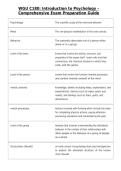
Psychology The scientific study of the mind and behavior
Mind The non-physical manifestation of the brain activity
Behavior The outwardly observable acts of a person either
alone or in a group
Level of the brain Events that involve the activity, structure, and
properties of the organ itself - brain cells and their
connections, the chemical solutions in which they
exist, and the genes.
Level of the person events that involve the function (mental processes)
and content (mental content) of the mind
mental contents Knowledge, beliefs (including ideas, explanations, and
expectations), desires (such as hopes, goals, and
needs), and feelings (such as fears, guilts, and
attractions).
mental processes Actions involved with thinking which include the need
for completing physical actions, paying attention,
perceiving sensations and remembering the past
Level of the group Analysis that involves understanding the individuals
behavior in the context of their relationships with
other people or the behavior of a group of people
as a whole
Structuralism (Wundt) an early school of psychology that used introspection
to explore the elemental structure of the human
mind. Wundt
, Consciousness State of being aware of the self and of the world
Introspection The technique of observing interior mental events as
they occur or immediately after they occur
Functionalism (William James) A school of psychology that focused on how our
mental and behavioral processes function - how they
enable us to adapt, survive, and flourish.
natural selection The theory that certain organisms in every species
possessed characteristics that enable them to
survive and reproduce more fruitfully than others
Adaption A trait that helps an organism survive and reproduce
gestalt (Max Wertheimer) -"The whole is different from the sum of its parts"
-how is perception organized?
ex: young woman and old woman picture
Behaviorism (Ivan Pavlov) Focus on how specific stimulus such as object, person
or event invokes a specific response as behavior in
reaction to the stimulus
Unconscious The condition of being unaware of the outside world,
and unable to bring oneself into awareness at will
defense mechanisms Unconscious psychological strategies that protect a
person from anxiety based on unacceptable thoughts
or feelings
Psychodynamic theory (Freud) Freudian theory that unconscious forces determine
behavior
Comprehensive Exam Preparation Guide
Psychology The scientific study of the mind and behavior
Mind The non-physical manifestation of the brain activity
Behavior The outwardly observable acts of a person either
alone or in a group
Level of the brain Events that involve the activity, structure, and
properties of the organ itself - brain cells and their
connections, the chemical solutions in which they
exist, and the genes.
Level of the person events that involve the function (mental processes)
and content (mental content) of the mind
mental contents Knowledge, beliefs (including ideas, explanations, and
expectations), desires (such as hopes, goals, and
needs), and feelings (such as fears, guilts, and
attractions).
mental processes Actions involved with thinking which include the need
for completing physical actions, paying attention,
perceiving sensations and remembering the past
Level of the group Analysis that involves understanding the individuals
behavior in the context of their relationships with
other people or the behavior of a group of people
as a whole
Structuralism (Wundt) an early school of psychology that used introspection
to explore the elemental structure of the human
mind. Wundt
, Consciousness State of being aware of the self and of the world
Introspection The technique of observing interior mental events as
they occur or immediately after they occur
Functionalism (William James) A school of psychology that focused on how our
mental and behavioral processes function - how they
enable us to adapt, survive, and flourish.
natural selection The theory that certain organisms in every species
possessed characteristics that enable them to
survive and reproduce more fruitfully than others
Adaption A trait that helps an organism survive and reproduce
gestalt (Max Wertheimer) -"The whole is different from the sum of its parts"
-how is perception organized?
ex: young woman and old woman picture
Behaviorism (Ivan Pavlov) Focus on how specific stimulus such as object, person
or event invokes a specific response as behavior in
reaction to the stimulus
Unconscious The condition of being unaware of the outside world,
and unable to bring oneself into awareness at will
defense mechanisms Unconscious psychological strategies that protect a
person from anxiety based on unacceptable thoughts
or feelings
Psychodynamic theory (Freud) Freudian theory that unconscious forces determine
behavior


