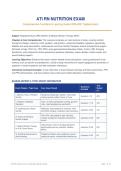
ATI RN NUTRITION EXAM
Comprehensive Test Bank & Learning Guide (2026-2027 Update Exam)
Subject: Registered Nurse (RN) Nutrition & Medical Nutrition Therapy (MNT)
Chapters & Core Competencies: This resource comprises six main divisions of study, covering nutrition
through the lifespan (maternal, infant, pediatric, and geriatric), endocrine/metabolic regulations (specifically
diabetes and acute pancreatitis), cardiovascular and renal nutrition therapies, enteral and parenteral support
(NG-tube, G-tube, PICC line, TPN, PPN), acute gastrointestinal disorders (Celiac, Crohn's, IBD, Dumping
Syndrome), and fundamental clinical assessment guidelines (laboratory values, Braden nutrition scales, and
wound healing support).
Learning Objectives: Students will master nutrition-related clinical calculations, nursing assessment of lab
markers (such as albumin and prealbumin), critical nursing interventions for hyper/hypoglycemia, prevention of
aspiration in tube-fed patients, and diet-medication interactions.
Commonly Confused Concepts: A clear distinction is drawn between Somogyi and Dawn phenomena, TPN
and PPN administration, and fluid overload versus fluid volume deficit laboratory manifestations.
EXAM BLUEPRINT & TOPIC WEIGHT DISTRIBUTION
Test
Questions
Exam Chapter / Topic Area Core Areas Tested Weight
Included
(%)
I. Maternal, Infant, & Pediatric Gestational weight gain, lactation, infant solids,
Questions 1-10 20%
Nutrition choking hazards, toddler Failure to Thrive
II. Diabetes & Metabolic Type 1 & 2 DM, carbohydrate counting, glycemic
Questions 11-18 16%
Regulation index, hypo/hyperglycemia, pancreatitis
III. Cardiovascular & Renal DASH diet, sodium/potassium restriction, CKD
Questions 19-26 16%
Nutrition and ESKD therapies, medication-food interactions
TPN, PPN, tube feeding (G-tube, NG-tube),
IV. Enteral & Parenteral
residual management, aspiration and diarrhea Questions 27-36 20%
Nutrition Support
control
Celiac disease, Crohn's, Dumping Syndrome,
V. Medical Nutrition Therapy
gastric bypass post-op, stomatitis, radiation, Questions 37-46 20%
for GI & Chronic Illness
MAOIs
VI. Nutritional Assessment & Prealbumin, Braden scale, weight loss, wound
Questions 47-50 8%
Wound Healing healing risk factors, mineral/vitamin deficiencies
ATI RN Nutrition Exam Verified Q&A Solution Guide Page 1 of 18
,ATI RN NUTRITION EXAM 2026-2027 UPDATE EXAM
SECTION I: MATERNAL, INFANT, & PEDIATRIC NUTRITION
Question 1: A nurse is teaching a client who has a BMI of 22 about dietary recommendations during
pregnancy. Which of the following statements by the client indicates an understanding of the teaching?
A. I should avoid a vegetarian diet during pregnancy.
B. I should decrease my intake of protein during pregnancy.
C. I should increase my daily intake by 600 calories.
D. I should plan to gain a total of 25 to 35 pounds during my pregnancy.
ANSWER ■: D — I should plan to gain a total of 25 to 35 pounds during my pregnancy.
Explanation: A weight gain of 25 to 35 lbs (11 to 16 kg) is the recommended range for a client of normal pre-pregnancy
weight (BMI 18.5 to 24.9). Vegetarian diets can be safe and nutritionally adequate during pregnancy if properly planned.
Protein intake should increase during pregnancy to support fetal and maternal tissue growth, not decrease. Energy
requirements increase by approximately 340 to 450 calories per day during the second and third trimesters, but not by
600 calories.
Question 2: A nurse is caring for a client who is at 8 weeks of gestation and has a pre-pregnancy BMI of
34. The client asks about weight goals during her pregnancy. Which of the following recommendations
should the nurse provide?
A. Maintain your current BMI of 34 throughout your pregnancy.
B. Gain approximately 6.8 kg (15 lb) during your pregnancy.
C. Lower your BMI to 30 through active dieting.
D. Gain 12.7 to 15.8 kg (28 to 35 lb) during your pregnancy.
ANSWER ■: B — Gain approximately 6.8 kg (15 lb) during your pregnancy.
Explanation: For a client who is obese (BMI 30 or greater) prior to pregnancy, the recommended weight gain is 11 to 20
lbs (approximately 5 to 9 kg), or an average of about 15 lbs (6.8 kg). Dieting to lose weight or maintaining pre-pregnancy
weight is not recommended due to risks to fetal development. Gaining 28 to 35 lbs is recommended for individuals with
a normal pre-pregnancy BMI.
ATI RN Nutrition Exam Verified Q&A Solution Guide Page 2 of 18
, ATI RN NUTRITION EXAM 2026-2027 UPDATE EXAM
Question 3: A nurse is educating a group of pregnant clients about vitamin and mineral intake. Which of
the following supplements or food substances should the nurse instruct the clients to avoid taking at
the same time as an iron supplement?
A. Magnesium
B. Vitamin B12
C. Vitamin A
D. Calcium
ANSWER ■: D — Calcium
Explanation: Calcium decreases the absorption of iron. Therefore, calcium supplements or calcium-rich foods (such as
dairy products) should not be consumed at the same time as iron supplements to ensure maximum absorption.
Magnesium, Vitamin B12, and Vitamin A do not interfere with iron absorption in this manner.
Question 4: A nurse is caring for a client who has anemia and a new prescription for an iron
supplement. The nurse should recommend that the client consume the supplement with which of the
following beverages to increase absorption?
A. Skim milk
B. Green tea
C. Tomato juice
D. Protein shake
ANSWER ■: C — Tomato juice
Explanation: Tomato juice is high in Vitamin C (ascorbic acid), which significantly enhances the absorption of
non-heme iron. Skim milk contains calcium, green tea contains polyphenols/tannins, and protein shakes may contain
calcium or soy, all of which inhibit or decrease iron absorption.
Question 5: A nurse is teaching a prenatal education class about breastfeeding. Which of the following
instructions should the nurse include regarding the timing of the first feeding?
A. Plan to breastfeed the newborn within 1 hour of delivery.
B. Offer supplemental formula until the milk supply is established.
C. Offer the newborn glucose water after the first breastfeeding session.
D. Plan to breastfeed the newborn on a strict schedule of every 4 hours.
ANSWER ■: A — Plan to breastfeed the newborn within 1 hour of delivery.
Explanation: Breastfeeding should be initiated within the first hour after birth. Offering supplemental formula or glucose
water can confuse the newborn, disrupt lactation, and is unnecessary. Newborns should be fed on demand, typically 8
to 12 times a day (every 2 to 3 hours), rather than on a rigid 4-hour schedule.
ATI RN Nutrition Exam Verified Q&A Solution Guide Page 3 of 18
Comprehensive Test Bank & Learning Guide (2026-2027 Update Exam)
Subject: Registered Nurse (RN) Nutrition & Medical Nutrition Therapy (MNT)
Chapters & Core Competencies: This resource comprises six main divisions of study, covering nutrition
through the lifespan (maternal, infant, pediatric, and geriatric), endocrine/metabolic regulations (specifically
diabetes and acute pancreatitis), cardiovascular and renal nutrition therapies, enteral and parenteral support
(NG-tube, G-tube, PICC line, TPN, PPN), acute gastrointestinal disorders (Celiac, Crohn's, IBD, Dumping
Syndrome), and fundamental clinical assessment guidelines (laboratory values, Braden nutrition scales, and
wound healing support).
Learning Objectives: Students will master nutrition-related clinical calculations, nursing assessment of lab
markers (such as albumin and prealbumin), critical nursing interventions for hyper/hypoglycemia, prevention of
aspiration in tube-fed patients, and diet-medication interactions.
Commonly Confused Concepts: A clear distinction is drawn between Somogyi and Dawn phenomena, TPN
and PPN administration, and fluid overload versus fluid volume deficit laboratory manifestations.
EXAM BLUEPRINT & TOPIC WEIGHT DISTRIBUTION
Test
Questions
Exam Chapter / Topic Area Core Areas Tested Weight
Included
(%)
I. Maternal, Infant, & Pediatric Gestational weight gain, lactation, infant solids,
Questions 1-10 20%
Nutrition choking hazards, toddler Failure to Thrive
II. Diabetes & Metabolic Type 1 & 2 DM, carbohydrate counting, glycemic
Questions 11-18 16%
Regulation index, hypo/hyperglycemia, pancreatitis
III. Cardiovascular & Renal DASH diet, sodium/potassium restriction, CKD
Questions 19-26 16%
Nutrition and ESKD therapies, medication-food interactions
TPN, PPN, tube feeding (G-tube, NG-tube),
IV. Enteral & Parenteral
residual management, aspiration and diarrhea Questions 27-36 20%
Nutrition Support
control
Celiac disease, Crohn's, Dumping Syndrome,
V. Medical Nutrition Therapy
gastric bypass post-op, stomatitis, radiation, Questions 37-46 20%
for GI & Chronic Illness
MAOIs
VI. Nutritional Assessment & Prealbumin, Braden scale, weight loss, wound
Questions 47-50 8%
Wound Healing healing risk factors, mineral/vitamin deficiencies
ATI RN Nutrition Exam Verified Q&A Solution Guide Page 1 of 18
,ATI RN NUTRITION EXAM 2026-2027 UPDATE EXAM
SECTION I: MATERNAL, INFANT, & PEDIATRIC NUTRITION
Question 1: A nurse is teaching a client who has a BMI of 22 about dietary recommendations during
pregnancy. Which of the following statements by the client indicates an understanding of the teaching?
A. I should avoid a vegetarian diet during pregnancy.
B. I should decrease my intake of protein during pregnancy.
C. I should increase my daily intake by 600 calories.
D. I should plan to gain a total of 25 to 35 pounds during my pregnancy.
ANSWER ■: D — I should plan to gain a total of 25 to 35 pounds during my pregnancy.
Explanation: A weight gain of 25 to 35 lbs (11 to 16 kg) is the recommended range for a client of normal pre-pregnancy
weight (BMI 18.5 to 24.9). Vegetarian diets can be safe and nutritionally adequate during pregnancy if properly planned.
Protein intake should increase during pregnancy to support fetal and maternal tissue growth, not decrease. Energy
requirements increase by approximately 340 to 450 calories per day during the second and third trimesters, but not by
600 calories.
Question 2: A nurse is caring for a client who is at 8 weeks of gestation and has a pre-pregnancy BMI of
34. The client asks about weight goals during her pregnancy. Which of the following recommendations
should the nurse provide?
A. Maintain your current BMI of 34 throughout your pregnancy.
B. Gain approximately 6.8 kg (15 lb) during your pregnancy.
C. Lower your BMI to 30 through active dieting.
D. Gain 12.7 to 15.8 kg (28 to 35 lb) during your pregnancy.
ANSWER ■: B — Gain approximately 6.8 kg (15 lb) during your pregnancy.
Explanation: For a client who is obese (BMI 30 or greater) prior to pregnancy, the recommended weight gain is 11 to 20
lbs (approximately 5 to 9 kg), or an average of about 15 lbs (6.8 kg). Dieting to lose weight or maintaining pre-pregnancy
weight is not recommended due to risks to fetal development. Gaining 28 to 35 lbs is recommended for individuals with
a normal pre-pregnancy BMI.
ATI RN Nutrition Exam Verified Q&A Solution Guide Page 2 of 18
, ATI RN NUTRITION EXAM 2026-2027 UPDATE EXAM
Question 3: A nurse is educating a group of pregnant clients about vitamin and mineral intake. Which of
the following supplements or food substances should the nurse instruct the clients to avoid taking at
the same time as an iron supplement?
A. Magnesium
B. Vitamin B12
C. Vitamin A
D. Calcium
ANSWER ■: D — Calcium
Explanation: Calcium decreases the absorption of iron. Therefore, calcium supplements or calcium-rich foods (such as
dairy products) should not be consumed at the same time as iron supplements to ensure maximum absorption.
Magnesium, Vitamin B12, and Vitamin A do not interfere with iron absorption in this manner.
Question 4: A nurse is caring for a client who has anemia and a new prescription for an iron
supplement. The nurse should recommend that the client consume the supplement with which of the
following beverages to increase absorption?
A. Skim milk
B. Green tea
C. Tomato juice
D. Protein shake
ANSWER ■: C — Tomato juice
Explanation: Tomato juice is high in Vitamin C (ascorbic acid), which significantly enhances the absorption of
non-heme iron. Skim milk contains calcium, green tea contains polyphenols/tannins, and protein shakes may contain
calcium or soy, all of which inhibit or decrease iron absorption.
Question 5: A nurse is teaching a prenatal education class about breastfeeding. Which of the following
instructions should the nurse include regarding the timing of the first feeding?
A. Plan to breastfeed the newborn within 1 hour of delivery.
B. Offer supplemental formula until the milk supply is established.
C. Offer the newborn glucose water after the first breastfeeding session.
D. Plan to breastfeed the newborn on a strict schedule of every 4 hours.
ANSWER ■: A — Plan to breastfeed the newborn within 1 hour of delivery.
Explanation: Breastfeeding should be initiated within the first hour after birth. Offering supplemental formula or glucose
water can confuse the newborn, disrupt lactation, and is unnecessary. Newborns should be fed on demand, typically 8
to 12 times a day (every 2 to 3 hours), rather than on a rigid 4-hour schedule.
ATI RN Nutrition Exam Verified Q&A Solution Guide Page 3 of 18