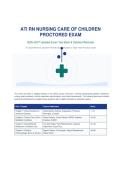
ATI RN NURSING CARE OF CHILDREN
PROCTORED EXAM
2026–2027 Updated Exam Test Bank & Detailed Rationale
A Comprehensive, Student-Friendly Study Blueprint & High-Yield Practice Guide
This exam test bank is mapped directly to the official course curriculum, covering fundamental pediatric milestones,
nursing safety protocols, clinical medication administration, and critical assessments. The following document contains
exactly 60 comprehensive multiple-choice questions with in-depth rationales for absolute mastery.
Unit / Chapter Topics Addressed Items
Chapter 1: Acute Conditions & Osteomyelitis, Asthma, Anaphylaxis, Pertussis, 1–15
Infectious Diseases Meningitis, Varicella
Chapter 2: Chronic Care, Diet & Celiac Disease, Cystic Fibrosis, MCNS, Diabetes 16–30
Metabolic Conditions Insipidus, SIADH
Chapter 3: Developmental Car Seat Safety, Pain Rating Scales, Cognitive 31–45
Milestones & Pediatric Care Impairment, Social Play
Chapter 4: Pediatric Digoxin Safety, Oral Nystatin, Wound Debridement, 46–60
Pharmacology, Burns & Trauma Septic Shock
,ATI RN NURSING CARE OF CHILDREN PROCTORED EXAM 2026–2027 UPDATED TEST BANK
Chapter 1: Acute Conditions & Infectious Diseases
Focuses on urgent medical diagnoses, acute respiratory sound identification, emergent pharmacological
interventions, and infection transmission.
Question 1: A nurse is teaching the parents of a school-aged child who has a new diagnosis of osteomyelitis of
the tibia. Which of the following statements by the parents indicates an understanding of the teaching?
A. My child will have a cast until healing is complete.
B. My child will receive antibiotics for several weeks.
C. My child can return to playing contact sports once he is discharged.
D. My child needs to be placed in strict contact isolation.
ANSWER ■: B — My child will receive antibiotics for several weeks.
Explanation: Osteomyelitis is an infectious process of the bone that requires long-term intravenous antibiotic therapy
(typically at least 4 to 6 weeks) for effective eradication of the pathogen. Weight bearing must be avoided, and the limb
should be supported in a comfortable position, so a cast is not indicated (Option A). Contact sports must be restricted for
weeks to months post-discharge to prevent fracture or injury to the healing bone (Option C). Since osteomyelitis is a
localized bone infection and not communicable, contact isolation is unnecessary (Option D).
Question 2: A nurse is auscultating the lungs of an adolescent who is having an acute asthma exacerbation.
The nurse notes a rapid, regular breathing pattern on assessment. This finding should be identified as:
A. Biot's respirations
B. Cheyne-Stokes respirations
C. Tachypnea
D. Bradypnea
ANSWER ■: C — Tachypnea
Explanation: Tachypnea represents a rapid, regular breathing pattern, commonly observed during respiratory distress,
anxiety, fever, or severe metabolic disturbances. Biot's respirations (Option A) consist of periods of apnea alternating
with two or three shallow breaths. Cheyne-Stokes respirations (Option B) are characterized by apnea alternating with
periods of hyperventilation. Bradypnea (Option D) is a slow, regular breathing pattern.
Nursing Care of Children Study Guide Page 2 CMS Syllabus Mapped
,ATI RN NURSING CARE OF CHILDREN PROCTORED EXAM 2026–2027 UPDATED TEST BANK
Question 3: A nurse in the emergency department is caring for a school-age child who is experiencing an
acute anaphylactic reaction. Which of the following is the priority nursing action?
A. Elevate the head of the child's bed.
B. Insert a large-bore IV catheter for the child.
C. Determine the allergen that caused the child's reaction.
D. Administer intramuscular epinephrine to the child.
ANSWER ■: D — Administer intramuscular epinephrine to the child.
Explanation: Using the urgent-versus-nonurgent clinical framework, the absolute priority is administering IM
epinephrine. During anaphylaxis, severe histamine release causes life-threatening bronchoconstriction and vasodilation,
leading to airway occlusion and cardiovascular collapse. Epinephrine rapidly reverses these effects. Elevating the bed
(Option A) and inserting an IV (Option B) are helpful supportive actions, but are secondary to immediate epinephrine.
Determining the allergen (Option C) is vital for future prevention but is nonurgent during an acute crisis.
Question 4: A nurse is receiving change-of-shift report on four pediatric clients. Which of the following children
should the nurse assess first?
A. A toddler who has a concussion and is experiencing an episode of forceful vomiting.
B. An adolescent who has infective endocarditis and reports a mild headache.
C. An adolescent who was placed into halo traction 1 hour ago and rates his pain at a 6 on a 0-10 scale.
D. A school-age child who has acute glomerulonephritis and exhibits brown-colored urine.
ANSWER ■: A — A toddler who has a concussion and is experiencing an episode of forceful vomiting.
Explanation: Using the urgent-versus-nonurgent approach, the toddler with a concussion and forceful vomiting must be
assessed first. Forceful (projectile) vomiting is a classic sign of increased intracranial pressure (ICP) and potential
neurological deterioration following a head injury. A mild headache in endocarditis (Option B), moderate postoperative
pain in new halo traction (Option C), and smoky/brown-colored hematuria in acute glomerulonephritis (Option D) are
expected disease manifestations and are stable/nonurgent compared to acute ICP increase.
Nursing Care of Children Study Guide Page 3 CMS Syllabus Mapped
, ATI RN NURSING CARE OF CHILDREN PROCTORED EXAM 2026–2027 UPDATED TEST BANK
Question 5: A nurse is planning care for an adolescent newly admitted with bacterial meningitis. How long
must droplet precautions be maintained after initiation of therapy?
A. Until the client has been afebrile for at least 12 hours.
B. For 7 days following admission to the facility.
C. Until the adolescent has a confirmed negative repeat blood culture.
D. For 24 hours following initiation of effective antimicrobial therapy.
ANSWER ■: D — For 24 hours following initiation of effective antimicrobial therapy.
Explanation: Droplet precautions are mandatory for bacterial meningitis to prevent the transmission of respiratory
pathogens. The client is considered noncontagious 24 hours after therapeutic, effective antimicrobial therapy has been
initiated (Option D). Fever resolution (Option A) can be achieved with antipyretics and does not indicate non-infectivity.
Keeping precautions for 7 days (Option B) is excessive and unnecessary. Repeat blood cultures (Option C) are drawn
after the complete course of antibiotics is finished to ensure eradication, rather than to guide isolation duration.
Question 6: A nurse in the emergency department is caring for a school-age child who presents with symptoms
of acute epiglottitis. Which of the following actions should the nurse prioritize?
A. Obtain a throat culture from the child.
B. Monitor the child's oxygen saturation continuously.
C. Place a warm mist humidifier in the child's room.
D. Place the child in a supine position to facilitate rest.
ANSWER ■: B — Monitor the child's oxygen saturation continuously.
Explanation: In epiglottitis, airway swelling can lead to rapid, complete airway obstruction. Monitoring oxygen saturation
is critical to assess respiratory status and evaluate if the child is responding to treatment. A throat culture (Option A) is
strictly contraindicated until an artificial airway is established because any throat irritation can trigger immediate
laryngospasm and complete airway closure. Humidified oxygen should be provided via face mask or blow-by rather than
warm mist (Option C). The child should never be placed supine (Option D), as this increases the risk of airway
obstruction; they should remain in an upright, tripod position.
Nursing Care of Children Study Guide Page 4 CMS Syllabus Mapped
PROCTORED EXAM
2026–2027 Updated Exam Test Bank & Detailed Rationale
A Comprehensive, Student-Friendly Study Blueprint & High-Yield Practice Guide
This exam test bank is mapped directly to the official course curriculum, covering fundamental pediatric milestones,
nursing safety protocols, clinical medication administration, and critical assessments. The following document contains
exactly 60 comprehensive multiple-choice questions with in-depth rationales for absolute mastery.
Unit / Chapter Topics Addressed Items
Chapter 1: Acute Conditions & Osteomyelitis, Asthma, Anaphylaxis, Pertussis, 1–15
Infectious Diseases Meningitis, Varicella
Chapter 2: Chronic Care, Diet & Celiac Disease, Cystic Fibrosis, MCNS, Diabetes 16–30
Metabolic Conditions Insipidus, SIADH
Chapter 3: Developmental Car Seat Safety, Pain Rating Scales, Cognitive 31–45
Milestones & Pediatric Care Impairment, Social Play
Chapter 4: Pediatric Digoxin Safety, Oral Nystatin, Wound Debridement, 46–60
Pharmacology, Burns & Trauma Septic Shock
,ATI RN NURSING CARE OF CHILDREN PROCTORED EXAM 2026–2027 UPDATED TEST BANK
Chapter 1: Acute Conditions & Infectious Diseases
Focuses on urgent medical diagnoses, acute respiratory sound identification, emergent pharmacological
interventions, and infection transmission.
Question 1: A nurse is teaching the parents of a school-aged child who has a new diagnosis of osteomyelitis of
the tibia. Which of the following statements by the parents indicates an understanding of the teaching?
A. My child will have a cast until healing is complete.
B. My child will receive antibiotics for several weeks.
C. My child can return to playing contact sports once he is discharged.
D. My child needs to be placed in strict contact isolation.
ANSWER ■: B — My child will receive antibiotics for several weeks.
Explanation: Osteomyelitis is an infectious process of the bone that requires long-term intravenous antibiotic therapy
(typically at least 4 to 6 weeks) for effective eradication of the pathogen. Weight bearing must be avoided, and the limb
should be supported in a comfortable position, so a cast is not indicated (Option A). Contact sports must be restricted for
weeks to months post-discharge to prevent fracture or injury to the healing bone (Option C). Since osteomyelitis is a
localized bone infection and not communicable, contact isolation is unnecessary (Option D).
Question 2: A nurse is auscultating the lungs of an adolescent who is having an acute asthma exacerbation.
The nurse notes a rapid, regular breathing pattern on assessment. This finding should be identified as:
A. Biot's respirations
B. Cheyne-Stokes respirations
C. Tachypnea
D. Bradypnea
ANSWER ■: C — Tachypnea
Explanation: Tachypnea represents a rapid, regular breathing pattern, commonly observed during respiratory distress,
anxiety, fever, or severe metabolic disturbances. Biot's respirations (Option A) consist of periods of apnea alternating
with two or three shallow breaths. Cheyne-Stokes respirations (Option B) are characterized by apnea alternating with
periods of hyperventilation. Bradypnea (Option D) is a slow, regular breathing pattern.
Nursing Care of Children Study Guide Page 2 CMS Syllabus Mapped
,ATI RN NURSING CARE OF CHILDREN PROCTORED EXAM 2026–2027 UPDATED TEST BANK
Question 3: A nurse in the emergency department is caring for a school-age child who is experiencing an
acute anaphylactic reaction. Which of the following is the priority nursing action?
A. Elevate the head of the child's bed.
B. Insert a large-bore IV catheter for the child.
C. Determine the allergen that caused the child's reaction.
D. Administer intramuscular epinephrine to the child.
ANSWER ■: D — Administer intramuscular epinephrine to the child.
Explanation: Using the urgent-versus-nonurgent clinical framework, the absolute priority is administering IM
epinephrine. During anaphylaxis, severe histamine release causes life-threatening bronchoconstriction and vasodilation,
leading to airway occlusion and cardiovascular collapse. Epinephrine rapidly reverses these effects. Elevating the bed
(Option A) and inserting an IV (Option B) are helpful supportive actions, but are secondary to immediate epinephrine.
Determining the allergen (Option C) is vital for future prevention but is nonurgent during an acute crisis.
Question 4: A nurse is receiving change-of-shift report on four pediatric clients. Which of the following children
should the nurse assess first?
A. A toddler who has a concussion and is experiencing an episode of forceful vomiting.
B. An adolescent who has infective endocarditis and reports a mild headache.
C. An adolescent who was placed into halo traction 1 hour ago and rates his pain at a 6 on a 0-10 scale.
D. A school-age child who has acute glomerulonephritis and exhibits brown-colored urine.
ANSWER ■: A — A toddler who has a concussion and is experiencing an episode of forceful vomiting.
Explanation: Using the urgent-versus-nonurgent approach, the toddler with a concussion and forceful vomiting must be
assessed first. Forceful (projectile) vomiting is a classic sign of increased intracranial pressure (ICP) and potential
neurological deterioration following a head injury. A mild headache in endocarditis (Option B), moderate postoperative
pain in new halo traction (Option C), and smoky/brown-colored hematuria in acute glomerulonephritis (Option D) are
expected disease manifestations and are stable/nonurgent compared to acute ICP increase.
Nursing Care of Children Study Guide Page 3 CMS Syllabus Mapped
, ATI RN NURSING CARE OF CHILDREN PROCTORED EXAM 2026–2027 UPDATED TEST BANK
Question 5: A nurse is planning care for an adolescent newly admitted with bacterial meningitis. How long
must droplet precautions be maintained after initiation of therapy?
A. Until the client has been afebrile for at least 12 hours.
B. For 7 days following admission to the facility.
C. Until the adolescent has a confirmed negative repeat blood culture.
D. For 24 hours following initiation of effective antimicrobial therapy.
ANSWER ■: D — For 24 hours following initiation of effective antimicrobial therapy.
Explanation: Droplet precautions are mandatory for bacterial meningitis to prevent the transmission of respiratory
pathogens. The client is considered noncontagious 24 hours after therapeutic, effective antimicrobial therapy has been
initiated (Option D). Fever resolution (Option A) can be achieved with antipyretics and does not indicate non-infectivity.
Keeping precautions for 7 days (Option B) is excessive and unnecessary. Repeat blood cultures (Option C) are drawn
after the complete course of antibiotics is finished to ensure eradication, rather than to guide isolation duration.
Question 6: A nurse in the emergency department is caring for a school-age child who presents with symptoms
of acute epiglottitis. Which of the following actions should the nurse prioritize?
A. Obtain a throat culture from the child.
B. Monitor the child's oxygen saturation continuously.
C. Place a warm mist humidifier in the child's room.
D. Place the child in a supine position to facilitate rest.
ANSWER ■: B — Monitor the child's oxygen saturation continuously.
Explanation: In epiglottitis, airway swelling can lead to rapid, complete airway obstruction. Monitoring oxygen saturation
is critical to assess respiratory status and evaluate if the child is responding to treatment. A throat culture (Option A) is
strictly contraindicated until an artificial airway is established because any throat irritation can trigger immediate
laryngospasm and complete airway closure. Humidified oxygen should be provided via face mask or blow-by rather than
warm mist (Option C). The child should never be placed supine (Option D), as this increases the risk of airway
obstruction; they should remain in an upright, tripod position.
Nursing Care of Children Study Guide Page 4 CMS Syllabus Mapped