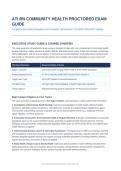
ATI RN COMMUNITY HEALTH PROCTORED EXAM
GUIDE
Comprehensive Study Companion and Complete 100-Question Test Bank (2026-2027 Update)
EXECUTIVE STUDY GUIDE & COURSE SYNOPSIS
This study guide and comprehensive exam review is designed to align with core competencies in Community Health
Nursing, providing a highly educational, student-friendly, and professional review of high-yield concepts, terminology,
clinical applications, and nursing procedures. It represents a structured distillation of essential clinical competencies
and includes a 100-question proctored-style practice test complete with in-depth rationales for every correct and
incorrect answer.
Metadata Dimension Resource Details & Scope
Subject / Specialty Community Health Nursing (Public Health & Home Health Specialties)
Primary Blueprint Source ATI RN Community Health 2019 Proctored Exam (Version 1)
Target Exam Cycle 2026-2027 Updated Proctored Examinations
Test Bank Scope 100 High-Yield, Practice-Mapped, In-Depth Single-Select Questions
Target Audience Registered Nursing Students preparing for ATI Proctored Examinations
Major Content Chapters & Core Topics
The exam curriculum is distributed across five major chapters, each focusing on unique public health dimensions:
1. Foundations of Community Health Nursing: Examines core paradigms of public health, ethical principles
(autonomy, distributive justice, beneficence, nonmaleficence, veracity), the epidemiological triangle (host, agent,
environment), and providing culturally congruent care across diverse patient cohorts (e.g., traditional American
Indian, Hispanic, and Asian practices).
2. Community Assessment, Environmental Health & Program Planning: Evaluates methodologies for assessing
populations (such as the visual windshield survey), assessing occupational health hazards (physical, chemical,
biological, and psychosocial), collaborating with regulatory bodies (such as OSHA and the EPA), and implementing
health education programs.
3. Communicable Disease Control & Vulnerable Populations: Investigates the surveillance, screening, reporting,
and management of infectious diseases (such as tuberculosis, gonorrhea, chlamydia, measles, pertussis, and Lyme
disease) alongside targeted outreach and support for highly vulnerable populations (including homeless veterans,
migrant farm workers, and victims of abuse or neglect).
4. Home Health, Hospice Care & Family Health: Addresses clinical priorities in home wellness (including home
safety assessments, safe use of assistive devices like crutches, sharps disposal, and post-stroke management),
palliative care concerns (caregiver burden, spiritual nursing), and family wellness priorities.
For Educational and Professional Study Use Only
,5. Case Management, Disaster Planning & Triage: Focuses on the roles of the nurse case manager (coordinator,
consultant, negotiator, systems allocator, advocate), the disaster management cycle (mitigation, preparedness,
response, recovery), and immediate clinical priority determination (shelter triage and the START disaster triage
method).
For Educational and Professional Study Use Only
,Key Learning Objectives, Concepts & Terminology
Epidemiological Concepts: Understanding and calculating vital statistics is essential for public health tracking:
• Prevalence Proportion: The total proportion of a population that has a specific disease at a specific point in time or
over a specified period. It encompasses both newly diagnosed cases and pre-existing cases. Calculated as: (Total
Existing Cases / Total Population) * Base Rate (e.g., 100,000).
• Incidence Rate: Measures only the newly diagnosed cases within a population during a specified timeframe.
Calculated as: (New Cases / Population at Risk) * Base Rate.
• Epidemiological Triangle: Models disease transmission using three interconnected vertices: the Agent (the physical,
chemical, or biological cause of disease, such as Paramyxovirus or Borrelia burgdorferi), the Host (the susceptible
living organism affected by the agent, such as children or humans), and the Environment (the physical, social, or
biological setting that brings host and agent together, such as school settings or wooded environments).
Ethical Frameworks: Nursing interventions must balance complex ethics:
• Autonomy: Respecting and supporting a client's right to self-determination and independent choice (e.g., supporting
a client's voluntary decision to decline chemotherapy).
• Distributive Justice: Advocating for the fair and equitable distribution of community resources, benefits, and burdens
among all members of society (e.g., ensuring eligible clients receive state Medicare benefits).
Commonly Confused Concepts
Concept Pair Core Clinical Distinction and Boundary Clarification
Primary vs. Secondary vs. Tertiary • Primary: Focuses on health promotion, immunizations, and education before
Prevention disease/injury occurs (e.g., teaching smoking risks or skateboard safety). •
Secondary: Focuses on early detection, screening, and immediate intervention (e.g.,
blood pressure checks, lipid screens, prenatal care, testing contacts). • Tertiary:
Focuses on rehabilitation, chronic management, and mitigating disability (e.g.,
arthritis living class, stroke therapy, support groups).
Community-Oriented vs. • Community-Oriented: Focuses on the health of the community as a whole
Community-Based Nursing (population-focused). Core activities include disease surveillance, investigation of
environmental hazards, and broad health education. • Community-Based: Focuses on
managing acute/chronic conditions for individuals and families in their natural
environments (homes, clinics). Core activities include wound care, medication
administration, and home ADL support.
Case Manager: Coordinator vs. • Coordinator: Organizes, schedules, and structures services/supplies (e.g., arranging
Negotiator vs. Advocate medical equipment delivery). • Negotiator: Bargains and discusses with external
providers to obtain optimal rates or payment options for the client's care. • Advocate:
Protects patient rights, voices safety concerns, and assists in self-determination.
Essential Procedures & Applications:
• Mantoux (Tuberculin) Skin Testing: Handled with a standard intradermal injection. False positives can occur in
individuals who received the BCG vaccine within the last 10 years, or who live in highly endemic countries.
• Home Sharps Safety: Insulin syringes and needles must be discarded into thick, puncture-proof metal or plastic
containers with tight lids rather than normal household bags or recycling bins.
• Disaster Triage (START): Categorizes disaster victims using a color-coded triage tag. Priority Red (Immediate)
represents life-threatening airway/breathing/circulation compromise that can be salvaged with immediate care (e.g.,
For Educational and Professional Study Use Only
, ATI RN COMMUNITY HEALTH PROCTORED EXAM STUDY GUIDE 2026-2027 UPDATE EXAM
rigid abdomen and shock, or severe shortness of breath). Yellow (Delayed) represents major systemic trauma like
femur fractures with intact distal pulses. Green (Minor) represents walking wounded.
COMPREHENSIVE 100-QUESTION TEST BANK
The following 100 questions are designed to simulate the rigor, format, and content distribution of a professional
proctored examination. Each question includes four plausible options, a clearly identified correct answer, and a robust
clinical explanation detail that breaks down both correct and incorrect choices to foster optimal learning.
STUDY COMPANION & TEST BANK Page 4
GUIDE
Comprehensive Study Companion and Complete 100-Question Test Bank (2026-2027 Update)
EXECUTIVE STUDY GUIDE & COURSE SYNOPSIS
This study guide and comprehensive exam review is designed to align with core competencies in Community Health
Nursing, providing a highly educational, student-friendly, and professional review of high-yield concepts, terminology,
clinical applications, and nursing procedures. It represents a structured distillation of essential clinical competencies
and includes a 100-question proctored-style practice test complete with in-depth rationales for every correct and
incorrect answer.
Metadata Dimension Resource Details & Scope
Subject / Specialty Community Health Nursing (Public Health & Home Health Specialties)
Primary Blueprint Source ATI RN Community Health 2019 Proctored Exam (Version 1)
Target Exam Cycle 2026-2027 Updated Proctored Examinations
Test Bank Scope 100 High-Yield, Practice-Mapped, In-Depth Single-Select Questions
Target Audience Registered Nursing Students preparing for ATI Proctored Examinations
Major Content Chapters & Core Topics
The exam curriculum is distributed across five major chapters, each focusing on unique public health dimensions:
1. Foundations of Community Health Nursing: Examines core paradigms of public health, ethical principles
(autonomy, distributive justice, beneficence, nonmaleficence, veracity), the epidemiological triangle (host, agent,
environment), and providing culturally congruent care across diverse patient cohorts (e.g., traditional American
Indian, Hispanic, and Asian practices).
2. Community Assessment, Environmental Health & Program Planning: Evaluates methodologies for assessing
populations (such as the visual windshield survey), assessing occupational health hazards (physical, chemical,
biological, and psychosocial), collaborating with regulatory bodies (such as OSHA and the EPA), and implementing
health education programs.
3. Communicable Disease Control & Vulnerable Populations: Investigates the surveillance, screening, reporting,
and management of infectious diseases (such as tuberculosis, gonorrhea, chlamydia, measles, pertussis, and Lyme
disease) alongside targeted outreach and support for highly vulnerable populations (including homeless veterans,
migrant farm workers, and victims of abuse or neglect).
4. Home Health, Hospice Care & Family Health: Addresses clinical priorities in home wellness (including home
safety assessments, safe use of assistive devices like crutches, sharps disposal, and post-stroke management),
palliative care concerns (caregiver burden, spiritual nursing), and family wellness priorities.
For Educational and Professional Study Use Only
,5. Case Management, Disaster Planning & Triage: Focuses on the roles of the nurse case manager (coordinator,
consultant, negotiator, systems allocator, advocate), the disaster management cycle (mitigation, preparedness,
response, recovery), and immediate clinical priority determination (shelter triage and the START disaster triage
method).
For Educational and Professional Study Use Only
,Key Learning Objectives, Concepts & Terminology
Epidemiological Concepts: Understanding and calculating vital statistics is essential for public health tracking:
• Prevalence Proportion: The total proportion of a population that has a specific disease at a specific point in time or
over a specified period. It encompasses both newly diagnosed cases and pre-existing cases. Calculated as: (Total
Existing Cases / Total Population) * Base Rate (e.g., 100,000).
• Incidence Rate: Measures only the newly diagnosed cases within a population during a specified timeframe.
Calculated as: (New Cases / Population at Risk) * Base Rate.
• Epidemiological Triangle: Models disease transmission using three interconnected vertices: the Agent (the physical,
chemical, or biological cause of disease, such as Paramyxovirus or Borrelia burgdorferi), the Host (the susceptible
living organism affected by the agent, such as children or humans), and the Environment (the physical, social, or
biological setting that brings host and agent together, such as school settings or wooded environments).
Ethical Frameworks: Nursing interventions must balance complex ethics:
• Autonomy: Respecting and supporting a client's right to self-determination and independent choice (e.g., supporting
a client's voluntary decision to decline chemotherapy).
• Distributive Justice: Advocating for the fair and equitable distribution of community resources, benefits, and burdens
among all members of society (e.g., ensuring eligible clients receive state Medicare benefits).
Commonly Confused Concepts
Concept Pair Core Clinical Distinction and Boundary Clarification
Primary vs. Secondary vs. Tertiary • Primary: Focuses on health promotion, immunizations, and education before
Prevention disease/injury occurs (e.g., teaching smoking risks or skateboard safety). •
Secondary: Focuses on early detection, screening, and immediate intervention (e.g.,
blood pressure checks, lipid screens, prenatal care, testing contacts). • Tertiary:
Focuses on rehabilitation, chronic management, and mitigating disability (e.g.,
arthritis living class, stroke therapy, support groups).
Community-Oriented vs. • Community-Oriented: Focuses on the health of the community as a whole
Community-Based Nursing (population-focused). Core activities include disease surveillance, investigation of
environmental hazards, and broad health education. • Community-Based: Focuses on
managing acute/chronic conditions for individuals and families in their natural
environments (homes, clinics). Core activities include wound care, medication
administration, and home ADL support.
Case Manager: Coordinator vs. • Coordinator: Organizes, schedules, and structures services/supplies (e.g., arranging
Negotiator vs. Advocate medical equipment delivery). • Negotiator: Bargains and discusses with external
providers to obtain optimal rates or payment options for the client's care. • Advocate:
Protects patient rights, voices safety concerns, and assists in self-determination.
Essential Procedures & Applications:
• Mantoux (Tuberculin) Skin Testing: Handled with a standard intradermal injection. False positives can occur in
individuals who received the BCG vaccine within the last 10 years, or who live in highly endemic countries.
• Home Sharps Safety: Insulin syringes and needles must be discarded into thick, puncture-proof metal or plastic
containers with tight lids rather than normal household bags or recycling bins.
• Disaster Triage (START): Categorizes disaster victims using a color-coded triage tag. Priority Red (Immediate)
represents life-threatening airway/breathing/circulation compromise that can be salvaged with immediate care (e.g.,
For Educational and Professional Study Use Only
, ATI RN COMMUNITY HEALTH PROCTORED EXAM STUDY GUIDE 2026-2027 UPDATE EXAM
rigid abdomen and shock, or severe shortness of breath). Yellow (Delayed) represents major systemic trauma like
femur fractures with intact distal pulses. Green (Minor) represents walking wounded.
COMPREHENSIVE 100-QUESTION TEST BANK
The following 100 questions are designed to simulate the rigor, format, and content distribution of a professional
proctored examination. Each question includes four plausible options, a clearly identified correct answer, and a robust
clinical explanation detail that breaks down both correct and incorrect choices to foster optimal learning.
STUDY COMPANION & TEST BANK Page 4